What Is the Minimum Raised Bed Depth for Growing Vegetables?
By Jim Vernon · 7 min read · Last updated
Discovering your carrots grew sideways because your raised bed was an inch too shallow is a frustrating waste of an entire growing season.
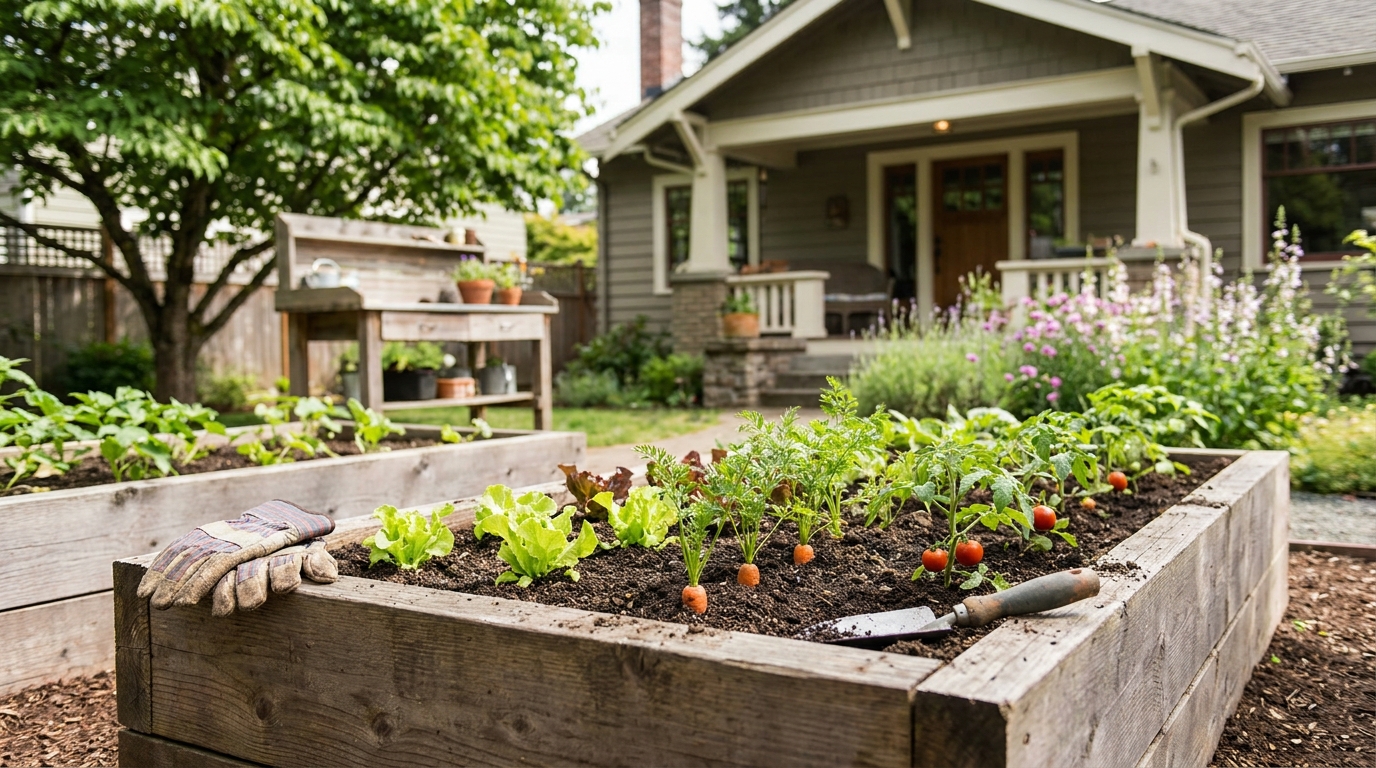
A raised garden bed only needs to be 6 inches (15 cm) deep to grow shallow-rooted crops like lettuce and spinach, but requires 12 to 18 inches (30 to 45 cm) of soil depth to support heavy-fruiting plants like tomatoes, peppers, and deep root crops. If you place your raised frame over open ground that roots can penetrate, the bed itself can be shallow. If you build over concrete, tree roots, or heavily compacted clay, your raised frame must contain the plant's entire root system. You can save hundreds of dollars in bagged soil simply by matching the physical depth of your wooden or metal frames to the biological requirements of the specific crops you intend to grow.
- Shallow-rooted crops like lettuce, radishes, and herbs thrive perfectly fine in just 6 inches (15 cm) of soil.
- Deep-rooted vegetables like indeterminate tomatoes and full-size carrots require 12 to 18 inches (30 to 45 cm) of loose soil.
- Pros break up the native earth beneath a shallow bed instead of paying extra to fill a tall bed.
- Filling beds with bulk soil delivery in 2026 costs roughly $60 per cubic yard, less than half the cost of bagged soil.
What Crops Grow Perfectly Fine in a Six-Inch Bed?
Many popular springtime vegetables and culinary herbs possess shallow, fibrous root systems that do not require deep soil profiles. If you are building low-profile beds exclusively for salad greens, 6 inches (15 cm) of soil is entirely sufficient. Radishes, lettuce, spinach, arugula, and green onions will thrive without ever touching the bottom of a 6-inch frame. These shallow beds are highly economical to fill and heat up much faster in the spring, allowing for earlier planting in USDA zones 4 through 6.
However, shallow beds dry out significantly faster than deeper ones. You will likely need to water a 6-inch (15 cm) deep bed daily during peak summer heat. Adding a 1-inch (2.5 cm) layer of shredded leaf mulch over the soil surface helps regulate moisture and temperature, preventing early bolting in cool-weather crops like cilantro and spinach.
- Lettuce and leafy greens max out their root systems at 4 to 5 inches (10 to 12 cm).
- Bush beans require only slightly more depth, thriving in 6 to 8 inches (15 to 20 cm) of soil.
How Deep Must Beds Be for Tomatoes, Peppers, and Root Vegetables?
Large, heavy-fruiting crops require substantially more underground real estate to anchor their stalks and access enough water to support heavy yields. Indeterminate tomatoes, bell peppers, eggplant, and winter squash need a minimum soil depth of 12 to 18 inches (30 to 45 cm). Root vegetables like parsnips and standard carrots also need at least 12 inches (30 cm) of loose, uncompacted soil to prevent their taproots from forking or stunting when they hit a hard barrier.
Growing these aggressive crops in deep beds also drastically reduces your daily watering burden. An 18-inch (45 cm) bed holds a massive reservoir of moisture at the bottom, allowing tomato taproots to draw up water even when the top 3 inches (7.5 cm) of soil are completely bone-dry.
- Indeterminate tomatoes will send roots down 24 inches (60 cm) if the soil allows it.
- Full-size carrots require at least 12 inches (30 cm) to prevent deformed, stubby growth.
Does the Soil Underneath a Raised Bed Actually Matter?
This is where a professional landscaper approaches a raised bed completely differently from a beginner. Beginners frequently build massive 24-inch (60 cm) tall beds simply to avoid dealing with the rocky, compacted native soil beneath it. They then spend hundreds of dollars buying premium bagged soil to fill that towering frame.
A professional will instead build a 10-inch (25 cm) wooden frame, saving money on lumber. Before filling the bed, they will spend thirty minutes double-digging the native soil underneath, breaking up the hardpan with a garden fork and working in a 2-inch (5 cm) layer of compost. By integrating the native earth, they provide the plants with a 20-inch (50 cm) deep root zone while purchasing half as much imported soil.
- Never place a weed barrier fabric across the bottom of a raised bed over open soil.
- Cardboard is a better bottom layer because it smothers weeds and then completely decomposes.
What Happens if a Raised Bed is Too Shallow for the Plant?
A common failure mode in container gardening occurs when homeowners build an 8-inch (20 cm) raised bed directly over a concrete patio or heavily compacted clay, then try to grow large heirloom tomatoes. Because the roots cannot penetrate the barrier below, they hit the bottom, coil around themselves, and eventually die back.
More critically, this shallow volume of soil cannot hold enough moisture. On an 85 degree Fahrenheit (29 C) afternoon, an 8-inch (20 cm) bed over concrete will completely dry out in six hours. The tomato plant experiences rapid moisture fluctuations, locking out calcium uptake. The result is a guaranteed case of blossom end rot, ruining the fruit with black, sunken bottoms. Avoid this by matching bed depth to the mature size of the crop.
- Shallow beds over impermeable surfaces require drip irrigation on a daily timer.
- Blossom end rot is directly tied to inconsistent watering in undersized soil volumes.
Should You Fill the Bottom of Deep Raised Beds With Wood?
If you do choose to build beds taller than 18 inches (45 cm) for ergonomic reasons, you do not need to fill the entire volume with expensive potting soil. Using the Hugelkultur method, you can fill the bottom half of a tall bed with rotting logs, thick branches, and untreated wood scraps.
As the wood slowly decomposes over several years, it acts like a sponge, retaining immense amounts of moisture and feeding beneficial fungi. You only need to place 10 to 12 inches (25 to 30 cm) of quality topsoil and compost mix over the wood layer. Just be aware that beds filled this way will settle by several inches each year as the wood breaks down, requiring a heavy top-up of fresh compost every spring.
- Never use treated lumber, cedar, or black walnut branches in the bottom of a vegetable bed.
- Hardwoods like oak and maple provide the best long-term moisture retention.
How Much Does Raised Bed Soil Actually Cost in 2026?
The cost difference between buying bagged soil at a home center and ordering bulk delivery from a landscape yard is staggering. In 2026, premium bagged raised bed soil averages $10 per 1.5 cubic foot bag. Since there are 27 cubic feet in a cubic yard, filling a large bed with bags costs roughly $180 per cubic yard.
Conversely, a specialized raised bed mix from a bulk landscape supplier averages $55 to $70 per cubic yard. Even after adding a standard $75 to $100 flat-rate delivery fee, bulk soil becomes drastically cheaper the moment you need more than two cubic yards. To save even more money, ask the supplier for a 50/50 mix of screened topsoil and mushroom compost rather than their premium proprietary blends.
- A standard 4-foot by 8-foot (1.2 by 2.4 m) bed raised to 12 inches (30 cm) requires exactly 1.18 cubic yards of soil.
- Buying in bulk saves an average of 60 percent compared to bagged retail products.
How Do You Calculate the Exact Soil Volume Needed for Your Bed?
Before ordering a delivery, you must calculate the exact internal volume of your garden frames. To find the required cubic yards, multiply the length, width, and depth of the bed in feet, then divide that total by 27. For example, a standard 4-foot by 8-foot (1.2 by 2.4 m) frame that is 1 foot (30 cm) deep yields 32 cubic feet. Divided by 27, you need 1.18 cubic yards of soil.
Always order 10 to 15 percent more soil than your exact mathematical volume. Bulk soil contains air pockets and will immediately compress when watered for the first time. If you order exactly 1.18 yards for that 12-inch (30 cm) bed, the soil level will drop to 10 inches (25 cm) after the very first rainstorm. Having an extra half-yard on hand ensures you can top off the frames to the rim before planting.
- One cubic yard equals 27 cubic feet, or roughly fourteen 40-pound (18 kg) bags of topsoil.
- Keep a tarp handy for bulk deliveries to protect your driveway from organic staining.
| Crop Root Profile | Common Vegetables | Minimum Raised Bed Depth |
|---|---|---|
| Shallow-rooted | Lettuce, Spinach, Radishes, Green Onions | 6 inches (15 cm) |
| Medium-rooted | Bush Beans, Chard, Eggplant, Cucumbers | 8 to 10 inches (20 to 25 cm) |
| Deep-rooted | Tomatoes, Peppers, Carrots, Winter Squash | 12 to 18 inches (30 to 45 cm) |
Frequently asked questions
Do raised garden beds need a bottom?
No, raised beds placed over soil should not have a bottom. Open bottoms allow excess water to drain freely and enable plant roots to reach deeper nutrients in the native earth. Only install a solid bottom if you are building the bed on a wooden balcony, concrete patio, or rooftop.
Should I line the bottom of my raised bed with cardboard?
Yes. Placing overlapping sheets of unwaxed, tape-free cardboard at the bottom of a new bed smothers existing grass and aggressive weeds. The cardboard will completely decompose within four to six months, allowing your vegetable roots to pass through into the soil below.
How much does raised bed soil settle after the first year?
Soil in a new raised bed typically settles by 15 to 20 percent after the first year of watering and organic matter decomposition. Expect a 12-inch (30 cm) deep bed to drop about 2 inches (5 cm), requiring a top-up of fresh compost each spring.
What is the best width for a raised garden bed?
The ideal width is 3 to 4 feet (0.9 to 1.2 meters). This allows you to comfortably reach the center of the bed from either side without ever needing to step on and compact the soil inside the frame.
Keep reading
- Starting Your First Vegetable Garden Without Wasting a SeasonMost first gardens fail for reasons that have nothing to do with a green thumb. Here are the five that matter.
- Building Soil That Actually Grows ThingsFeeding plants is a short-term fix. Feeding the soil is what makes a garden easy.
- Reviving a Tired Lawn: A Season-Long PlanA thin lawn is a symptom. Treating the symptom with more seed is why it keeps coming back.