Reviving a Tired Lawn: A Season-Long Plan
By Jim Vernon · 5 min read · Last updated
A thin lawn is a symptom. Treating the symptom with more seed is why it keeps coming back.
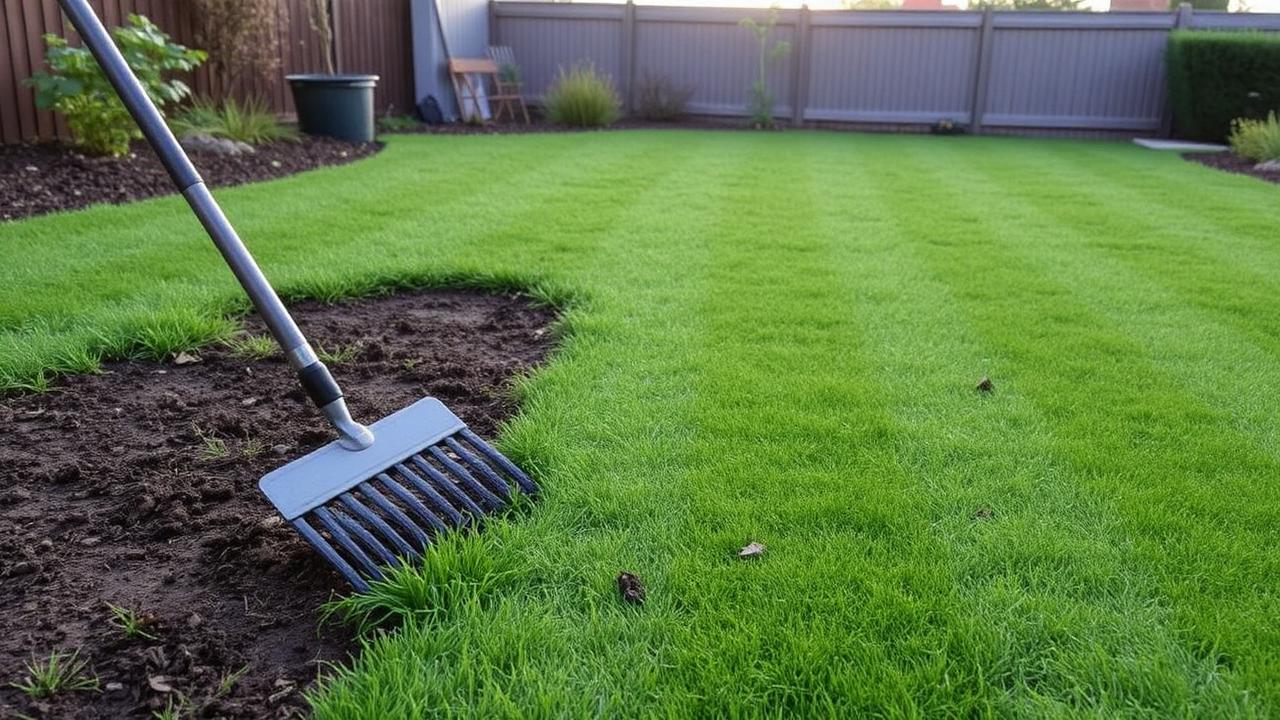
Moss, bare patches, and yellowing are almost always downstream of three causes: compaction, thatch, and shade. Seed and fertiliser applied without addressing those produce a short-lived improvement.
Diagnose first
- Moss with standing water after rain: compaction or poor drainage.
- Spongy surface, springy underfoot: thatch layer over 12 mm.
- Thin grass under trees or beside a fence: shade — change the grass species, not the routine.
- Yellow with a pale, even tone: nitrogen shortage.
The order of operations
- Mow short, but never remove more than a third of the blade in one pass.
- Scarify to pull out thatch and moss. Expect the lawn to look ruined; this is normal.
- Aerate — hollow-tine if compacted, spike if merely firm.
- Overseed at the full new-lawn rate on bare patches, half rate elsewhere.
- Top-dress lightly with a sandy loam to fill the tine holes.
- Feed with a balanced or autumn feed depending on the season.
- Water consistently for three weeks — new seed cannot survive a dry spell.
Timing beats effort
Late summer to early autumn is the best window for cool-season grasses: warm soil, cooling air, and weak weed competition. Spring is the second-best option and mid-summer is the worst.
Should I use moss killer?
It kills the moss it touches without changing why moss won. Use it to clear the surface before scarifying, then fix drainage, compaction, or shade or it returns within a year.
How long until it looks good?
Two weeks of looking worse, four to six weeks to look normal, and a full season to look thick.
How much seed and top-dressing will a 1,200 sq ft lawn need?
Roughly 7-10 lbs of seed for a full renovation, or 4-5 lbs to thicken an existing lawn, plus about 0.9 cubic yards of top-dressing material spread a quarter-inch deep after aeration.
Can I revive a lawn without scarifying?
You can slow the decline with feeding and overseeding alone, but if thatch or moss is the underlying cause, skipping mechanical removal usually means the same problem returns within a year.
Worked example: a 1,200 square foot lawn
Overseeding a full renovation at a typical full-lawn rate for cool-season grass runs somewhere around 6 to 8 pounds per 1,000 square feet, so a 1,200 square foot lawn needs roughly 7 to 10 pounds of seed if it is bare, or half that — about 4 to 5 pounds — if you are thickening an existing but thin lawn rather than starting from scratch.
Top-dressing after aeration at a quarter-inch layer over the same area needs close to 0.9 cubic yards of sandy loam, delivered as roughly twenty-five 40 lb bags or one small trailer load in bulk — buying bulk is usually cheaper past about half a cubic yard.
| Symptom | Likely cause | Primary fix |
|---|---|---|
| Moss in shaded patches | Shade plus compaction | Aerate and overseed with a shade-tolerant blend |
| Bare patches on a slope | Runoff before water soaks in | Aerate, then water in short repeated bursts |
| Thin lawn despite regular feeding | Thatch blocking nutrient contact | Scarify before the next feed |
| Yellow patches after dog use | Localised nitrogen burn | Dilute urine spots immediately with water |
- Common mistake: overseeding without first dealing with the thatch or compaction that caused the thinning.
- Common mistake: mowing new seedlings before they reach about 3 inches, which stresses shallow new roots.
- Common mistake: feeding heavily right after scarifying, when the lawn cannot yet use the nutrients efficiently.
- Common mistake: watering briefly every day instead of deeply a few times a week once the lawn is established.
Choosing the right seed blend
A general-purpose ryegrass blend suits high-traffic lawns and germinates fastest, often within seven to ten days in warm soil. A fine-leaved fescue blend suits ornamental lawns but wears out faster under football and dogs. Shade-tolerant blends trade some density for the ability to photosynthesise in lower light, and are the only sensible choice under trees regardless of how much you feed or water the area.
Reading the lawn a month after renovation
By week four, new grass should be thickening into a visible sward rather than isolated seedlings. Patchy germination at that point usually traces back to one of three causes: seed washed into low spots by heavy rain, birds taking seed from an unprotected surface, or the top-dressing layer drying out faster than the seed underneath could root through it.
| Week after renovation | What you should see | Action if behind schedule |
|---|---|---|
| 1-2 | Germination beginning, soil still visible | Keep surface consistently moist, do not let it crust |
| 3-4 | Seedlings 3-5 cm, first mow due | Check for bare patches and overseed lightly again |
| 6-8 | Even coverage, first proper feed | If patchy, resow rather than waiting for it to fill in |
Dealing with weeds during a renovation
Broadleaf weed killers cannot be applied within a few weeks of overseeding, since most also kill germinating grass seed. The practical order is to spot-treat isolated weeds before scarifying, tolerate a flush of new weed seedlings alongside the new grass, then hand-pull or spot-treat again once the new lawn has been mown three or four times and is established enough to compete on its own.
Soil pH and why it is worth testing
Most turf grasses prefer a slightly acidic to neutral soil, roughly pH 6 to 7. A soil that has drifted too acidic or too alkaline locks up nutrients even when feed is applied correctly, which is a common reason a lawn stays thin despite a sensible feeding schedule. A basic home soil test kit is inexpensive and worth doing once before a full renovation, since correcting pH with lime or sulphur takes months to act and is far cheaper than repeating a failed renovation.
| Soil pH reading | Likely effect on lawn | Correction |
|---|---|---|
| Below 6.0 | Nutrient lockout, moss encouraged | Garden lime, applied per soil test result |
| 6.0-7.0 | Normal range for most turf grasses | No correction needed |
| Above 7.5 | Iron and manganese deficiency, yellowing | Elemental sulphur, applied gradually |
A note on lawn edges and paths
A crisp, cleanly cut edge along paths and borders makes a lawn look tended even before the grass itself has fully recovered, and it is worth doing early in a renovation rather than waiting for the whole area to fill in. A half-moon edging iron cut once in spring and lightly trimmed through the season holds a defined line far longer than string trimming alone.
Run the numbers for your own project
- Grass Seed CalculatorHow much grass seed do I need?
- Lawn Fertilizer CalculatorHow much fertilizer does my lawn need?
Keep reading
- Starting Your First Vegetable Garden Without Wasting a SeasonMost first gardens fail for reasons that have nothing to do with a green thumb. Here are the five that matter.
- Building Soil That Actually Grows ThingsFeeding plants is a short-term fix. Feeding the soil is what makes a garden easy.
- Balcony and Container Gardening That Survives AugustContainers fail in heat, not in cold. Almost all of that comes down to volume.