Indoor
Grow Light Calculator
Get hang height, run hours, and coverage area for your grow light based on the plants you are growing.
Your light plan
Your DLI estimate sits within the target range for this growth stage.
Formula
DLI = (PPFD × hours × 3,600) ÷ 1,000,000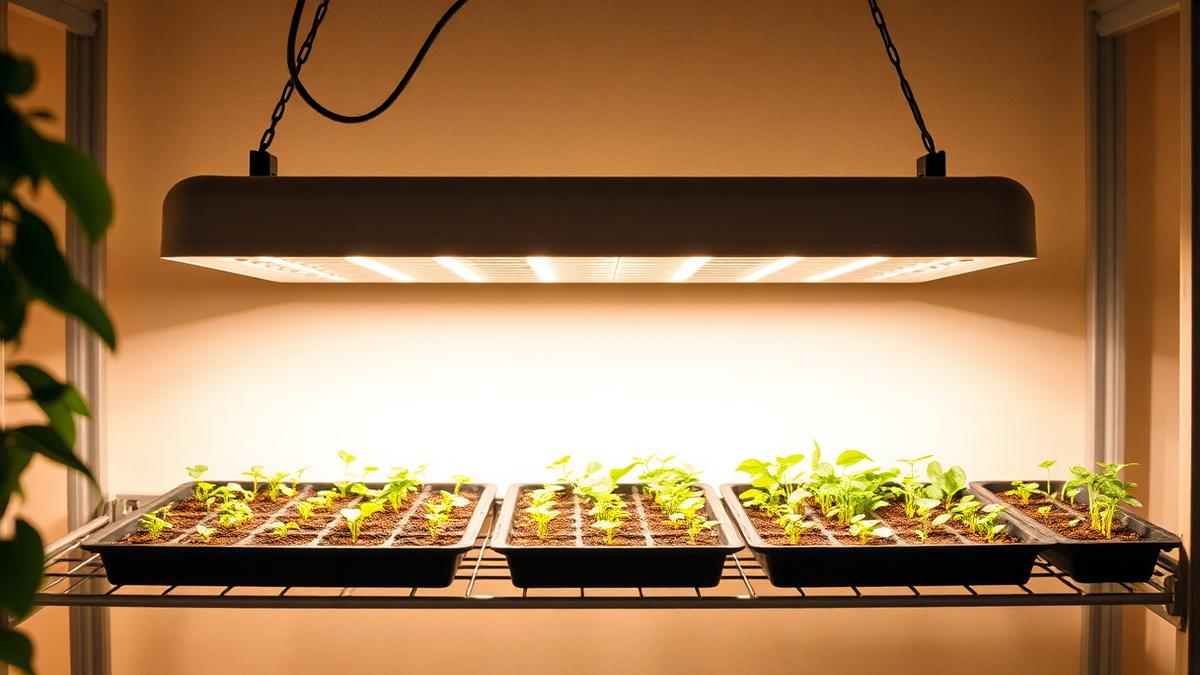
What actually determines grow light success
Three numbers control how well a grow light performs: PPFD (the intensity of usable light hitting the leaf), the number of hours it runs each day, and the resulting Daily Light Integral, or DLI — the total photosynthetic light a plant receives in 24 hours. Getting the wattage right on the box means little if the light hangs too high or runs too few hours to hit the DLI a plant actually needs.
Target DLI by growth stage
| Stage | Target DLI (mol/m²/day) | Typical hours/day |
|---|---|---|
| Seedlings / clones | 8-12 | 16-18 |
| Leafy greens & vegetative growth | 12-18 | 14-18 |
| Fruiting vegetables (tomato, pepper) | 20-30 | 14-16 |
| Flowering / high-light crops | 25-40 | 10-12 |
Hang height rules of thumb
A fixture's power alone doesn't tell you how far it should hang — efficiency and beam angle matter too. As a starting point, higher-wattage full-spectrum LED panels intended for a given footprint typically hang 12-24 inches above the canopy, moving closer for lower-power units and farther for very intense ones to avoid bleaching leaves.
| Setup | Approx. watts per sq ft | Typical hang height |
|---|---|---|
| Low-intensity supplemental light | 10-25 W/ft² | 6-12 in above canopy |
| Standard full-spectrum LED panel | 25-45 W/ft² | 12-18 in above canopy |
| High-output flowering fixture | 45+ W/ft² | 18-24 in above canopy |
Signs your DLI is off
- Stretchy, pale stems reaching toward the light: DLI too low, move the fixture closer or add hours.
- Bleached, curling, or crispy leaf edges nearest the light: DLI too high, raise the fixture or shorten hours.
- Slow, leggy growth despite fertilizing: check hang height before assuming a nutrient problem.
- Uneven growth across a tray: coverage area may be too large for the fixture's real usable footprint.
Measuring vs. estimating PPFD
A dedicated PAR/PPFD meter gives the most accurate reading at your exact hang height, and is worth the investment if you run several lights. Failing that, most grow light manufacturers publish a PPFD map at set distances in their spec sheet — use the closest matching distance for your setup as an estimate.
What is DLI and why does it matter more than intensity alone?
Daily Light Integral (DLI) is the total amount of usable light a plant receives over 24 hours — intensity multiplied by duration. Two setups with very different PPFD and hours can deliver the same DLI, and DLI correlates better with growth than instantaneous light readings alone.
How high should I hang my grow light?
Higher wattage and more efficient fixtures can hang further away while still delivering enough PPFD; low-wattage lights need to sit close to compensate. As a rule, start near the manufacturer's recommended height and adjust based on visible growth and leaf color over one to two weeks.
Can I just run my grow light 24 hours a day?
No. Most plants need a dark period to carry out important metabolic processes and won't grow better under 24-hour light — many will actually stress or stall. Vegetative growth typically wants 14-18 hours of light, flowering stages often want 10-12.
Do I need to measure PPFD myself?
A cheap PAR/PPFD meter or app-based estimate helps, but most consumer grow lights list an approximate PPFD at given distances in their spec sheet, which this calculator uses as a stand-in when you don't have a meter.
Written and reviewed by Jim Vernon, editor of Home & Garden Answers · Last reviewed February 2026