Structures
Greenhouse Size and Heating Calculator
Size a greenhouse to your beds and find the heater output needed to hold your target temperature all winter.
Glazing U-value used: 0.65 BTU/h·sq ft·°F
Size and heating estimate
Includes a 10% margin so the heater can recover after doors or vents are opened.
Formula
Heat loss (BTU/h) = glazing area (sq ft) × U × ΔT°F + 0.018 × volume (cu ft) × air changes/h × ΔT°F; heater = heat loss × 1.1Saves your inputs, results and formula. Works offline too.
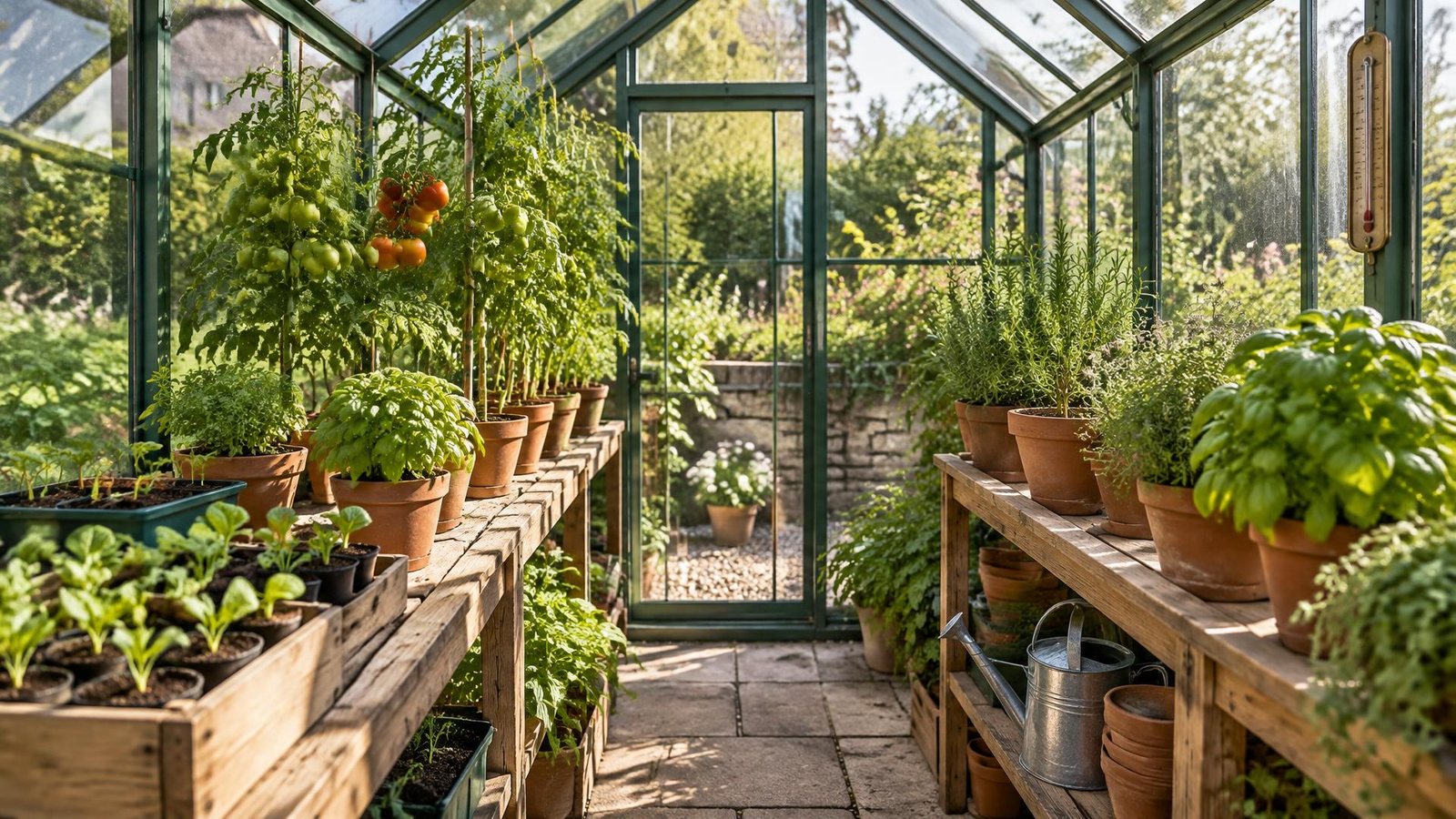
Sizing a greenhouse around how you grow
Start with the beds or benches you want, then add the paths you need to reach them. A common small layout is a central path about 2 ft wide with a bench or bed down each side, each no deeper than about 3 ft so you can reach the back without leaning on plants. That makes 8 ft the most practical minimum width; anything narrower usually means a single bench and a path.
Length is easier to add than width, and most hobby greenhouses grow in 2 ft sections. Gardeners almost always wish they had built bigger: seed trays, overwintering pots and summer tomatoes compete for the same space. If you are deciding between two sizes, choose the larger one and use the heating estimate to see what it costs to keep warm.
How greenhouse heat loss is worked out
A greenhouse loses heat in two ways. Heat passes straight through the glazing, and that loss is the glazing area multiplied by the material's U-value and by the temperature difference between inside and outside. Warm air also leaks out and is replaced with cold air; that loss is the air volume multiplied by how many times the air changes each hour, by the temperature difference, and by 0.018 (the heat needed to warm one cubic foot of air by 1°F).
The calculator treats the structure as a simple gable: four walls up to the side-wall height, two triangular gable ends, and two sloped roof panels running to the ridge. The floor is left out because the ground loses very little heat compared with the glazing. The result is the heat the heater must replace on your coldest expected night, plus a 10% margin.
Glazing makes the biggest difference
| Glazing | U-value (BTU/h·sq ft·°F) | U-value (W/m²·°C) |
|---|---|---|
| Single glass | 1.13 | 6.4 |
| Single poly film | 1.15 | 6.5 |
| Double glass | 0.70 | 4.0 |
| Double poly film, air-inflated | 0.70 | 4.0 |
| Twin-wall polycarbonate (8 mm) | 0.65 | 3.7 |
| Triple-wall polycarbonate (16 mm) | 0.48 | 2.7 |
Choosing a temperature to hold
- Frost-free (about 40°F): enough to overwinter hardy-ish plants such as geraniums and citrus kept on the dry side.
- Cool (about 45-50°F): keeps winter salads and herbs growing slowly and protects most tender perennials.
- Warm (about 60°F or more): needed for seed starting and tropical plants; heating costs rise quickly with every extra degree.
Every degree of extra warmth adds roughly the same amount of heat loss, so holding 60°F instead of 45°F on a 20°F night takes about 60% more heat. Heating a smaller insulated section with a bubble-wrap partition is often cheaper than heating the whole house.
Picking the heater
Electric fan heaters are easy to control with a thermostat and add no moisture or fumes, which makes them the usual choice for small greenhouses; 1 kW of electric heat equals about 3,412 BTU/h. Vented gas or paraffin heaters suit larger houses or sites without power, but unvented models release water vapour and fumes and need fresh air. Always use a heater rated for damp locations and a properly protected outdoor circuit.
How big a heater does a small greenhouse need?
An 8 x 12 ft twin-wall polycarbonate greenhouse held at 50°F on a 20°F night loses roughly 7,800 BTU per hour (about 2.3 kW) through its glazing and air leaks. Size the heater about 10% above the calculated heat loss so it can recover after the door has been opened.
Which glazing keeps a greenhouse warmest?
Triple-wall polycarbonate and double glass lose the least heat, around 0.5-0.7 BTU per hour per square foot per °F. Single-pane glass and single-layer poly film lose roughly twice as much, so they need about twice the heater output for the same temperature difference.
Why does the calculator ask about air leaks?
Cold air sneaking in around doors, vents and panel overlaps has to be warmed too. A tight new greenhouse changes its air about once an hour on a cold night, while an older or drafty structure can change it three times or more, adding noticeably to the heating load.
How much growing space should I leave for paths?
A central path of about 2 ft (60 cm) is the practical minimum for walking and carrying trays. Benches or beds on either side are easiest to reach when each is no deeper than about 3 ft (90 cm).
Written and reviewed by Jim Vernon, editor of Home & Garden Answers · Last reviewed October 2026