Crop Rotation for Home Gardens: A Simple Four-Group System
By Jim Vernon · 5 min read · Last updated
Crop rotation textbooks are written for farms with acres to spare. Here is a version that fits four raised beds.
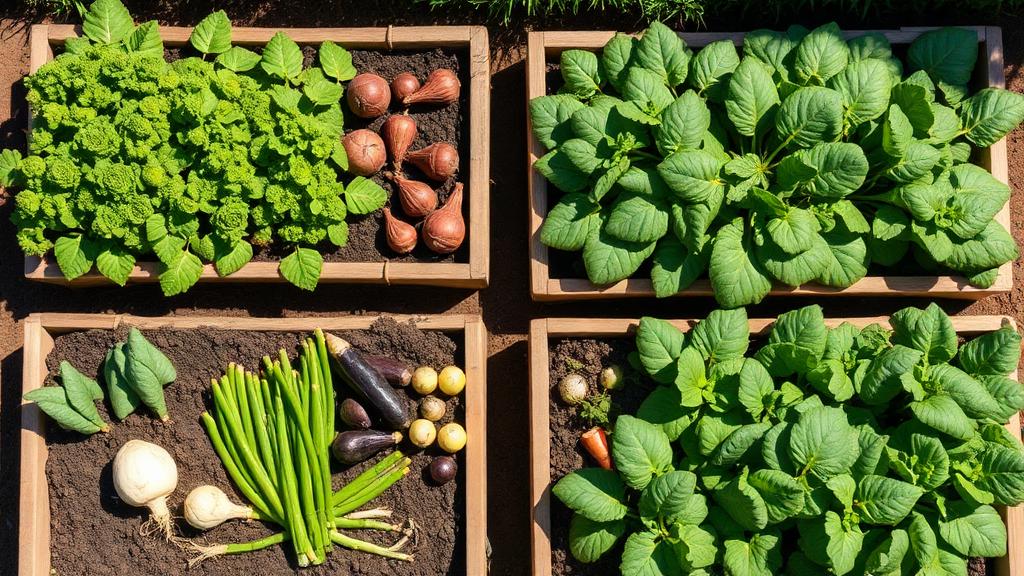
Crop rotation means not growing the same plant family in the same spot year after year. It matters because many soil-borne diseases and pests specialise in one plant family and build up in the soil where that family is grown repeatedly, while nutrient demands also differ by family and can deplete soil in predictable, family-specific ways.
Group vegetables by family, not by individual crop
| Group | Examples | Soil tendency |
|---|---|---|
| Nightshades | Tomatoes, peppers, potatoes, eggplant | Heavy feeders, prone to shared soil-borne blights |
| Brassicas | Broccoli, cabbage, kale, radish | Heavy feeders, share clubroot risk |
| Legumes | Beans, peas | Fix nitrogen, improve soil for the next group |
| Alliums & roots | Onions, garlic, carrots, beets | Lighter feeders, different pest profile |
A simple four-bed rotation
- Year 1: Legumes in bed A, brassicas in bed B, nightshades in bed C, alliums/roots in bed D.
- Year 2: Rotate each group one bed over — legumes move to bed B, brassicas to bed C, and so on.
- Year 3 and 4: Continue the rotation until each group has passed through all four beds.
- Repeat the four-year cycle, adjusting for whichever crops actually get grown each year.
Placing legumes ahead of heavy feeders like brassicas or nightshades is a deliberate choice: legumes fix nitrogen in the soil through root nodules, leaving a modest fertility boost for the following year's heavy-feeding group.
Rotation matters most for a specific set of problems
- Clubroot in brassicas, which can persist in soil for years once established.
- Early and late blight in nightshades, which overwinter in soil and plant debris.
- Nematode buildup, which tends to be crop-specific and eases with a break in host plants.
- Nutrient depletion patterns specific to heavy feeders grown in the same spot repeatedly.
Keeping records makes rotation realistic
A simple bed map noted each year — even a rough sketch with crop family and date — is enough to keep a four-year rotation honest. Memory alone reliably fails past year two, especially across several beds with mixed plantings.
Worked example: mapping a four-bed rotation
Say beds A-D each measure 4x8 feet. In year one, bed A grows beans (legumes), bed B grows broccoli and cabbage (brassicas), bed C grows tomatoes and peppers (nightshades), and bed D grows onions and carrots (alliums/roots). In year two, shift each group one bed clockwise: legumes move to bed B, brassicas to bed C, nightshades to bed D, and alliums/roots to bed A. By year five, every group has cycled through all four beds and the rotation repeats.
Common mistakes
- Rotating by individual crop instead of by plant family, missing that potatoes and tomatoes share nightshade diseases.
- Forgetting where a crop was planted the previous year and repeating it in the same bed by accident.
- Rotating annual vegetable beds but leaving diseased soil untouched around nearby perennial plantings.
- Skipping rotation for a 'just this once' convenience planting, which often becomes a repeated habit.
- Assuming a raised bed with fresh soil each year makes rotation unnecessary, when disease can still arrive via transplants or tools.
Adjusting the rotation for what you actually grow
A strict four-group rotation assumes roughly equal bed space devoted to each group, which rarely matches real eating habits — most home gardeners grow more nightshades and roots than legumes. It is fine to give the heaviest-demand groups more bed space as long as each specific plot still avoids repeating the same family for at least two to three years.
Cover crops extend the benefit of rotation
| Cover crop | Season | Main benefit |
|---|---|---|
| Crimson clover | Fall-spring | Fixes nitrogen, attracts pollinators when flowering |
| Winter rye | Fall-spring | Suppresses weeds, adds organic matter, tolerates hard frost |
| Buckwheat | Summer gap | Fast-growing, smothers weeds between spring and fall crops |
Signs your current rotation needs adjusting
- Recurring disease in the same family despite believing you were rotating — check the actual bed map against memory.
- One bed consistently underperforming regardless of amendments, which can point to a buildup specific to whatever family has grown there most.
- New pest or disease pressure appearing that wasn't a problem in earlier years of the same rotation.
Rotation with just one or two raised beds
A gardener with a single 4x8 bed cannot run a true four-group rotation, but can still capture most of the benefit by tracking what grew there for the last two years and simply avoiding a third consecutive year of the same family. In practice this often means alternating a heavy feeder like tomatoes with a legume or root crop family every other year, and using a fall cover crop of crimson clover or winter rye in the off years to rebuild fertility and interrupt disease cycles in the same footprint. Splitting one bed into quarters with a simple string grid and rotating within those quarters year to year gets a two-bed household most of the way to a real four-year cycle without needing more square footage.
Is crop rotation necessary in a small garden with only one or two beds?
It is harder to execute with strict four-year cycles, but even alternating heavy feeders with legumes or roots year to year in a single bed captures much of the benefit.
Does rotation apply to companion-planted mixed beds?
Yes, though it requires tracking the dominant family in each bed section rather than a single crop per bed.
How long should I wait before replanting the same family in a spot?
Three to four years is the standard guideline for most soil-borne disease risks, though a two-year gap still meaningfully reduces buildup compared with no rotation at all.
Do cover crops fit into a rotation plan?
Yes — a fall or winter cover crop like clover or winter rye can occupy a bed between vegetable rotations, adding organic matter and, in the case of clover, fixing nitrogen for the next group.
What if I only have containers, not beds?
Rotation in containers is less critical since the growing medium is isolated, but refreshing or partially replacing potting mix between heavy feeders still helps avoid nutrient depletion and disease buildup.
Run the numbers for your own project
- Raised Bed Soil CalculatorHow much soil do I need to fill my raised bed?
- Composting CalculatorWhat ratio of greens to browns does my compost need?
Keep reading
- Starting Your First Vegetable Garden Without Wasting a SeasonMost first gardens fail for reasons that have nothing to do with a green thumb. Here are the five that matter.
- Building Soil That Actually Grows ThingsFeeding plants is a short-term fix. Feeding the soil is what makes a garden easy.
- Reviving a Tired Lawn: A Season-Long PlanA thin lawn is a symptom. Treating the symptom with more seed is why it keeps coming back.