Thinning Fruit on Apple, Pear and Peach Trees for Bigger Harvests
By Jim Vernon · 4 min read · Last updated
Pulling off half the baby apples feels wrong, but it is how you get fruit worth eating and a crop again next year.
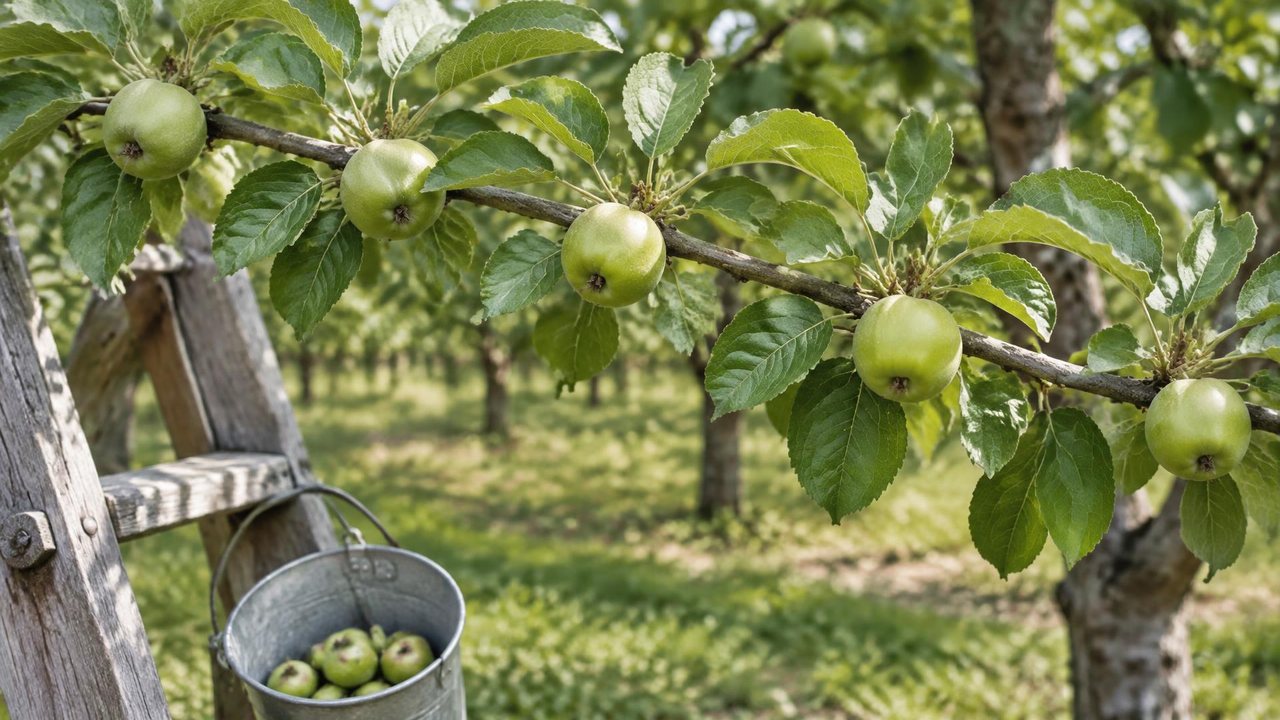
Fruit thinning means removing some of the young fruit a few weeks after bloom so the fruit left on the tree grows larger and sweeter. A heavily loaded tree spreads its energy across too many fruits, giving small, bland fruit, broken branches and often a skipped crop the next year. Thinning apples, pears and peaches to set spacings once the fruit is marble-sized fixes all three problems.
When should you thin fruit?
Thin as early as you can tell which fruit has set, usually 3-6 weeks after full bloom. For apples and pears that is when fruit is about 0.5-1 inch across. For peaches and nectarines, finish before the pit hardens, roughly when fruit is about 1 inch across. Many trees shed some fruit naturally in early summer, often called June drop, so you can wait until just after it, but thinning later than that gives much smaller benefits.
How far apart should fruit be left?
| Tree | Fruit per cluster | Spacing along the branch | Notes |
|---|---|---|---|
| Apple | 1, the largest | 6-8 inches | Keep the king fruit, the center one, unless it is damaged |
| European pear | 1-2 | About 6 inches | Thin less on light-cropping varieties |
| Asian pear | 1 | 6-8 inches | Fruit stays small and gritty if left in clusters |
| Peach and nectarine | 1 | 6-8 inches | Usually needs the hardest thinning of all |
| Plum | 1-2 | 3-4 inches | Japanese plums need more thinning than European types |
How do you thin by hand?
- Start at the top of the tree and work down, one branch at a time, so you can see the spacing.
- Remove damaged, misshapen, insect-marked and undersized fruit first.
- Reduce each cluster to the number in the table, keeping the largest, best-shaped fruit.
- Space the remaining fruit along the branch to the recommended distance.
- For apples and pears, snip stems with small scissors or hold the spur and twist the fruit off, so you do not tear off the spur that carries next year's buds.
- Peaches can be pinched or rubbed off by hand, since the fruit lets go easily at this stage.
Why does thinning help next year's crop?
Apples and pears form next year's flower buds during the current summer. When a tree carries a very heavy crop, it has too little energy left to form those buds, so it flowers lightly the next spring. This pattern of a big crop followed by a poor one is called biennial bearing. Regular early thinning keeps the crop moderate every year and helps break the cycle on trees already stuck in it.
Does thinning reduce pests and disease?
Yes, in two ways. Fruits touching in a tight cluster trap moisture and give insects such as codling moth a sheltered place to enter, so spacing them out reduces rot and pest damage. Thinning also gives you a close look at every branch early in the season, which is when damage from pests, hail or disease is easiest to spot and deal with.
How do you protect branches on a heavy year?
- Thin harder on young trees and on long, thin branches that bend under the load.
- Prop heavily loaded limbs with a padded forked stake as the fruit swells.
- Remove fruit from the tips of long branches first, where the leverage is greatest.
- On very young trees, remove all fruit for the first year or two so the tree builds roots and framework.
What mistakes make thinning less effective?
- Waiting until midsummer, when the tree has already spent energy on fruit you remove.
- Pulling fruit straight down and ripping away the fruiting spur.
- Leaving doubles because both fruits look good; one large fruit is worth more than two small ones.
- Thinning only the branches you can reach while the top of the tree stays overloaded.
How does thinning interact with pruning?
Winter pruning and summer thinning do different jobs. Pruning removes whole branches to open the canopy, let in light and shape the tree, and it removes some flower buds along the way. Thinning fine-tunes the crop that actually sets. A well-pruned tree needs less thinning because it carries fewer, better-placed fruiting spurs, but even a perfectly pruned apple or peach usually sets more fruit than it can ripen well, so plan on both every year.
How long does thinning take?
On a mature semi-dwarf apple or peach, expect 30-60 minutes per tree the first time, faster once you learn the spacing by eye. A step ladder, small pointed scissors and a bucket for the removed fruit are all you need. Thin on a dry day, and start with the tree that bloomed first, since its fruit will be largest and most ready.
Do I need to thin cherries?
Usually not. Cherries are small, set heavily and rarely benefit enough to be worth the work, though very young cherry trees can be relieved of some fruit.
Can I thin by removing blossoms instead?
Yes, blossom thinning works and gives the strongest effect on fruit size, but it is risky where late frost can kill blossoms after you thin.
What do I do with the thinned fruit?
Compost it or bag it for the trash. If your trees had pest problems, dispose of it away from the orchard so insects inside the fruit do not complete their life cycle.
Run the numbers for your own project
- Frost Date LookupWhen is my last frost and how long is my season?
- What to Plant This MonthWhat can I plant right now where I live?
Keep reading
- Starting Your First Vegetable Garden Without Wasting a SeasonMost first gardens fail for reasons that have nothing to do with a green thumb. Here are the five that matter.
- Building Soil That Actually Grows ThingsFeeding plants is a short-term fix. Feeding the soil is what makes a garden easy.
- Reviving a Tired Lawn: A Season-Long PlanA thin lawn is a symptom. Treating the symptom with more seed is why it keeps coming back.