How Do You Design a Native Plant Border for Pollinators?
By Jim Vernon · 5 min read · Last updated
A border of showy 'pollinator-friendly' nursery annuals often supports far fewer bees and butterflies than a modest bed of true regional natives, because most native pollinators evolved alongside specific local plants.
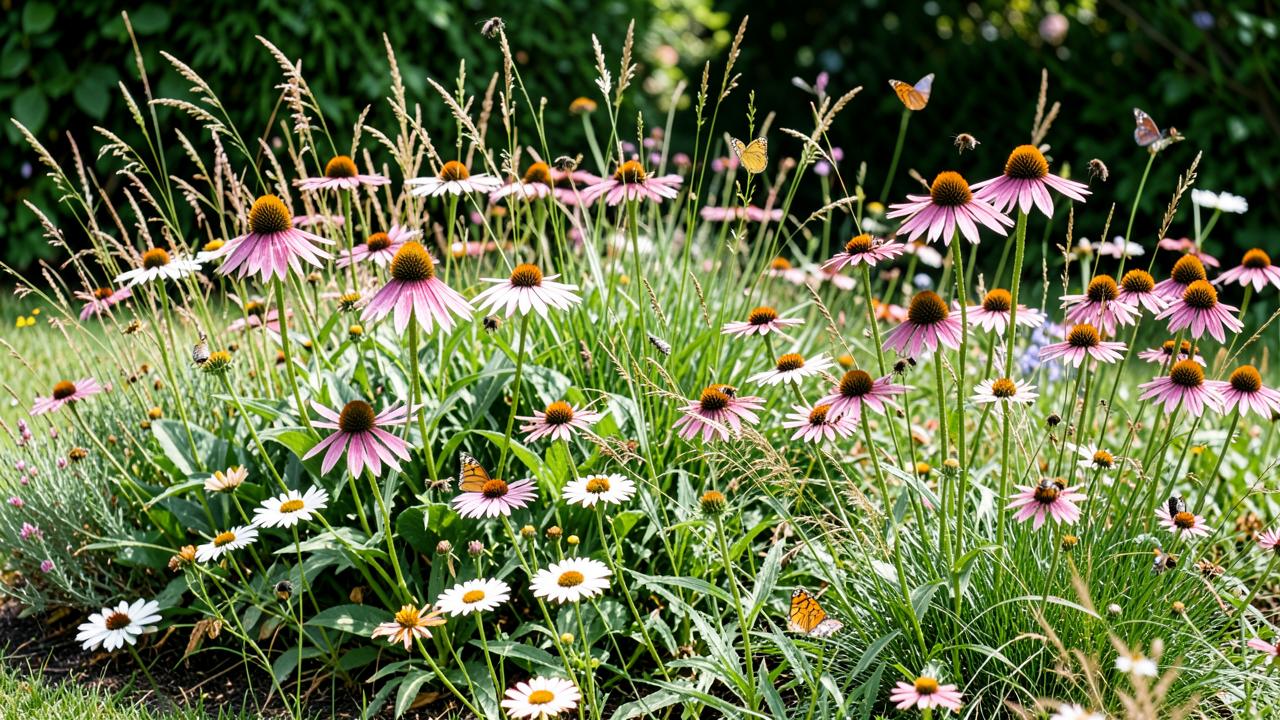
Design a pollinator border with regionally native plants selected for overlapping, staggered bloom from early spring through frost, arranged in drifts of 5-7 plants of the same species rather than single specimens scattered throughout, and left standing over winter rather than cut back in fall. This combination provides continuous nectar and pollen, makes it easier for pollinators to find and use each bloom period, and preserves overwintering habitat in hollow stems and leaf litter.
Why do native plants matter more than generically 'pollinator-friendly' plants?
Many popular pollinator-marketed plants, including some butterfly bush cultivars and double-flowered hybrids, offer nectar to generalist pollinators but little or no usable pollen, and some hybridized flowers have had their pollen and nectar bred out entirely for a fuller petal look. Specialist native bees and butterfly larvae, meanwhile, often depend on specific native plant relationships — monarch caterpillars, for example, feed only on milkweed species. A border built on regional natives supports both generalist and specialist pollinators; one built on ornamental cultivars alone usually doesn't.
What does a staggered bloom schedule look like?
| Bloom period | Example native plants (adjust by region) | Pollinators supported |
|---|---|---|
| Early spring | Golden alexanders, wild columbine, serviceberry | Early bumblebees, mason bees |
| Late spring-early summer | Penstemon, coreopsis, milkweed | Bumblebees, monarchs, mason bees |
| Mid-late summer | Coneflower, bee balm, black-eyed Susan, mountain mint | Honeybees, native bees, butterflies |
| Fall | Aster, goldenrod, Joe-Pye weed | Migrating monarchs, late-season bees |
How should plants be arranged and spaced in the border?
- Plant in drifts or clusters of 5-7 of the same species rather than single specimens, since larger patches of one bloom are easier for pollinators to locate and forage efficiently.
- Space perennials at their recommended mature spacing, typically 12-18 inches for smaller species and 18-24 inches for larger ones like coneflower or Joe-Pye weed.
- Layer heights with taller plants (Joe-Pye weed, ironweed) toward the back or center and shorter plants (coreopsis, wild strawberry) toward the border's edge.
- Leave small bare patches of soil in part of the bed for ground-nesting native bees, which make up a majority of native bee species and need direct soil access, not mulch cover.
Does 'leaving it messy' really matter for winter pollinator habitat?
Yes — many native bee species overwinter as larvae inside hollow or pithy plant stems, and butterfly and moth species overwinter as chrysalises or eggs attached to leaf litter and standing plant debris. Cutting a border back hard and clearing all debris in fall, the standard tidy-garden habit, removes much of this overwintering habitat before it's used. Leaving stems standing until temperatures consistently reach the 50s in spring lets those insects complete their life cycle.
How big does a pollinator border need to be to make a difference?
Research on urban and suburban pollinator gardens shows meaningful benefits even from beds as small as 100-200 square feet, as long as bloom continuity and plant diversity are prioritized over sheer size. A collection of small, well-designed native borders across a neighborhood does more collectively than one large but sparse planting, since pollinators need reliable forage within their typical flight range, often just a few hundred feet for smaller native bees.
How do you find out which plants are actually native to your specific region?
"Native to North America" is too broad a label to be useful — a plant native to the Southeast may be entirely out of its ecological range in the Pacific Northwest and offer little benefit to local pollinator species there. State native plant societies and university extension offices publish regional plant lists, and several online native plant finder tools let you search by zip code to get a list of species genuinely native to your specific area rather than the country as a whole.
Can a native pollinator border coexist with a tidy, formal landscape style?
Yes, using a design technique sometimes called the "cues to care" approach: a defined edge (a mowed strip, a low border, or a clean bed line) around an otherwise informal, naturalistic planting signals intentional design rather than neglect, which matters for both personal preference and HOA compliance. Choosing a smaller number of well-behaved, clump-forming native species over aggressive spreaders also keeps a native border looking more curated without sacrificing the pollinator value of straight species over hybrids.
What is the realistic first-year timeline for a new pollinator border?
Most native perennials establish root systems in year one and put more energy into top growth and bloom in years two and three — a pattern often summarized as "sleep, creep, leap." Expect a modest, somewhat sparse-looking bed the first season even with correct planting, filling in substantially by the second year and reaching full density and bloom coverage by the third. Planting small plugs or bare-root natives in fall, rather than waiting for spring, often gives roots a head start and produces a fuller look one season sooner.
Frequently asked questions
How many plant species should a pollinator border include?
Aim for at least 8-12 species that together cover early spring through fall bloom, since diversity in bloom timing and flower shape supports a wider range of pollinator species than a few showy plants blooming all at once in midsummer.
Do native plant borders need less water and fertilizer than a typical flower bed?
Yes, once established (usually after the first one to two growing seasons), regionally native plants are adapted to local rainfall and soil fertility and typically need little to no supplemental watering or fertilizer, unlike many ornamental perennials bred for showier bloom.
Is it bad to include a few non-native flowers in a native pollinator border?
Not necessarily — many non-invasive non-native flowers still provide usable nectar for generalist pollinators. The concern is specifically invasive species and heavily hybridized double-flowered cultivars with little pollen; a border that's majority native with a few well-chosen non-invasive additions still functions well.
Run the numbers for your own project
- Wildflower and Pollinator Mix CalculatorHow much wildflower seed do I need for my patch?
- Garden Bed Plant SpacingHow many plants fit in my bed?
Keep reading
- Starting Your First Vegetable Garden Without Wasting a SeasonMost first gardens fail for reasons that have nothing to do with a green thumb. Here are the five that matter.
- Building Soil That Actually Grows ThingsFeeding plants is a short-term fix. Feeding the soil is what makes a garden easy.
- Reviving a Tired Lawn: A Season-Long PlanA thin lawn is a symptom. Treating the symptom with more seed is why it keeps coming back.