How Do You Plant a Tree So It Actually Survives and Thrives?
By Jim Vernon · 4 min read · Last updated
The single biggest killer of newly planted trees isn't drought or disease — it's planting them too deep, which slowly suffocates the roots over several years.
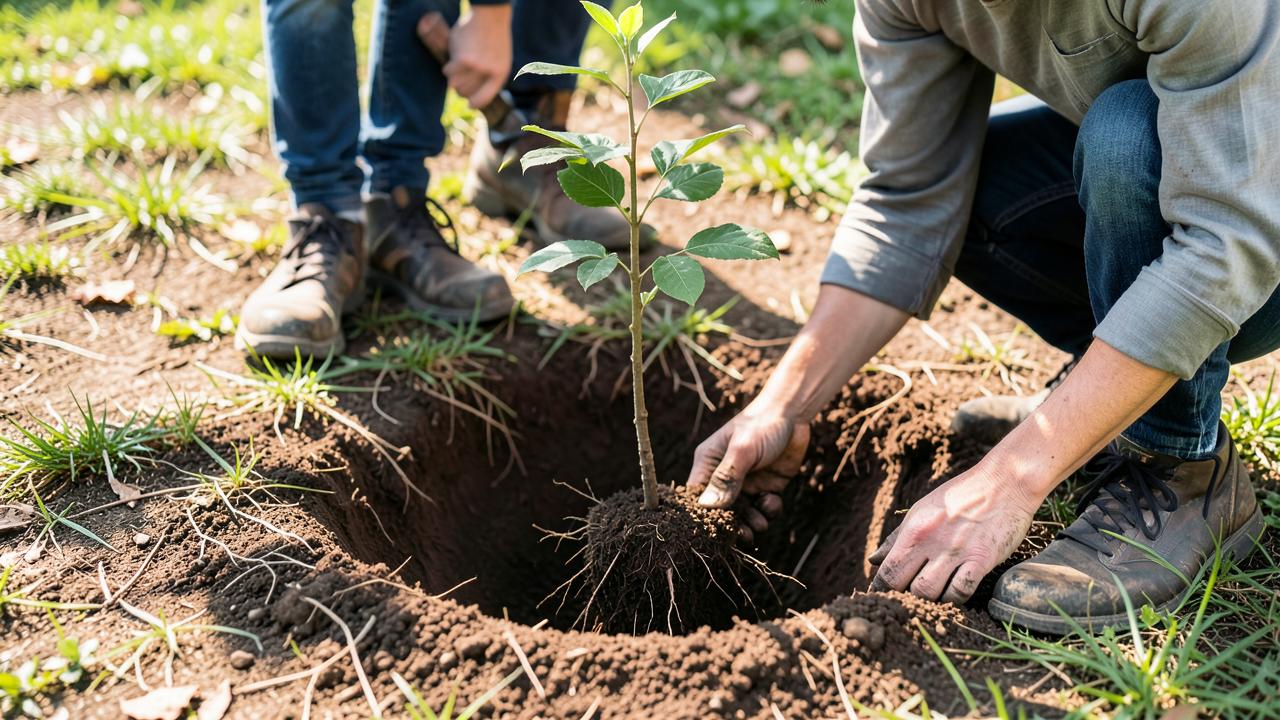
Plant a tree by digging a hole 2-3 times wider than the root ball but no deeper than it, locating the root flare (where the trunk widens at the top of the roots) and keeping it level with or slightly above grade, then backfilling with the native soil you dug out rather than heavily amended mix. Water deeply at planting and skip staking unless the site is very windy or the tree is top-heavy and unstable.
Why does planting depth matter so much?
Roots need oxygen, and burying the root flare below grade traps moisture against the trunk and starves the roots of air, leading to root rot and girdling roots that can kill a tree slowly over 3-10 years — long after the original planting is forgotten as the cause. Container and balled-and-burlap trees from nurseries are frequently already planted too deep in their pots, so check for the flare yourself rather than trusting the nursery's soil line.
How do you find the root flare before planting?
- Remove the top few inches of soil or mulch from the root ball until you see the trunk visibly widen into roots.
- If you can't find a flare within the top 3-4 inches, the tree was likely planted too deep in its container; you may need to remove excess soil from the top of the root ball itself.
- For balled-and-burlap trees, cut away and remove all burlap, twine, and wire baskets after placing the tree — these don't fully decompose and can girdle roots.
Step-by-step planting process
- Call 811 to mark utility lines before digging, and confirm mature size against the planting site's overhead wires and structures.
- Dig a hole 2-3 times the width of the root ball, with sloped sides, and only as deep as the root ball measures from flare to bottom.
- Set the tree in the hole with the flare 1-2 inches above grade to account for settling; check level from multiple angles.
- Backfill with the original native soil, tamping gently every few inches to remove large air pockets, then water slowly to settle the soil further.
- Build a shallow berm 2-3 feet out from the trunk to hold irrigation water, and apply mulch 2-3 inches deep, keeping it 3-4 inches clear of the trunk itself.
| Tree size at planting | Hole width | Water at planting | Watering through year 1 |
|---|---|---|---|
| Container, 5-15 gal | 2-3 ft diameter | 5-10 gallons | 10-15 gal, 1-2x/week |
| B&B, 1.5-2 in caliper | 4-5 ft diameter | 15-20 gallons | 15-20 gal, 2x/week |
| B&B, 2-3 in caliper | 5-6 ft diameter | 20-25 gallons | 20-25 gal, 2x/week |
Do new trees need staking?
Most trees, especially those with a trunk caliper under 2 inches and a reasonably balanced root ball, establish better without stakes, since a small amount of trunk movement in wind builds trunk strength and root anchoring. Stake only top-heavy trees, bare-root trees, or trees on consistently windy, exposed sites, using wide flexible ties, not wire, and remove the stakes after one growing season.
How far should a new tree be planted from the house or other structures?
Match distance to the tree's mature canopy and root spread, not its size at planting: small ornamental trees (15-25 ft mature height) need at least 8-10 feet of clearance from a foundation, while large shade trees (50-80 ft mature height) need 20-30 feet or more to avoid future conflicts with roots, siding, and roofline. Utility lines overhead call for the same logic in reverse — check mature height against wire height before choosing a planting spot, since a fast-growing shade tree under power lines guarantees a future topping job or removal.
Does the type of tree change how you should plant it?
Bare-root trees, common for fruit trees and sold dormant in late winter, need their roots soaked for a few hours before planting and spread out naturally in a wider, shallower hole rather than crammed into a narrow one. Container-grown trees often have circling roots from time spent in the pot; before planting, score or gently tease apart the outer inch of root mass so roots grow outward into native soil instead of continuing to circle and eventually girdling the trunk. Balled-and-burlap trees are heaviest and most prone to planting-depth errors, since soil often shifts during transport and covers the flare.
What ongoing care does a tree need after the first year?
| Care task | Years 1-2 | Years 3-5 | After year 5 |
|---|---|---|---|
| Watering | Weekly deep watering in dry weeks | Every 2-3 weeks in drought | Rarely needed except severe drought |
| Mulch ring | Maintain 2-3 in, refresh yearly | Maintain 2-3 in | Optional but still beneficial |
| Fertilizer | Usually unnecessary if soil is decent | Only if growth is weak | Only if a soil test shows deficiency |
| Structural pruning | Light shaping only | Establish scaffold branches | Maintenance pruning only |
Frequently asked questions
What is the best time of year to plant a tree?
Fall, roughly 6-8 weeks before the ground freezes, is often ideal because cooler air temperatures reduce transplant stress while soil is still warm enough for root growth. Early spring before bud break is the next best window; avoid planting during peak summer heat wherever possible.
How long should you keep watering a newly planted tree?
Plan on consistent deep watering for the first two full growing seasons, roughly 15-25 gallons once or twice a week depending on tree size and rainfall, tapering in year three as the root system spreads beyond the original planting hole.
Can a tree recover if it was accidentally planted too deep?
Yes, if caught within the first year or two, excavating soil away from the trunk down to the true root flare (called an 'air spading' or manual dig-out) can reverse most of the damage. Left for many years, girdling roots and rot may already be established and harder to fully correct.
Run the numbers for your own project
- Hedge and Tree Spacing CalculatorHow far apart should I space my hedge or trees?
- Plant Watering CalculatorHow often and how much should I water this plant?
- Mulch CalculatorHow much mulch do I need for my beds?
Keep reading
- Starting Your First Vegetable Garden Without Wasting a SeasonMost first gardens fail for reasons that have nothing to do with a green thumb. Here are the five that matter.
- Building Soil That Actually Grows ThingsFeeding plants is a short-term fix. Feeding the soil is what makes a garden easy.
- Reviving a Tired Lawn: A Season-Long PlanA thin lawn is a symptom. Treating the symptom with more seed is why it keeps coming back.