How Do You Install Metal Landscape Edging That Won't Heave or Rust Out?
By Jim Vernon · 6 min read · Last updated
Install heavy-gauge metal edging once, and you will never spend another spring digging runaway grass roots out of your flower beds.
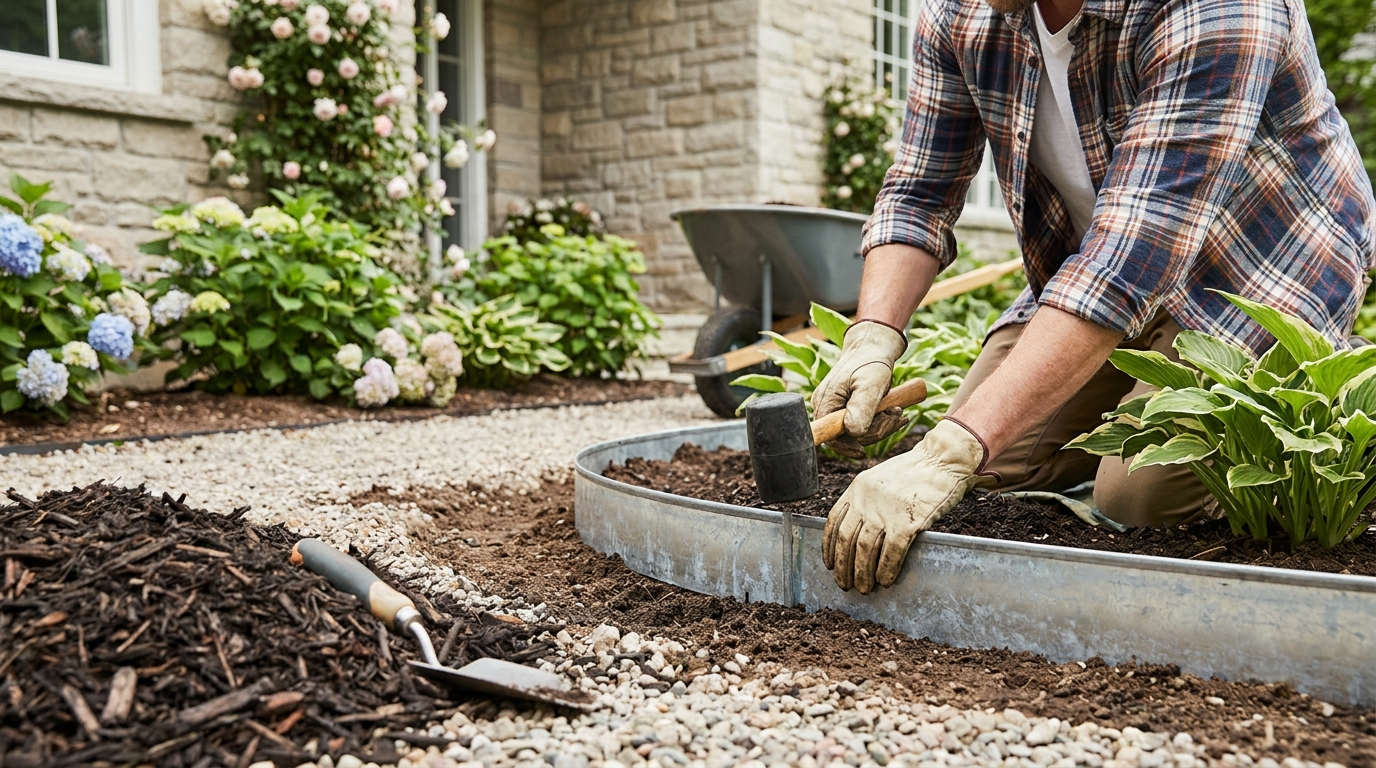
To install metal landscape edging that stays put and blocks grass roots, you must trench at least 4 inches (10 cm) deep, overlap the seams by 2 inches (5 cm), and drive stakes at opposing 45-degree angles every 3 feet (0.9 m). Leaving the top edge exactly 0.5 inches (1.2 cm) above the soil line stops invasive turf while preventing catastrophic lawnmower blade strikes. Forget flimsy plastic tubing or shallow pounding; metal edging requires a true trench to act as an underground root barrier and above-ground mulch retainer. Installing 14-gauge steel or 1/8-inch (3 mm) aluminum takes heavy digging, but when locked in properly, it creates a permanent, zero-maintenance border that defines a landscape for decades.
- Dig a 4-inch (10 cm) trench to bury the edging deep enough to stop horizontal grass roots.
- Drive stakes at opposing 45-degree angles rather than straight down to prevent winter frost heave.
- Leave exactly 0.5 inches (1.2 cm) of metal above the lawn soil line to clear lawnmower blades.
- Use 1/8-inch (3 mm) aluminum in snowy or coastal climates, and 14-gauge steel in drier regions.
Which type of metal edging is best for your climate?
Aluminum and steel are the two primary choices for metal borders, and your climate dictates which one survives best. In USDA Hardiness Zones 3 through 6 where road salt splashes into yards, or in humid coastal regions, 1/8-inch (3 mm) extruded aluminum is mandatory because it cannot rust. In drier or warmer zones, 14-gauge powder-coated or weathering steel offers superior rigidity for heavy clay soils. Steel eventually develops a surface patina, but 14-gauge thickness takes roughly 40 years to rust through completely in average soil. Avoid 18-gauge or 20-gauge steel found at discount hardware racks; it bends when you hit a rock and rots out in less than five years.
How deep should you dig the trench for metal landscape edging?
You cannot pound metal edging directly into undisturbed soil without warping it. The most common failure mode for metal edging is shallow installation, allowing creeping grasses to tunnel underneath. Use a half-moon edger to cut the initial turf line, then a heavy mattock to excavate a trench exactly 4 inches (10 cm) deep. Standard strips are 4 inches (10 cm) tall. The bottom edge must rest on solid subsoil, with the top edge sitting exactly 0.5 inches (1.2 cm) above the lawn level. This depth acts as a physical wall against horizontal root runners. If banking mulch heavily, use 6-inch (15 cm) edging, burying at least 70 percent of the profile to maintain structural soundness.
How do you stake metal edging so it survives winter frost heave?
This is a critical judgment call where professionals diverge from beginners. A beginner will slide the edging into the trench and use a 3-pound (1.36 kg) drilling hammer to pound the steel stakes straight down through the pre-cut slots. In freezing climates, ice lenses form in the soil, grabbing that vertical profile and jacking the edging straight out of the ground by spring. A pro never drives stakes perfectly vertical. Instead, they drive the stakes through the slots at opposing 45-degree angles, creating a cross-locking effect in the soil similar to pitching a high-wind tent. You need one stake every 3 feet (0.9 m), plus an anchor at every single overlapping joint. Always drive the stake on the garden bed side of the edging, never the lawn side, so the turf roots face a smooth, uninterrupted barrier.
How do you overlap and connect metal edging pieces correctly?
Metal edging expands and contracts with temperature swings, so the joints require a mechanical connection. Never butt two ends perfectly flush against each other. Instead, overlap the ends of the metal strips by at least 2 inches (5 cm). Most professional-grade systems come with interlocking tabs or slide-on brackets. Slide the bottom lip of the new piece behind the top lip of the existing piece, ensuring the overlap runs away from your main viewing angle so the seam disappears visually. Once overlapped, drive a steel stake directly through the overlapping bracket to pin both pieces together. If you must cut a piece and lose the factory bracket, overlap the raw ends by 4 inches (10 cm) and drill a 1/4-inch (6 mm) hole through both, securing them with a stainless steel carriage bolt.
How do you bend metal edging into smooth curves without kinking it?
Creating organic, sweeping curves requires using your body weight and a sturdy fulcrum. Aluminum bends easily, but both aluminum and steel will kink permanently if forced too aggressively. To create a wide radius curve, lay the 8-foot (2.4 m) strip flat on the grass. Walk along the strip in small, shuffling steps while pulling the ends upward to establish a gentle, sweeping bow. For tight corners around a tree ring, find a sturdy tree trunk or a 5-gallon bucket to use as a bending form. Wrap the metal around the curved form, applying slow, steady pressure over 30 seconds to let the metal yield without snapping. If you accidentally kink 14-gauge steel, or need to cut a strip to length, skip the tin snips. You must use an angle grinder with a 4.5-inch (11.4 cm) cutoff wheel to cleanly sever the piece before splicing.
What does it actually cost to install metal landscape edging in 2026?
Budgeting for metal edging requires calculating linear footage, stakes, and corner brackets. In 2026, 14-gauge raw weathering steel runs $4.00 to $4.50 per linear foot, while heavy-duty 1/8-inch (3 mm) thick aluminum costs $6.00 to $7.50 per linear foot. A standard 16-foot by 12-foot (4.8 by 3.6 m) kidney-bean shaped garden bed requires roughly 45 linear feet of edging. A DIY steel installation costs approximately $210 for materials. Hiring a professional landscaping crew to excavate, install, and backfill typically adds $5.00 to $8.00 per linear foot in labor, pushing the total cost to roughly $500. While metal costs three times more than rolled plastic edging upfront, it never needs replacing, making the ten-year cost of ownership significantly lower.
How do you backfill and maintain metal edging long-term?
Once the edging is staked and leveled, immediate backfilling locks it in place permanently. Do not just kick loose dirt into the trench. Use a hand tamper or a shovel handle to pack heavy native soil against both sides of the metal simultaneously, preventing the metal from leaning toward the weaker side. Keep the lawn side packed with dense soil up to the 0.5-inch (1.2 cm) reveal line, and fill the garden side with topsoil and a 2-inch (5 cm) layer of mulch. Maintenance is practically non-existent, but keep string trimmers away from painted steel or aluminum. The abrasive line strips away the protective powder coating, opening the door for rapid rust in steel or unsightly oxidation pitting in aluminum.
| Material | 2026 DIY Cost (Per Lin. Ft.) | Lifespan | Best Climate |
|---|---|---|---|
| 18-Gauge Steel (Big Box) | ~ $2.50 | 3-5 years | Dry climates only |
| 14-Gauge Heavy Steel | $4.00 - $4.50 | 40+ years | Zones 7-10, heavy clay |
| 1/8-Inch Extruded Aluminum | $6.00 - $7.50 | Indefinite | Zones 3-6, coastal |
Frequently asked questions
Can you install metal landscape edging over tree roots?
You should never sever tree roots larger than 2 inches (5 cm) in diameter to install edging, as this destabilizes the tree and invites disease. Instead, use a hacksaw to cut a notch out of the bottom of the metal edging so it bridges over the root while keeping the top line level.
Will metal landscape edging burn my plants or grass in summer?
No. While metal absorbs heat, the soil acts as a massive thermal heat sink, rapidly pulling the temperature out of the buried portion of the edging. Grass and plant roots growing directly against the metal will not scorch, even in 100-degree Fahrenheit (38 C) heatwaves.
How do you pull up metal edging if you want to redesign a garden?
Dig away the soil on the garden side of the edging first to expose the stakes. Use a flat pry bar or a claw hammer to lever the stakes out of the ground individually. Do not pull up on the metal edging strip itself, or you will bend the brackets and ruin the piece for reuse.
Keep reading
- Starting Your First Vegetable Garden Without Wasting a SeasonMost first gardens fail for reasons that have nothing to do with a green thumb. Here are the five that matter.
- Building Soil That Actually Grows ThingsFeeding plants is a short-term fix. Feeding the soil is what makes a garden easy.
- Reviving a Tired Lawn: A Season-Long PlanA thin lawn is a symptom. Treating the symptom with more seed is why it keeps coming back.