How Do You Install a Rain Barrel That Won't Overflow or Breed Mosquitoes?
By Jim Vernon · 7 min read · Last updated
A single summer thunderstorm drops enough water on your roof to flood your foundation, but capturing that runoff can slash your summer watering bill if you build the system right.
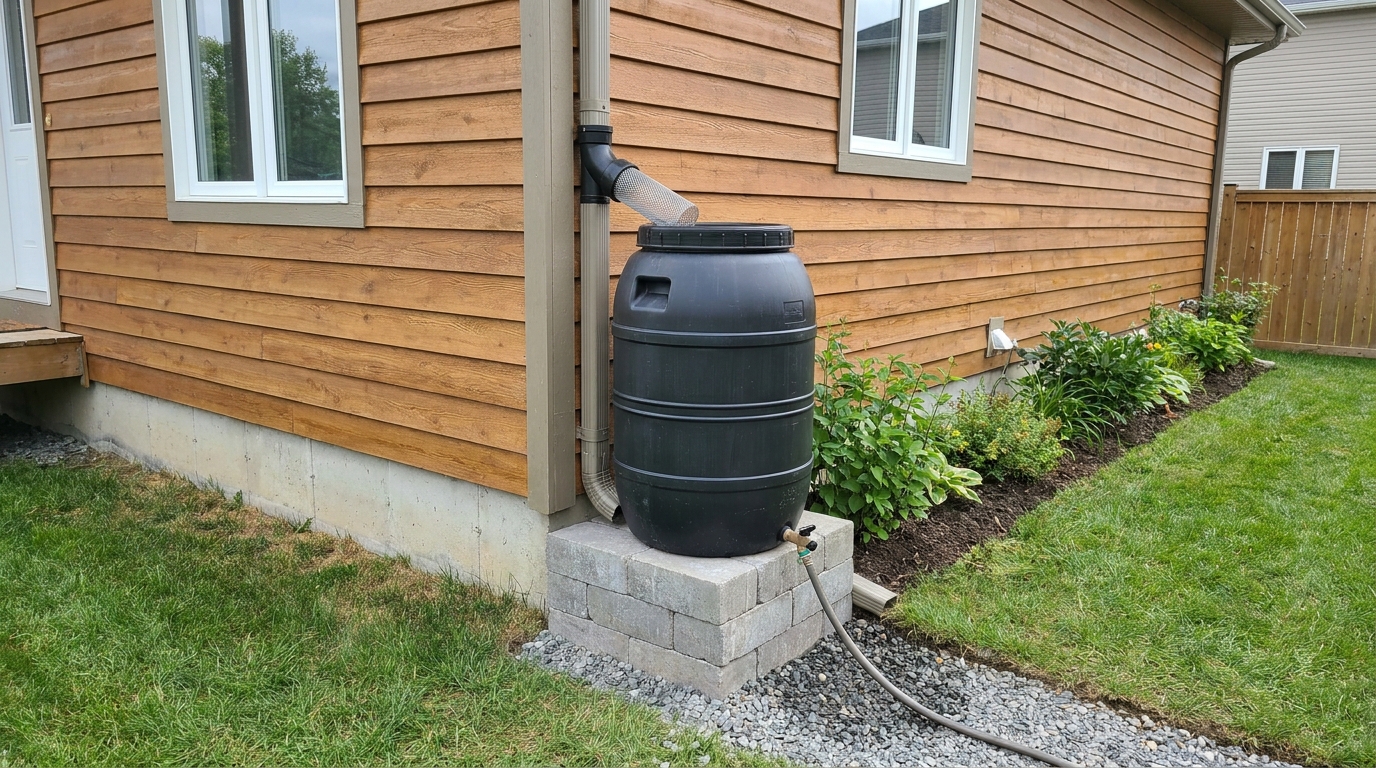
To install a rain barrel correctly, you must build a level, elevated base out of gravel and concrete pavers, install a closed-loop downspout diverter to prevent flooding, and seal the system with fine brass mesh to keep mosquitoes out. Expect to spend between $100 and $250 (2026 USD) for a food-grade 55-gallon (208-liter) barrel, a diverter kit, and base materials. Setting up a rain collection system takes an afternoon, but the biggest mistake homeowners make is treating it like a simple bucket under a pipe. Water weighs 8.34 pounds per gallon (1 kg per liter), meaning a full barrel puts nearly 460 pounds (208 kg) of pressure on the ground beneath it. You need a rock-solid foundation, a reliable gravity-fed spigot, and an automatic overflow strategy to protect your home's foundation from rot and water intrusion.
- A full 55-gallon rain barrel weighs roughly 460 pounds and requires a compacted gravel and paver base to prevent tipping.
- Always use a closed-loop downspout diverter rather than cutting the downspout off completely to stop the barrel from aggressively overflowing during heavy storms.
- Seal every opening with 1/16-inch brass mesh and use monthly BTI dunks to prevent the barrel from becoming a mosquito breeding ground.
- Drain the barrel and detach the diverter hose before winter temperatures drop below 32°F (0°C) to prevent ice from splitting the plastic.
Where Should You Place Your Rain Barrel?
Choose a downspout closest to the garden beds you intend to water, ideally on a flat patch of ground sloping away from the house. Because rain barrels rely entirely on gravity, you will get roughly 0.43 PSI of water pressure for every 1 foot (30 cm) of elevation. Placing your barrel on a base that is 12 to 18 inches (30 to 45 cm) high makes it much easier to fit a standard watering can under the spigot, and it provides enough head pressure to push water through a standard 5/8-inch (1.6 cm) soaker hose.
Avoid locations directly adjacent to basement window wells, HVAC condenser units, or outdoor electrical outlets. Even the best-designed systems can splash or leak over time, and you do not want an accidental water discharge damaging critical home infrastructure.
How Do You Build a Base That Won't Sink or Tip?
A 55-gallon (208-liter) barrel weighs roughly 460 pounds (208 kg) when completely full. A common failure mode for beginners is setting the barrel directly on topsoil or a single layer of loose garden bricks. After three heavy rains, the soil softens, the bricks sink asymmetrically, and the heavy barrel tips over, dumping hundreds of gallons of water directly against the foundation.
To avoid this, dig a shallow pit 4 inches (10 cm) deep and roughly 3 by 3 feet (90 by 90 cm) wide. Tamp the dirt hard, fill it with 2 inches (5 cm) of crushed 3/4-inch (1.9 cm) angular gravel, and level it. Top the gravel with heavy 12-by-12-inch (30-by-30 cm) concrete patio pavers. Use a 2-foot (60 cm) spirit level to ensure the pad is perfectly flat.
If you use cinderblocks to elevate the barrel above the pavers, stack them tightly and interlock the joints. Do not place blocks on their sides where the hollow cores are exposed horizontally; they have virtually no structural integrity in that orientation. Always place them so the solid concrete webbing bears the vertical load. A standard 8-by-8-by-16-inch (20-by-20-by-40 cm) concrete block costs roughly $2.50 in 2026, making a sturdy, two-tier block stand highly affordable.
How Do You Cut the Downspout and Install a Diverter?
You need a hacksaw, a tape measure, a metal file, and a downspout diverter kit. Place your empty rain barrel on its finished base. Measure the exact height from the base to the water inlet port on your barrel. Mark your aluminum downspout exactly 1 inch (2.5 cm) below that inlet height.
Cut out a section of the downspout according to the diverter manufacturer's instructions, which usually requires removing a 2-to-3-inch (5 to 7.5 cm) gap of metal. File off any sharp aluminum burrs inside the pipe so leaves and roofing grit will not snag and form a clog. Slip the top and bottom pieces of the rubber or plastic diverter onto the downspout, secure them with the provided self-tapping sheet metal screws, and connect the corrugated flexible hose from the diverter to the barrel's inlet port.
Why Should You Use a Diverter Instead of a Direct Downspout Connection?
Here is a judgement call a pro makes differently from a beginner. A beginner will often cut the downspout completely off and let it dump directly into the open top of a rain barrel. During a torrential 1-inch (2.5 cm) rainstorm, a 1,000-square-foot (93-square-meter) roof sheds 600 gallons (2,270 liters) of water. A direct-dump setup will fill a 55-gallon (208-liter) barrel in under five minutes, then aggressively overflow the top, washing away topsoil and soaking your foundation walls.
A pro always uses an inline downspout diverter. A diverter creates a safe, closed loop: water flows into the barrel until it reaches the fill line. Once the barrel is completely full, the backpressure forces the remaining rainwater to bypass the barrel hose and travel straight down the original downspout to your existing yard drainage.
How Do You Keep Mosquitoes and Algae Out of the Water?
Stagnant water is an ideal breeding ground for pests and pathogens. To stop mosquitoes, ensure every entry point, especially the overflow valve and the top lid, is sealed with fine brass or stainless steel mesh, ideally 1/16-inch (1.5 mm) or smaller. Standard fiberglass window screen works temporarily but degrades quickly when exposed to UV light. If you live in the deep South (USDA Zones 8-10), mosquito pressure is relentless from March through November, and a single tear in the mesh will create a backyard mosquito factory.
For extra insurance, drop a quarter of a BTI mosquito dunk into the barrel once a month. The naturally occurring Bacillus thuringiensis israelensis bacteria kills mosquito larvae without harming plants, pets, or pollinators. To prevent algae growth, never use a translucent or white barrel. Sunlight penetration causes rapid algae blooms that will quickly clog your spigot. Choose a dark, opaque barrel like forest green, black, or dark brown to block UV rays completely.
How Do You Plumb the Overflow Hose Safely?
Even with a high-quality diverter, heavy sustained storms can sometimes overwhelm the primary connections. Your barrel must have a dedicated overflow port near the top rim. Attach a 1.5-inch (3.8 cm) or larger diameter sump pump hose to this port.
Route this hose a minimum of 6 feet (1.8 meters) away from your foundation, angling it downhill toward a garden bed, a gravel drainage swale, or a street drain. Never aim the overflow at a neighbor's property line or over a concrete walkway where it could puddle and freeze into a slip hazard during a sudden temperature drop.
How Do You Winterize a Rain Barrel Before Freezing Temperatures Hit?
Water expands by about 9 percent when it freezes. If you leave a rain barrel full of water during a hard freeze below 32°F (0°C), the expanding ice will split the thick plastic side walls and destroy the brass spigot.
By late fall, ideally before your USDA hardiness zone experiences its first heavy frost, you must drain the barrel completely. Leave the bottom spigot fully open so any residual moisture or melting snow can drain out immediately. Detach the corrugated hose connecting the diverter to the barrel, and cap the diverter port on your downspout using the winterizing plug included with your kit. In USDA Zones 1 through 6, winterizing is an absolute mandate. If your barrel is relatively light once empty, tip it upside down or move it into a garage or shed until spring.
| Feature | Inline Downspout Diverter | Direct Downspout Connection |
|---|---|---|
| Overflow Management | Automatic; water bypasses barrel when full | Requires manual management or massive overflow hose |
| Foundation Risk | Low; excess water travels to original ground drain | High; aggressive spilling over the top of the barrel |
| Installation Difficulty | Moderate; requires precise hacksaw cuts and fitting | Easy; simply cut the downspout and aim it into barrel |
| Debris Filtration | Excellent; most diverters include internal leaf catchers | Poor; requires large mesh screen on barrel top that clogs fast |
| Winterizing | Simple; plug the diverter port on the downspout | Difficult; requires reattaching downspout extension |
Frequently asked questions
Is it illegal to collect rainwater in the United States?
In the vast majority of the US, collecting rainwater from your own roof is completely legal and actively encouraged by local municipalities to reduce stormwater runoff. However, a few states, such as Colorado and Utah, have historical water rights laws that strictly limit the amount of rainwater you can harvest. Always verify your local and state regulations, as well as your HOA bylaws, before installing a system.
Can I connect multiple rain barrels together?
Yes. This technique is called daisy-chaining. You can connect multiple barrels by running a short length of 1-inch (2.5 cm) flexible tubing between the overflow port of the first barrel and the inlet port of the second. When the primary barrel fills, the overflow automatically begins filling the secondary barrel, seamlessly doubling your capacity.
Is water from a rain barrel safe for watering vegetable gardens?
Rain barrel water is excellent for watering the soil around vegetables, but it should not be sprayed directly onto leafy greens you intend to eat raw, like lettuce or spinach. Roof runoff can contain bird droppings, asphalt shingle grit, and airborne pollutants. Always water at the base of the plant to keep the edible portions clean, and never use rain barrel water for human or pet consumption.
Keep reading
- Starting Your First Vegetable Garden Without Wasting a SeasonMost first gardens fail for reasons that have nothing to do with a green thumb. Here are the five that matter.
- Building Soil That Actually Grows ThingsFeeding plants is a short-term fix. Feeding the soil is what makes a garden easy.
- Reviving a Tired Lawn: A Season-Long PlanA thin lawn is a symptom. Treating the symptom with more seed is why it keeps coming back.