How Deep Should a Raised Bed Actually Be?
By Jim Vernon · 6 min read · Last updated
A foot of soil costs twice as much as six inches, but whether your tomatoes will notice the difference depends entirely on what is buried beneath your garden boxes.
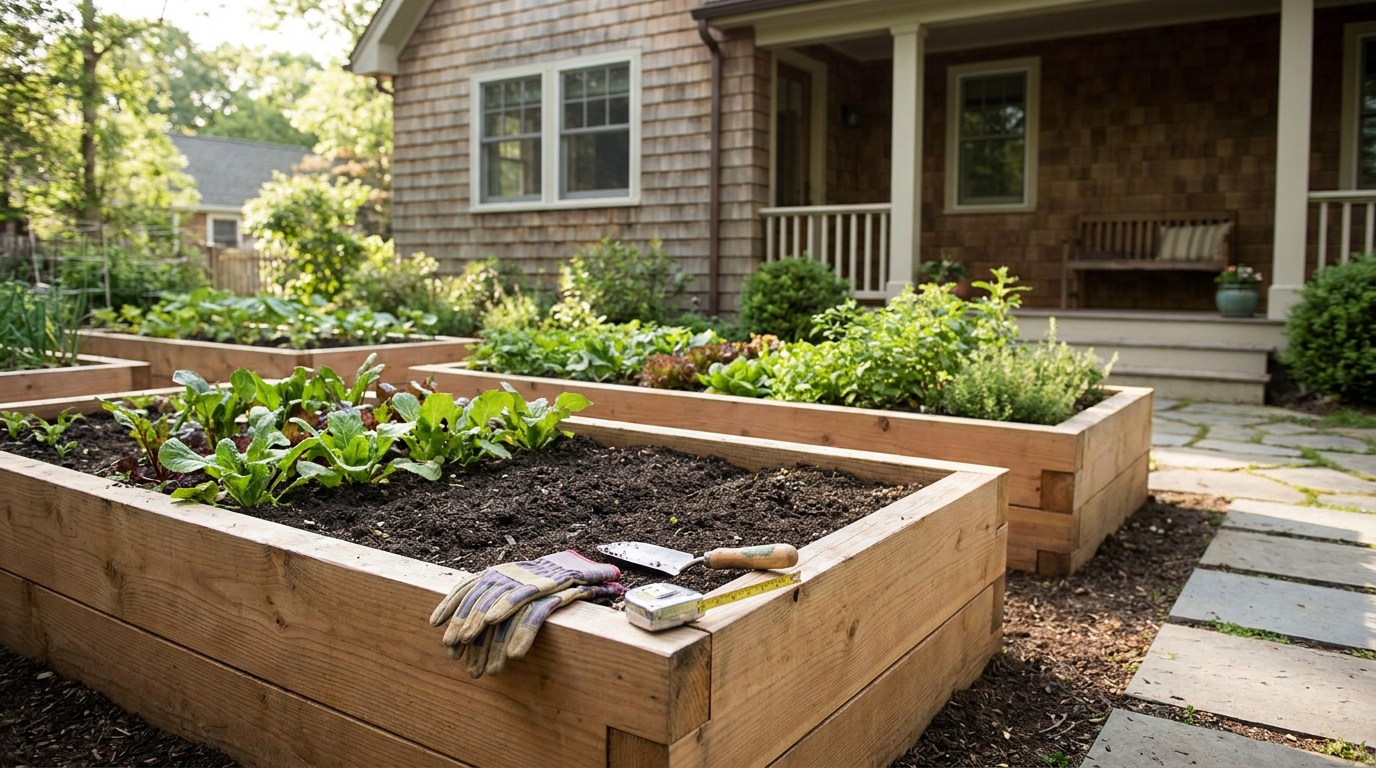
A raised bed needs a minimum of 6 inches (15 cm) of soil depth for shallow-rooted crops like lettuce and radishes, while deep-rooted plants like tomatoes and carrots require 12 to 18 inches (30 to 45 cm) of uncompacted soil. If you are building over hardpan, heavily compacted clay, or concrete, the wooden or metal frame must provide that full required depth itself. However, if your raised bed sits on top of workable native yard soil, you only need an 8-inch (20 cm) frame, because plant roots will naturally grow down into the earth below. The ideal depth is a strict calculation of what you intend to grow, what existing surface you are building on, and how much you are willing to spend on lumber and bulk soil delivery in 2026. Building deeper than necessary wastes money, while building too shallow stunts your harvest.
- Build 6-inch frames for greens and 12- to 18-inch frames for fruiting crops if building over poor soil.
- Calculate your soil needs in cubic yards; a standard 4 by 8 foot bed at 12 inches deep requires 1.18 cubic yards of soil.
- Fracture the native soil beneath a shallow bed to double your effective rooting depth without paying for extra imported topsoil.
- Expect to pay between $45 and $75 per cubic yard for bulk raised bed mix in 2026, plus delivery fees.
What is the absolute minimum depth for a raised garden bed?
Six inches (15 cm) is the hard floor for a functional raised bed. At this depth, you have enough volume to support short-season, shallow-rooted crops like lettuce, spinach, arugula, radishes, and most culinary herbs. A 6-inch bed is incredibly cheap to build using standard 2-by-6 lumber and requires very little soil to fill.
However, a bed this shallow comes with strict water management demands. Because the soil volume is low, it dries out rapidly under the midday sun. In peak summer heat, a 6-inch bed may require daily watering to prevent greens from bolting or wilting. If the bed is placed directly over a concrete patio or a solid landscape fabric weed barrier, that 6 inches is all the roots will ever get. Anything beyond basic greens will quickly become root-bound and nutrient-starved.
How deep do roots actually grow for common vegetables?
Plants do not care where the wooden sides of your bed end; they only care about how deep the loose, well-draining soil extends. To get maximum yields from fruiting crops and root vegetables, you need to provide a deeper uncompacted zone.
Medium-rooting crops like peppers, eggplants, bush beans, cucumbers, and broccoli need a functional soil depth of 12 to 18 inches (30 to 45 cm). Deep-rooting crops, including indeterminate tomatoes, pumpkins, sweet potatoes, and long carrots like Imperators, will easily send taproots 24 to 36 inches (60 to 90 cm) down if the soil allows it. If you restrict a tomato plant to 8 inches of total soil depth, it will survive, but it will require aggressive fertilizing and constant watering to yield a worthwhile harvest.
Does the surface under the raised bed change how deep it needs to be?
This is the single most important factor in sizing a raised bed. If you are placing a cedar frame over an asphalt driveway, the frame itself must be 18 inches (45 cm) tall to grow peppers. But if you are placing that same frame in a grassy backyard, the rules change entirely.
This is where a professional landscaper makes a different judgement call than a beginner. A beginner who wants 16 inches (40 cm) of root depth will typically buy 16-inch-wide lumber and pay to fill the entire volume with expensive imported soil. A pro will build an 8-inch (20 cm) frame, remove the sod beneath it, and use a broadfork or a digging fork to heavily loosen and fracture the native yard soil down another 8 to 10 inches (20 to 25 cm). By blending a few inches of compost into that native subsoil before filling the wooden frame, the pro achieves a 16-inch effective rooting depth while cutting lumber and soil costs in half.
How do you calculate soil volume and the 2026 cost to fill a bed?
Buying bagged soil from a big-box store to fill anything larger than a single 4-by-4-foot box is a staggering waste of money. Raised beds consume massive amounts of material, and you need to calculate your volume in cubic yards to buy bulk topsoil or compost blends from a local landscape yard.
To find your cubic yardage, multiply the length, width, and depth of your bed in feet, then divide by 27. For example, a standard 4-by-8-foot bed that is 1 foot deep is 32 cubic feet. Divided by 27, that equals 1.18 cubic yards. In 2026, a high-quality 50/50 blend of screened topsoil and compost runs between $45 and $75 per cubic yard in the United States, plus a flat delivery fee usually ranging from $50 to $100. Filling three 4-by-8-foot beds at a 12-inch depth will require 3.5 cubic yards and cost roughly $200 to $350 total in bulk. Buying that same 95 cubic feet of soil in 1.5-cubic-foot plastic bags would cost well over $500.
What is the most common mistake when filling deep raised beds?
When gardeners build 24-inch or 32-inch (60 to 80 cm) tall beds for better ergonomics, they quickly realize how expensive it is to fill them. A common cost-saving failure mode is poorly executed Hügelkultur: throwing large, unrotted logs, loose branches, and cardboard into the bottom half of the bed, then covering it with 10 inches (25 cm) of soil.
The failure happens mid-season. As the loose wood inevitably rots and settles, massive sinkholes form. The soil level can drop 6 to 8 inches (15 to 20 cm) in a few weeks, physically tearing the roots off mature tomato plants and exposing crowns to rot. To avoid this, if you use organic filler in the bottom of a deep bed, you must use tightly packed, partially rotted wood, fill every single void with sand or cheap topsoil, and tamp it down aggressively before adding your top 12 inches (30 cm) of premium growing mix.
Is a taller raised bed better for drainage and back health?
Beds built to 24 or 30 inches (60 to 75 cm) tall are excellent for gardeners with mobility issues or bad backs. They also conform better to ADA guidelines for wheelchair accessibility, which recommend a maximum reach distance of 24 inches (60 cm) across the soil.
However, tall beds behave differently in extreme weather. In USDA Zones 4 through 6, the massive exposed surface area of a 30-inch tall metal bed means the soil will freeze much harder in winter, which can kill perennial herbs like rosemary that might have survived in ground-level soil. On the flip side, that same bed will thaw and warm up 10 degrees Fahrenheit (about 5.5 degrees Celsius) faster in the spring, allowing you to plant warm-weather crops weeks earlier than your neighbors.
| Crop Type | Examples | Depth Over Concrete | Depth Over Open Soil |
|---|---|---|---|
| Shallow-Rooted | Lettuce, Spinach, Radish, Basil | 6 to 8 inches | 6 inches |
| Medium-Rooted | Peppers, Bush Beans, Broccoli | 12 to 18 inches | 8 to 10 inches |
| Deep-Rooted | Tomatoes, Carrots, Squash | 18 to 24 inches | 10 to 12 inches |
Frequently asked questions
Do I need to put rocks or gravel in the bottom of a raised bed for drainage?
No. Putting gravel under potting soil creates a perched water table. Water will not move from the fine-textured soil into the coarse gravel until the soil is 100 percent saturated, which actually keeps plant roots soggy and promotes root rot. Let the soil sit directly on the earth.
Can I just use pure compost to fill a raised bed?
Pure compost shrinks drastically as it breaks down, meaning your bed will be half-empty by autumn. It can also hold too much moisture and occasionally burn young seedlings with excess nitrogen. Always blend compost with structural mineral soil like screened topsoil or peat moss.
How much does soil settle in a new raised bed?
Even well-tamped soil will settle by 10 to 15 percent in its first year due to rain and organic matter decomposition. A bed filled to 12 inches (30 cm) in May will likely drop to 10 inches (25 cm) by October. Plan to top off your beds with 1 to 2 inches of fresh compost every spring.
Keep reading
- Starting Your First Vegetable Garden Without Wasting a SeasonMost first gardens fail for reasons that have nothing to do with a green thumb. Here are the five that matter.
- Building Soil That Actually Grows ThingsFeeding plants is a short-term fix. Feeding the soil is what makes a garden easy.
- Reviving a Tired Lawn: A Season-Long PlanA thin lawn is a symptom. Treating the symptom with more seed is why it keeps coming back.