Extending the Growing Season: Row Covers, Cold Frames, and Low Tunnels Compared
By Jim Vernon · 5 min read · Last updated
A few dollars of row cover fabric can add three to six weeks onto each end of a growing season — often more reliably than moving the whole garden indoors.
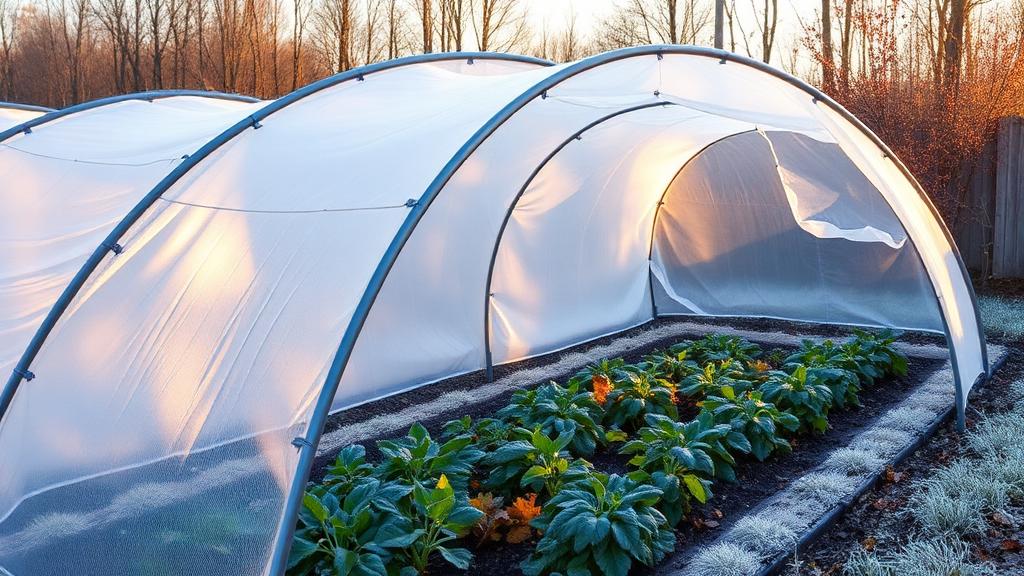
Season extension tools trade cost and complexity for degrees of frost protection and weeks of extra growing time. Matching the tool to the actual need — a light frost buffer versus a genuine mini-greenhouse — avoids overspending on protection a crop does not need.
The main options compared
| Method | Frost protection | Typical cost | Best for |
|---|---|---|---|
| Floating row cover (lightweight) | 2-4°F | Low | Frost-tender crops on a marginal night, pest exclusion |
| Floating row cover (heavyweight) | 6-8°F | Low-Medium | Hardy greens through light freezes |
| Low tunnel (hoops + plastic) | 10-20°F depending on layers | Medium | Extending harvest weeks into cold season |
| Cold frame | 10-20°F, more with insulation | Medium | Hardening seedlings, overwintering hardy greens |
| Unheated high tunnel / hoop house | Similar to cold frame but larger scale | High | Serious season extension across a whole bed or more |
Row cover: the simplest and cheapest option
Floating row cover is a lightweight spun fabric laid directly over crops or supported on hoops. It lets light and water through while trapping a few degrees of warmth and, as a side benefit, excludes many flying pests. It is the standard tool for protecting a marginal frost night or for pushing cool-season crops a few weeks earlier or later.
Cold frames suit seedlings and low-growing crops
A cold frame is essentially a bottomless box with a transparent lid set directly on the ground, capturing solar heat during the day and slowing heat loss at night. It is ideal for hardening off seedlings before transplant and for overwintering hardy greens like spinach or mâche, but the lid needs venting on sunny days even in winter, since trapped heat can build quickly and overheat or scorch plants.
Low tunnels for row-scale extension
A low tunnel — wire or plastic hoops covered in row cover or greenhouse plastic — extends the growing season for a full row rather than a single bed's worth of seedlings. Doubling up a layer of row cover under plastic sheeting on a low tunnel adds meaningfully more frost protection than either layer alone, which matters for pushing hardy crops through real winter cold rather than just a light frost.
Which crops benefit most
- Cold-hardy greens (spinach, kale, mâche, arugula) extend well into and sometimes through winter under a low tunnel or cold frame.
- Root crops like carrots can be left in the ground under heavy mulch and a cover, harvested through much of winter in many climates.
- Frost-tender crops like tomatoes gain only a modest window at each end of the season — enough to save a crop from an unexpected early frost, not to grow through real winter cold.
Building a simple low tunnel
- Bend 9-gauge wire or half-inch PVC into hoops spaced roughly 3-4 feet apart along the bed.
- Drape row cover directly over the hoops for a light frost buffer, or greenhouse-grade plastic for a stronger, warmer tunnel.
- Anchor the edges with soil, sandbags, or landscape staples so wind cannot lift the cover off overnight.
- Vent by opening the ends or rolling up one side on sunny days above roughly 40-45°F to prevent overheating.
Cost and payback compared
| Method | Approx. cost for a 4x8 bed | Typical season gain |
|---|---|---|
| Lightweight row cover | $10-20 | 1-3 weeks each end |
| Low tunnel (hoops + cover) | $30-70 | 3-6 weeks each end |
| Cold frame | $50-150 (built or kit) | 4-8 weeks, plus overwintering some crops |
Common mistakes
- Sealing a low tunnel or cold frame completely on a sunny winter day and cooking the crop inside.
- Choosing a heavy cover for a marginal frost when a lightweight one would have been enough and let more light through.
- Forgetting that covered beds still need regular watering, since they dry out faster than exposed soil.
- Waiting until the first hard freeze to set up protection instead of having it ready before the first marginal frost night.
Frost date math for planning a cover season
In a zone 5 garden with a last spring frost around May 10, a low tunnel with two layers of row cover reliably buffers 10-15°F, which supports direct-sowing hardy greens like spinach and kale as early as mid-March, six to eight weeks ahead of the unprotected date, since soil under the tunnel also warms faster during the day. In a zone 7 garden with a last frost near April 1, the same setup can push cool-season transplants out by late February. The math runs the other direction in fall: a first frost date of October 15 becomes a soft target rather than a hard stop, since a cold frame or low tunnel commonly extends harvest of hardy greens 4-6 weeks past that date, and sometimes through an entire mild winter in zone 7 and warmer. USDA zone alone doesn't capture this — a zone 6 garden at high elevation with strong radiative cooling on clear nights loses heat faster under a single layer of row cover than a zone 6 garden in a humid, cloudier region, so treat published frost-protection figures as a starting estimate to confirm with a min-max thermometer inside the cover during the first cold snap.
Do row covers need to be removed during the day?
Lightweight row cover left on frost-tender crops is usually fine to leave in place continuously; heavier covers or low tunnels on sunny days may need venting to avoid overheating.
Can season extension replace a heated greenhouse?
No — these methods buffer a number of degrees against frost and add weeks to a season, but they do not create a genuinely warm growing environment through deep winter the way a heated structure does.
Is it worth building a cold frame for just a few seedling trays?
Yes, if hardening off seedlings is a recurring spring task — a simple cold frame pays for itself in convenience within one or two seasons compared with manually carrying trays in and out.
How do I know which frost protection level I actually need?
Check the forecast low against the crop's frost tolerance: a couple of degrees below freezing usually only needs lightweight row cover, while a hard freeze into the low 20s°F calls for a low tunnel or cold frame with additional insulation.
Can I leave a low tunnel up all winter?
For hardy greens in mild-to-moderate climates, yes, with periodic venting on sunny days; in regions with sustained deep freezes, additional insulation like a second layer or straw bales around the edges is usually needed to keep crops alive.
Run the numbers for your own project
- Grow Light CalculatorHow high and how long should my grow light run?
- Seed Starting Schedule CalculatorWhen should I start my seeds indoors?
Keep reading
- Starting Your First Vegetable Garden Without Wasting a SeasonMost first gardens fail for reasons that have nothing to do with a green thumb. Here are the five that matter.
- Building Soil That Actually Grows ThingsFeeding plants is a short-term fix. Feeding the soil is what makes a garden easy.
- Reviving a Tired Lawn: A Season-Long PlanA thin lawn is a symptom. Treating the symptom with more seed is why it keeps coming back.