How Does Crop Rotation Build Soil Fertility Over Time?
By Jim Vernon · 5 min read · Last updated
Planting tomatoes in the same spot every year quietly builds up both nutrient depletion and disease pressure, even if nothing looks wrong for the first few seasons.
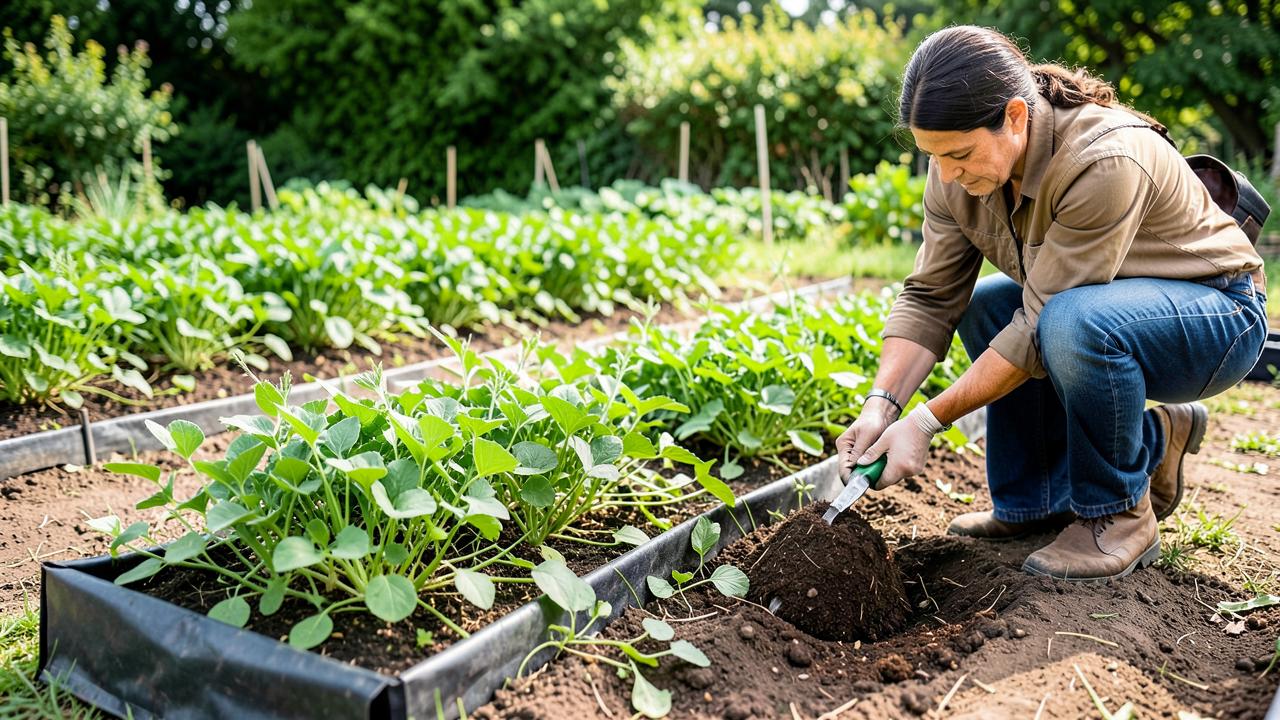
Crop rotation builds soil fertility by moving plant families to a different bed each year on a 3-4 year cycle, so no single nutrient gets stripped repeatedly from the same soil and no crop-specific pest or pathogen gets a chance to build up in one spot. Heavy feeders like tomatoes and corn are followed by soil-building legumes, then lighter feeders, spreading nutrient demand across the rotation instead of concentrating it.
What's a workable 4-year rotation for a home garden?
| Year | Group | Examples | Role |
|---|---|---|---|
| 1 | Heavy feeders (fruiting) | Tomatoes, peppers, squash, corn | Draw down nitrogen and other nutrients built up in years 3-4 |
| 2 | Heavy feeders (leafy/root) | Brassicas (broccoli, cabbage), beets, carrots | Continue drawing nutrients, different pest/disease profile than year 1 |
| 3 | Light feeders / legumes | Beans, peas | Fix atmospheric nitrogen into soil via root nodules, replenishing what fruiting crops used |
| 4 | Soil builders | Cover crop (clover, rye) or alliums (onion, garlic) | Rebuild organic matter and structure before the cycle repeats |
Why does rotation matter for disease, not just nutrients?
Many soil-borne diseases and pests are family-specific and persist in soil for years after the host crop is gone — early blight and Verticillium wilt on tomatoes, clubroot on brassicas, and white rot on alliums all build up in soil where their host family returns repeatedly. Rotating that family out for 3-4 years starves the pathogen of a host, letting populations decline before the susceptible crop returns. A single missed rotation cycle rarely causes visible damage, but repeated same-spot planting compounds the problem year over year.
How do legumes actually add nitrogen back to soil?
Beans, peas, and other legumes host Rhizobium bacteria in root nodules that convert atmospheric nitrogen into a plant-available form, some of which remains in the soil after the plant is cut down (not necessarily pulled, since most of the fixed nitrogen stays in the roots and lower stem). Cutting spent bean or pea plants at soil level and leaving roots in place, rather than pulling the whole plant, preserves more of this nitrogen benefit for the next crop planted there.
Can a small garden with limited beds actually rotate crops?
- Divide even a modest space into 3-4 zones and rotate crop families through them yearly, accepting that zones will be smaller than ideal for each family.
- Use containers for one or two crop families as a flexible fifth 'zone' that can host whichever family is currently displaced from the rotation.
- Prioritize rotating the crops most prone to soil-borne disease first — tomatoes and brassicas — even if a less disease-prone crop like lettuce ends up repeating a spot more often.
- Where space truly doesn't allow rotation, lean more heavily on compost additions and resistant varieties to offset the fertility and disease risks of repeated planting.
How does crop rotation interact with cover cropping and compost?
Rotation, cover cropping, and compost addition work together rather than substituting for each other — rotation manages what's demanded from and left behind by living crops, while compost adds organic matter and micronutrients regardless of rotation stage, and a cover crop (planted in an off-season slot) adds biomass and, if it's a legume like clover, additional fixed nitrogen. A bed that's rotated well but never gets compost still depletes over time; the two practices address different parts of soil health.
How do you actually track a rotation plan across years?
A simple garden map with beds numbered and a yearly log of which family grew where is enough for most home gardens — a spreadsheet, a paper notebook, or even photos of a hand-drawn sketch taken each spring all work, as long as it's checked before planting rather than relied on from memory. Gardeners with just 2-3 beds sometimes skip formal tracking and simply remember, but this breaks down within a few years as new crops and varieties are added, which is when unintentional repeats of the same family in the same spot start happening.
Does rotation reduce the need for fertilizer?
It reduces but doesn't eliminate the need. A well-planned rotation that includes a legume year and a cover crop or compost-heavy soil-building year measurably reduces how much synthetic or purchased organic fertilizer a heavy feeder needs the following year, sometimes by a third or more depending on baseline soil fertility. It doesn't replace fertilizer entirely, since vegetables generally remove more nutrients from soil than a rotation alone replaces, especially phosphorus and potassium, which legumes don't meaningfully add back the way they do nitrogen.
What's a common rotation mistake even experienced gardeners make?
- Rotating the crop but not its companion cover — planting brassicas where a brassica cover crop like mustard grew the previous fall still counts as repeating the family.
- Treating potatoes as separate from tomatoes and peppers in a rotation plan, when all three are nightshades sharing the same soil-borne disease risks.
- Forgetting perennial herbs and asparagus, which occupy permanent beds outside the rotation entirely and should be mapped separately rather than folded into the annual rotation count.
- Rotating on paper but not in practice — skipping a planned rotation because a bed 'looked fine last year' is how disease pressure quietly builds over several seasons.
How long does a pathogen actually persist in soil without its host?
It varies by pathogen — some fungal spores like clubroot can persist 7+ years, while many others decline substantially within 3-4 years without a host. A 3-4 year rotation is a practical minimum, not a guarantee against long-lived pathogens.
Does rotation matter for container gardening?
Less so, since containers use fresh or refreshed soil each season rather than the same ground indefinitely. Rotation matters most in in-ground beds where soil and its organisms persist year to year.
What if I only have room for one bed?
Rotate what you can by splitting the bed into sections, and lean on compost, resistant varieties, and removing diseased plant debris promptly to reduce the risks that rotation would otherwise manage.
Run the numbers for your own project
- Soil Amendment and pH CalculatorHow much lime or sulfur do I need to fix my soil pH?
- Composting CalculatorWhat ratio of greens to browns does my compost need?
- Companion Planting ChartWhat should I plant next to this crop?
Keep reading
- Starting Your First Vegetable Garden Without Wasting a SeasonMost first gardens fail for reasons that have nothing to do with a green thumb. Here are the five that matter.
- Building Soil That Actually Grows ThingsFeeding plants is a short-term fix. Feeding the soil is what makes a garden easy.
- Reviving a Tired Lawn: A Season-Long PlanA thin lawn is a symptom. Treating the symptom with more seed is why it keeps coming back.