Yard Drainage and French Drains: Fixing Standing Water
By Jim Vernon · 5 min read · Last updated
A French drain installed in the wrong location just moves the puddle a few feet — diagnosing where water actually comes from matters more than the trench itself.
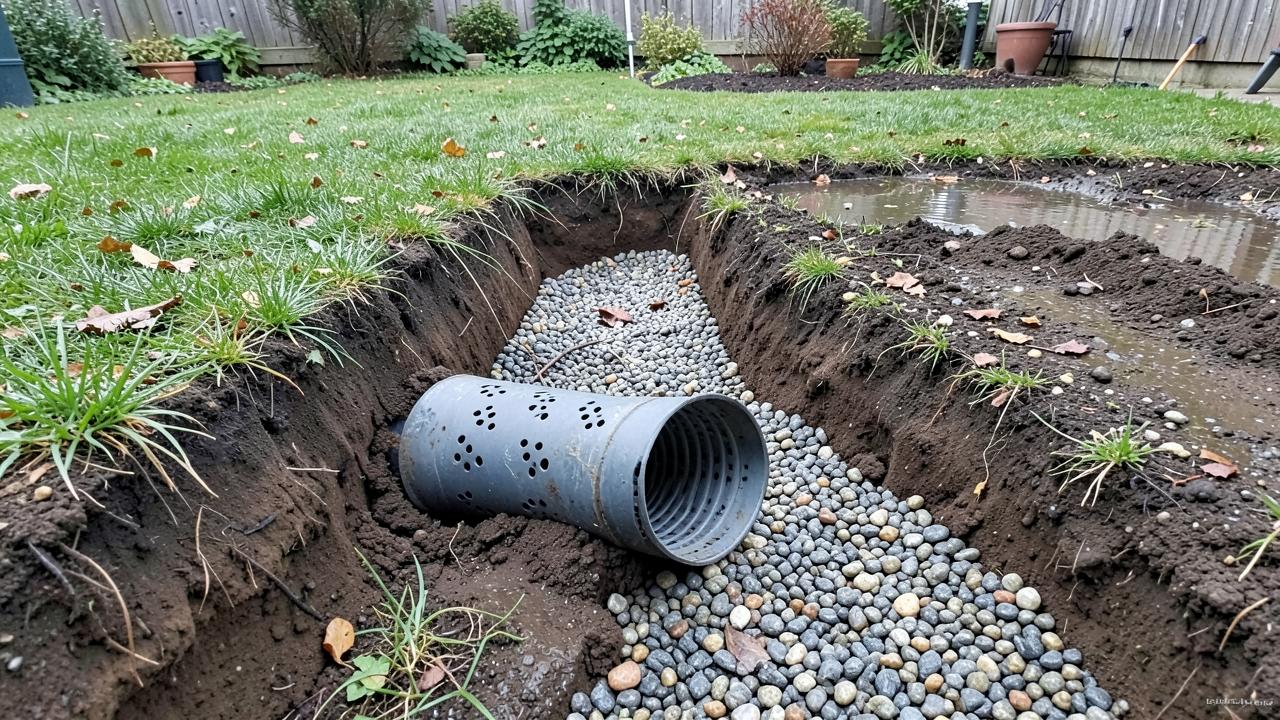
Standing water in a yard usually comes from one of three sources — surface runoff pooling in a low spot, a high water table saturating soil from below, or roof/downspout water dumping faster than soil can absorb — and each needs a different fix. A French drain (a gravel-filled trench with a perforated pipe) solves subsurface saturation and intercepting groundwater well, but it does little for pure surface ponding, which usually needs regrading or a surface (catch basin) drain instead.
How do you diagnose which type of drainage problem you have?
- Watch the yard during and right after a heavy rain — water sheeting across the surface toward a low point points to a grading problem; water seeping up through the lawn slowly over the following day points to a high water table or poor soil percolation.
- Dig a test hole about 12 inches deep and fill it with water; if it doesn't drain within 12-24 hours, the soil itself has poor percolation and any drain needs to carry water to daylight or a dry well rather than relying on the surrounding soil to absorb it.
- Check whether downspouts discharge near the wet area — a disconnected or short downspout extension is one of the most common and cheapest-to-fix causes of a chronically soggy spot near the foundation.
- Note whether the wet area is downhill from a neighboring property or impervious surface like a driveway, which may be redirecting water onto your lot.
How is a French drain sized and built?
| Component | Typical spec | Why it matters |
|---|---|---|
| Trench depth | 18-24 in. (deeper near foundations, 8-12 in. minimum for simple yard drains) | Needs to sit below the saturated zone to intercept water before it surfaces |
| Trench slope | 1% minimum (1/8 in. per foot), ideally 2% | Gravity is the only thing moving water through the pipe; flat runs silt up and fail |
| Pipe | 4-in. perforated PVC or corrugated pipe, holes down or wrapped in fabric sock | Perforations let groundwater enter along the whole run |
| Gravel backfill | 3/4-in. clean drain rock, wrapped in landscape fabric | Keeps soil fines from clogging the pipe over time |
| Outlet | Daylight to lower grade, storm drain, or dry well | A French drain with no true outlet just becomes an underground reservoir |
What is a dry well and when do you need one?
A dry well is a gravel-filled pit (or a perforated plastic chamber) that collects water and lets it infiltrate slowly into surrounding soil, used when there's no lower point on the property to daylight a drain to. Sizing depends on soil percolation rate and the catchment area feeding it — a typical residential dry well handling one downspout runs 3-4 feet in diameter by 3-4 feet deep, filled with washed stone, but poor-draining clay soil may need it 2-3 times larger to handle the same volume.
When does regrading solve the problem better than a drain?
If the problem is purely surface water pooling in a shallow low spot with no groundwater involvement, adding 1-2 inches of soil sloped at a minimum 2% grade (about 1/4 inch per foot) away from the area is often cheaper and more permanent than a subsurface drain, since it eliminates the low spot rather than draining it. Regrading against a house foundation should always slope away for at least the first 6-10 feet, per most building codes, to prevent water intrusion at the foundation.
What does a French drain project typically cost?
- DIY materials for a 50-foot French drain: roughly $300-600 for pipe, gravel, and fabric, plus rental of a trencher (~$100-150/day) if not hand-digging.
- Professional installation of the same run: $1,500-4,000 depending on depth, soil conditions, and access.
- A dry well addition: $1,000-3,000 depending on size and excavation difficulty.
- Simple regrading of a problem area under 500 square feet: $500-1,500 for material and equipment, often less than a comparable drain installation.
How does a catch basin or channel drain differ from a French drain?
A catch basin (a grated box set into the grade at a low point) collects surface water directly at the point it pools and pipes it away below ground, which makes it the right tool for pure surface ponding rather than subsurface saturation. A channel or trench drain, a long narrow grated trough, serves a similar purpose along a linear path, such as at the base of a driveway apron or across a walkway where sheet-flow crosses it. Both differ from a French drain in that they intercept water at the surface rather than pulling it from saturated soil below grade, and both need to tie into the same kind of gravity-fed outlet — daylight, storm system, or dry well — or they simply relocate the ponding problem a few feet.
What plants or landscaping choices help with chronically wet areas?
A rain garden — a shallow, planted depression that collects and slowly infiltrates runoff — complements drainage work in spots that stay damp even after grading and drains are improved, typically planted with species tolerant of both standing water and dry spells, such as switchgrass or red-twig dogwood. Turf performs poorly where soil stays saturated more than a day or two, so converting that spot to a planted bed often solves the aesthetic problem even when drainage can't be fully corrected.
Will a French drain dry out a swampy lawn permanently?
It will lower the water table locally around the drain, which helps significantly, but a lawn sitting on genuinely poor-draining clay may still stay soggier than a well-drained lawn even after a drain is installed. In persistent cases, combining a French drain with soil amendment or a rain garden planting adapted to wet conditions gives a more complete result.
How deep does a French drain need to be near a foundation?
Foundation drains (sometimes called curtain drains) typically run 12-24 inches deep and are placed several feet out from the foundation, intercepting water before it reaches the wall. Depth should match or exceed the depth of the saturated soil layer causing the problem, which a test hole helps determine.
Can I install a French drain myself, or does it need a professional?
Many homeowners successfully install simple yard French drains themselves, since the work is straightforward trenching and no rigid slope tolerances beyond basic gravity flow. Drains near foundations, under hardscape, or requiring connection to municipal storm systems are worth hiring out due to code requirements and the cost of getting it wrong.
Run the numbers for your own project
- Gravel and Path CalculatorHow much gravel do I need for my path or driveway?
- Project Cost EstimatorWhat will this project cost me?
- Garden Fence and Trellis CalculatorHow many posts and rails does my fence or trellis need?
Keep reading
- How Much Paint Do You Actually Need for a Room?The tin says 400 square feet. Your wall says otherwise. Here is the arithmetic that actually holds up.
- Starting Your First Vegetable Garden Without Wasting a SeasonMost first gardens fail for reasons that have nothing to do with a green thumb. Here are the five that matter.
- DIY or Hire a Pro? A Decision Framework That Is Not About MoneyThe labour saving is real. So is the cost of a job done twice — and of tools you use once.