Whole-House Fans and Ventilation: Cooling Without the AC
By Jim Vernon · 5 min read · Last updated
A whole-house fan can pull cool evening air through your entire house in minutes for a fraction of AC's electricity cost.
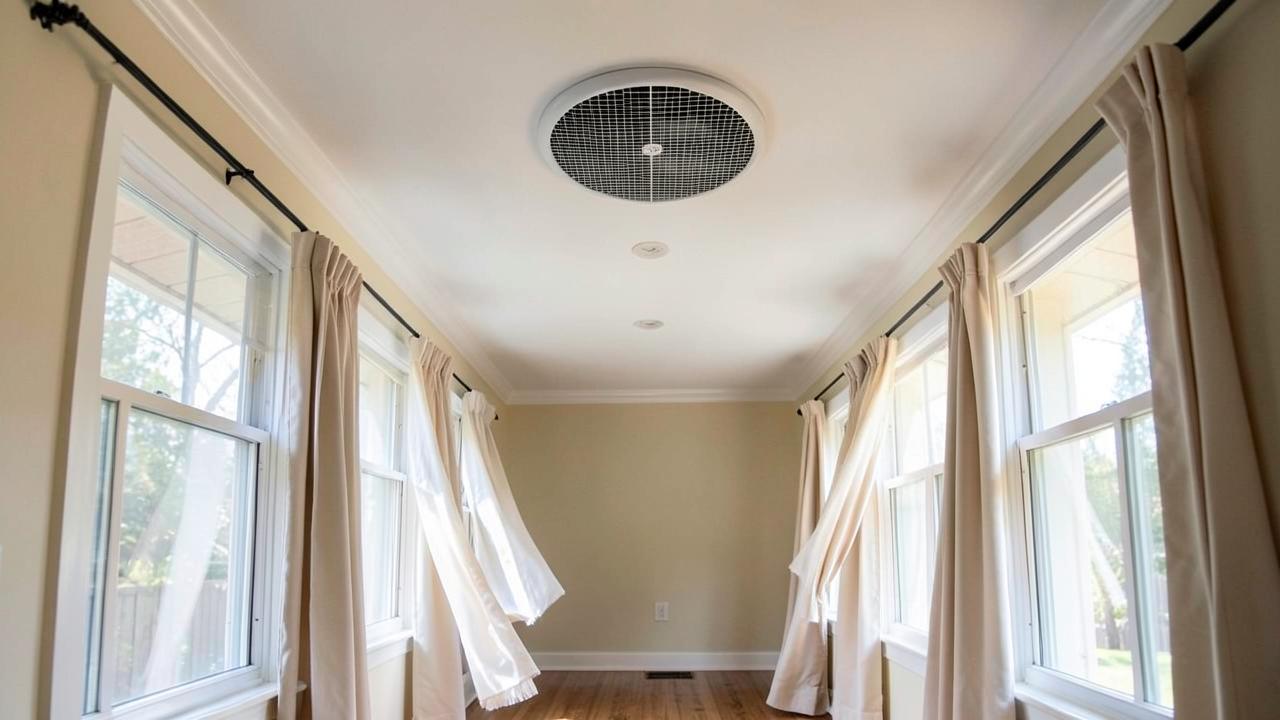
A whole-house fan, mounted in the attic floor or a hallway ceiling, pulls outside air through open windows and pushes stale hot air out through attic vents, cooling a house in minutes on evenings when outdoor temperature drops below indoor temperature — typically using 200-700 watts versus 2,000-5,000 watts for central AC. It's a different tool from bathroom/kitchen exhaust fans (which remove localized moisture and odors) and balanced mechanical ventilation systems like ERVs/HRVs (which provide continuous fresh air exchange in a tightly sealed house), and most homes benefit from having more than one type.
How does a whole-house fan actually work, and when does it help?
The fan creates negative pressure inside the house, drawing outside air in through open windows and expelling hot attic-adjacent air through roof or gable vents, typically exchanging the entire volume of air in a house in 2-3 minutes at full speed. It works best in climates with a meaningful day-night temperature swing — think Western and mountain states where summer days hit 95°F but nights drop to 65-70°F — letting you cool the house naturally each evening and delay or skip AC use the next morning.
| Ventilation type | Job | Typical cost installed |
|---|---|---|
| Whole-house fan | Rapid whole-home air exchange using outdoor air, evenings/nights | $900-2,500 |
| Bath/kitchen exhaust fan | Spot removal of moisture and odors at the source | $150-500 per fan |
| ERV/HRV (energy/heat recovery ventilator) | Continuous fresh air exchange in a tightly sealed house, tempering incoming air | $2,500-5,500 |
| Attic ventilation fan (gable or ridge) | Reduces attic temperature, protects roofing and insulation, not living space air | $300-800 |
How do you size a whole-house fan for your home?
Size by calculating your home's square footage times ceiling height to get volume in cubic feet, then choose a fan rated to move that volume in 2-3 minutes — for a typical 2,000 sq ft home with 8-foot ceilings (16,000 cubic feet), that's roughly 5,300-8,000 CFM. Undersized fans exist and are cheaper but take much longer to exchange air and provide less noticeable cooling; oversizing wastes money on a bigger fan and motor than the house needs.
- Confirm your attic has enough net free vent area to exhaust the fan's airflow without excessive back-pressure — as a rule of thumb, roughly 1 sq ft of net free vent area per 750 CFM of fan capacity.
- Open windows on the side of the house away from prevailing evening breeze first, then a few on the opposite side, to create effective cross-flow.
- Run the fan starting when outdoor temperature drops below indoor temperature, typically early evening through early morning in most climates.
- Turn it off and close the house up before outdoor temperature rises back above indoor temperature to trap the night's cool air inside.
Do you need continuous mechanical ventilation too?
In a newer or recently air-sealed home (roughly under 3 air changes per hour at 50 pascals on a blower door test), natural infiltration is no longer enough to provide adequate fresh air, and a continuous mechanical ventilation system becomes important for indoor air quality, not just optional comfort. An ERV or HRV brings in fresh outdoor air and exhausts stale indoor air continuously at a low, quiet rate (often 50-150 CFM depending on house size) while recovering 60-80% of the outgoing air's heat or coolness, so it doesn't undo your heating or cooling investment.
What mistakes reduce whole-house fan effectiveness?
- Running it during the day when outdoor air is hotter than indoor air, which just pulls in more heat.
- Leaving it running with too few windows open, forcing air through gaps and increasing noise without improving airflow.
- Skipping an insulated, motorized damper on the fan housing, which lets attic heat pour back into the house through the fan opening all winter when it's not in use.
- Undersizing attic vent area, which causes the fan to work harder and louder than necessary while under-delivering its rated CFM.
How much energy and money does a whole-house fan actually save?
Running a whole-house fan for 6-8 hours on a mild evening uses roughly 1.5-5 kWh depending on fan size and speed, costing perhaps $0.20-0.75 at typical electricity rates, versus running central AC for the same hours at 2,000-5,000 watts, which could cost $2-8 for the same period. Over a cooling season with 60-90 usable nights (climates with real day-night swings), that difference adds up to meaningful seasonal savings, often cited in the $50-200 range depending on local rates and how many nights qualify. The bigger savings frequently come indirectly — by pre-cooling the house overnight, you delay AC startup the next day and often skip it entirely on days that would otherwise require a few hours of afternoon cooling.
How do you choose between fan types and installation locations?
- Traditional attic-mounted fans are the cheapest and simplest but tend to be the loudest option without an insulated housing.
- Ducted, remote-mounted whole-house fans move the noisy fan itself away from the ceiling grille, running through insulated ductwork to a quieter exterior exhaust point, for a higher price but much lower indoor noise.
- Two-speed or variable-speed models let you run a gentler airflow on cooler nights and full power during a hot spell, extending comfortable use across more of the season.
- Placement in a central hallway ceiling generally distributes airflow more evenly through a home's bedrooms than a fan mounted at one end of the house.
Can a whole-house fan replace air conditioning entirely?
In climates with reliably cool nights, it can significantly reduce AC use and sometimes eliminate the need for it on shoulder-season days, but it can't replace AC during sustained heat waves where nighttime lows stay above about 75°F, since there's no cool air left to pull in.
Is a whole-house fan noisy?
Older direct-drive models can be quite loud (60-70 dB at the fan), but modern insulated, belt-driven, or duct-mounted whole-house fans run much quieter, often comparable to a bathroom exhaust fan, and are worth the modest price premium for that reason.
Do I need to open specific windows, or does it matter?
Opening windows on the shaded or downwind side of the house draws in cooler air more effectively than windows in direct sun or facing a hot patio. Rotating which windows you open based on the evening's wind direction improves performance.
Run the numbers for your own project
- Home Air Quality and Ventilation CalculatorDoes my home get enough fresh air ventilation?
- Ceiling Fan Size CalculatorWhat size ceiling fan fits my room?
- Energy Savings CalculatorWill this upgrade pay for itself?
Keep reading
- How Much Paint Do You Actually Need for a Room?The tin says 400 square feet. Your wall says otherwise. Here is the arithmetic that actually holds up.
- DIY or Hire a Pro? A Decision Framework That Is Not About MoneyThe labour saving is real. So is the cost of a job done twice — and of tools you use once.
- Storage for Small Rooms That Does Not Make Them SmallerSmall rooms do not need more storage. They need storage that stops interrupting the eye.