When Should You Repot a Houseplant, and What Mix Should You Use?
By Jim Vernon · 5 min read · Last updated
Roots poking through drainage holes and water running straight through the pot both mean the same thing: it's time.
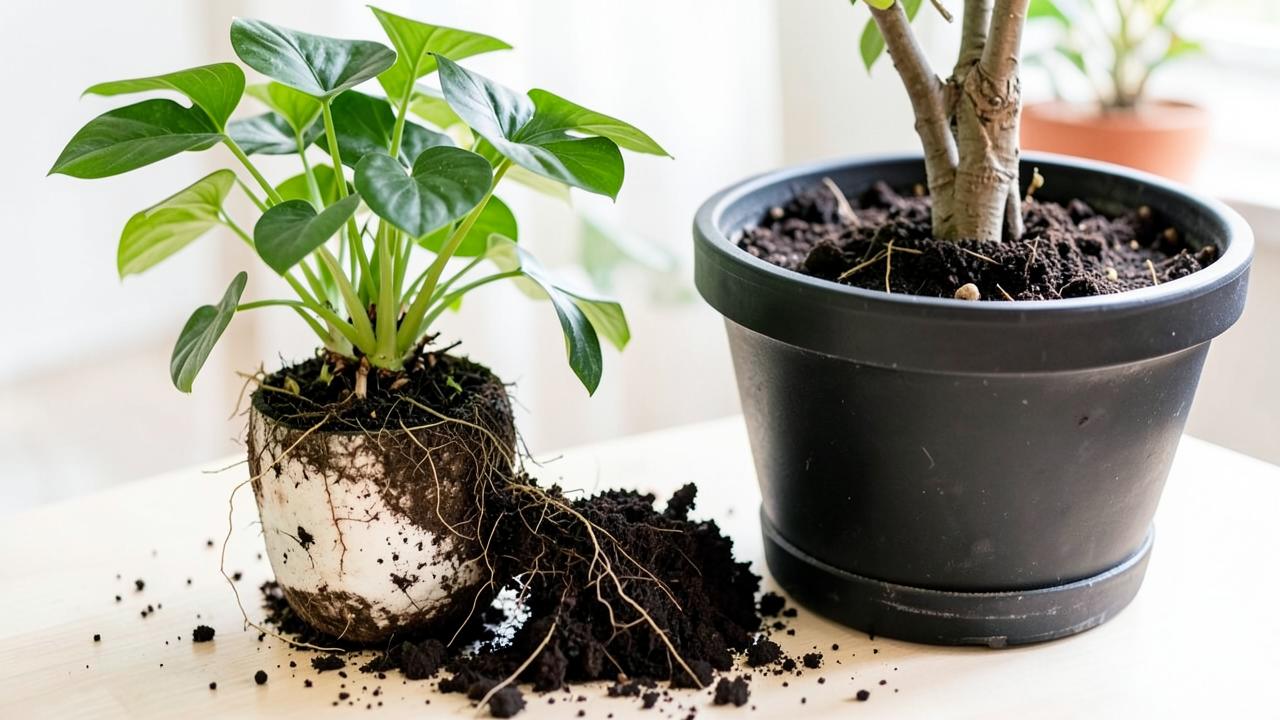
Repot when you see roots circling the inside of the pot, growing out of the drainage holes, or when water runs straight through without the soil visibly holding it. For most houseplants that works out to once every 12 to 24 months, ideally in spring or early summer when the plant is actively growing and can recover quickly from the disturbance.
What are the real signs a plant needs repotting?
- Roots visible at the drainage holes or circling the surface of the soil.
- Water runs through in seconds rather than being absorbed, meaning there's more root than soil.
- Growth has stalled for a full season despite adequate light and fertilizer.
- The pot tips over easily because roots have displaced the soil's weight.
- Soil pulls away from the pot's sides when dry, a sign the mix has broken down.
How much bigger should the new pot be?
Go up one size, not three. A 6-inch pot moves to an 8-inch pot, not a 12-inch one. Oversizing buries the roots in a large volume of moist soil they can't yet use, which is the single most common cause of root rot after a well-intentioned repot. As a rule of thumb, add no more than 2 inches of diameter for plants under 12 inches tall.
| Plant type | Soil mix recipe | Repot frequency |
|---|---|---|
| Tropical foliage (pothos, philodendron) | 2 parts potting soil, 1 part perlite, 1 part orchid bark | Every 1-2 years |
| Succulents and cacti | 1 part potting soil, 1 part coarse sand or pumice, 1 part perlite | Every 2-3 years |
| Orchids (phalaenopsis) | Pure fir bark or bark with sphagnum moss, no soil | Every 1-2 years when bark breaks down |
| Ferns and calatheas | 2 parts potting soil, 1 part perlite, handful of peat or coco coir | Every 1-2 years |
| Snake plants and ZZ plants | 1 part potting soil, 1 part perlite or coarse sand | Every 2-4 years |
What's the step-by-step process?
- Water the plant a day ahead so roots are hydrated and less likely to snap.
- Squeeze the sides of the old pot and slide the plant out, tipping it sideways rather than pulling by the stem.
- Gently loosen circling roots with your fingers and trim any that are mushy, black, or clearly dead.
- Add a layer of fresh mix in the new pot, set the plant so its base sits about an inch below the rim, then fill in around the sides.
- Water thoroughly until it drains, then hold off on fertilizer for about four weeks while roots settle.
What tools and supplies make repotting go smoothly?
A clean pair of pruning snips or scissors, a trowel or old spoon for backfilling mix, and a tarp or old towel to catch spilled soil cover most repots. For plants with dense, circling roots, a chopstick or hand cultivator helps tease the root ball apart without tearing. Keep isopropyl alcohol on hand to wipe blades between plants if you're repotting several in one session, since a blade that just cut through rotten roots on one plant can spread disease to the next.
How do you know if the new pot is actually the right size?
After filling in around the root ball, there should be roughly half an inch to an inch of space between the root ball and the pot's inner wall on every side for a small pot, growing to one to two inches for larger floor plants. If you can still see wide gaps of bare soil once the plant is centered, the pot is too big and will hold more moisture than the roots can use for weeks after repotting. If the roots touch the pot wall on more than one side before you've even added mix, size up rather than forcing a tight fit that will need repotting again within months.
Why do plants sometimes sulk right after repotting?
Transplant shock shows up as drooping leaves or a pause in growth for one to three weeks, even when the repot was done correctly. Roots were disturbed and need time to re-establish contact with the new soil before they can support the top growth at full capacity. Keep the plant out of direct sun and skip fertilizer during this window; resist the urge to repot again to 'fix' the wilting.
What does it cost to repot a typical houseplant collection?
A bag of general potting mix runs $8-15 for 8 quarts, and a bag of perlite or orchid bark to amend it adds another $8-12, enough to repot several small to medium plants. A new terracotta or plastic pot in the 6-10 inch range typically costs $8-25 depending on material, so a full repot of one plant, pot included, usually lands between $15 and $40. Buying mix and pots in bulk once a year, rather than one plant at a time, is the more economical approach for anyone with more than a handful of plants.
Can you repot a houseplant in winter?
It's better to wait for spring if you can, since winter's low light slows root recovery. If a plant is root-bound and declining, a careful repot in winter is still safer than leaving it, just expect a slower recovery than a spring repot would give.
Do I need to repot every plant into a bigger pot?
No. If a plant has reached the size you want, repot into the same size pot, trimming back a portion of the roots and refreshing the exhausted soil. This keeps mature plants like fiddle leaf figs from outgrowing your space indefinitely.
Is bagged potting soil alone good enough for houseplants?
Straight bagged potting soil retains too much water for most houseplants and compacts over time, suffocating roots. Cutting it with perlite, bark, or coarse sand at roughly a 3:1 or 2:1 ratio improves drainage and airflow significantly.
What's the difference between potting up and root pruning?
Potting up means moving into a larger container to give roots more room to expand. Root pruning means trimming the roots back and returning the plant to the same size pot with fresh mix, which is the better choice once a plant has reached the maximum size you want it to grow.
Run the numbers for your own project
- Houseplant Light MatcherWhich houseplants suit this window?
- Plant Watering CalculatorHow often and how much should I water this plant?
Keep reading
- How Much Paint Do You Actually Need for a Room?The tin says 400 square feet. Your wall says otherwise. Here is the arithmetic that actually holds up.
- DIY or Hire a Pro? A Decision Framework That Is Not About MoneyThe labour saving is real. So is the cost of a job done twice — and of tools you use once.
- Storage for Small Rooms That Does Not Make Them SmallerSmall rooms do not need more storage. They need storage that stops interrupting the eye.