What Does a Whole-House Repaint Really Cost in 2026?
By Jim Vernon · 8 min read · Last updated
A bad paint job costs you twice, but paying a premium doesn't always guarantee a flawless finish.
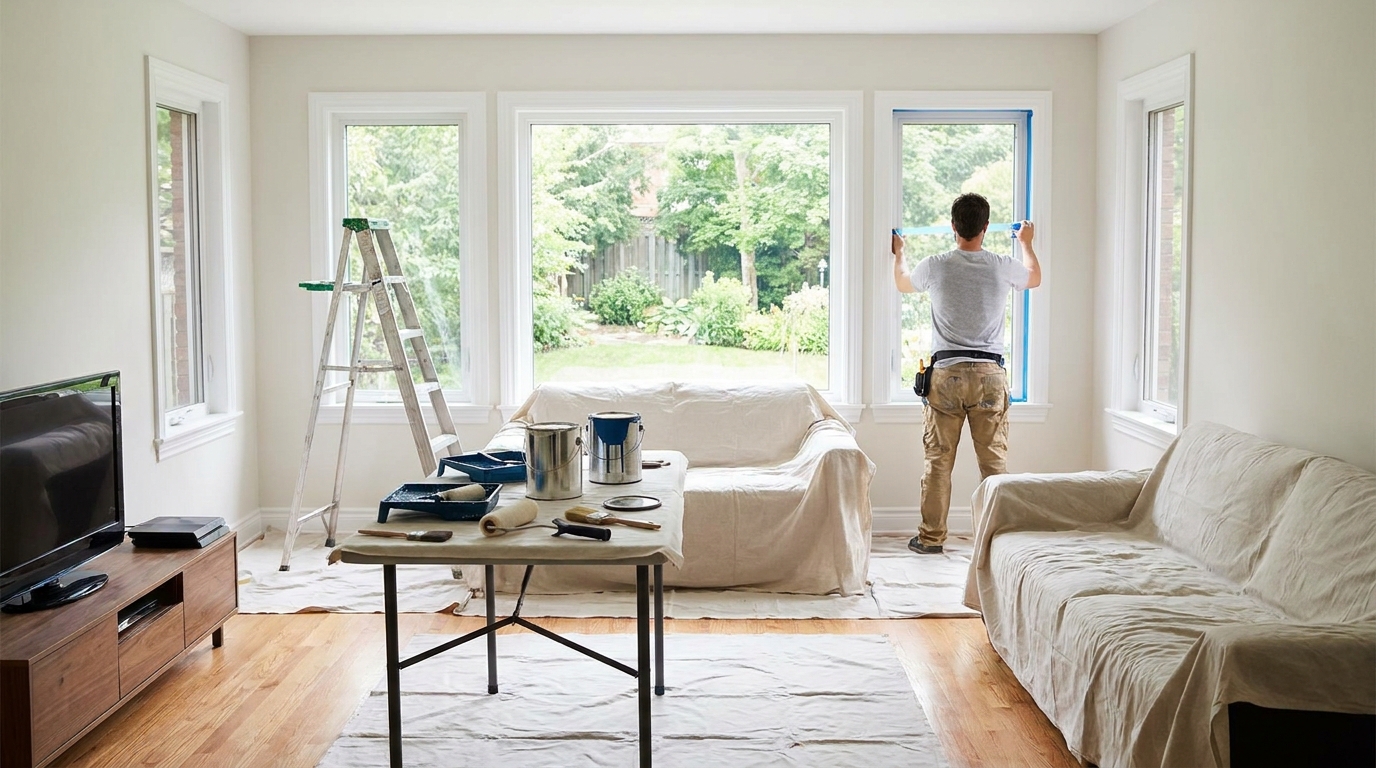
In 2026, a professional whole-house interior repaint for a standard 2,000-square-foot (185-square-meter) home costs between $5,500 and $9,000. If you do it yourself, expect to spend $800 to $1,500 on paint and supplies. The massive gap between DIY and professional pricing comes entirely down to labor and surface preparation. A pro crew will spend 70 percent of their time patching, sanding, and caulking before opening a single can of paint. While painting an empty room is straightforward, calculating the cost of an entire house requires factoring in ceiling heights, trim condition, drywall damage, and regional labor rates. Whether you hire it out or grab a roller, understanding these line items prevents budget blowouts and ensures a finish that actually lasts.
- Professional labor makes up 80 to 85 percent of a painting quote, averaging $45 to $75 per hour per painter in 2026.
- A typical 2,000-square-foot house requires 12 to 15 gallons of wall paint, 3 to 5 gallons for trim, and 5 gallons for ceilings.
- Skipping degreasing and sanding before painting trim is a guaranteed failure mode, causing new latex paint to peel off in strips.
- Professionals use raking light to find wall defects before quoting, a critical judgement call that beginners skip.
How much does a professional interior repaint cost per square foot?
Most contractors price interior painting based on floor square footage for quick estimates, averaging $2.75 to $4.50 per square foot in 2026. However, accurate quotes are calculated based on paintable wall surface area. A 2,000-square-foot (185-square-meter) home typically translates to roughly 5,500 to 6,000 square feet of actual wall space, assuming standard 8-foot (2.4-meter) ceilings. If your home features vaulted 12-foot (3.6-meter) ceilings, the surface area increases dramatically, requiring scaffolding and specialty extension poles that drive up labor costs.
When breaking it down by room, a standard 12-by-12-foot bedroom costs between $400 and $650 to paint professionally, including minor prep and two coats on the walls. Large open-concept living rooms can range from $900 to $1,500 due to the extensive cutting-in required around windows, built-ins, and transitions. Stairwells are notoriously expensive, often adding $500 to $800 on their own because of the dangerous ladder setups required to reach the upper walls.
- Primary bedroom and en suite bath: $700 to $1,200
- Standard guest bedroom: $400 to $650
- Kitchen (walls and pantry only, no cabinets): $300 to $500
- Living and dining open spaces: $900 to $1,500
What is the true cost of DIY painting materials?
If you are taking on a whole-house repaint yourself, do not budget based on builder-grade paint prices. In 2026, premium 100-percent acrylic latex paint costs $65 to $85 per gallon. For a 2,000-square-foot home, you will need approximately 15 gallons for two coats on the walls, 5 gallons of ceiling flat, 4 gallons of urethane-modified trim paint, and at least 5 gallons of a high-quality bonding primer. Just the liquid materials will set you back around $1,000.
The hidden costs of DIY painting hide in the sundries. High-quality 3/8-inch (9.5-millimeter) nap microfiber rollers, synthetic angle sash brushes, heavy-duty canvas drop cloths, painter's tape, joint compound, and 120-grit sanding sponges add up quickly. A proper setup with extension poles and a sturdy fiberglass stepladder will add $300 to $500 to your initial run to the hardware store. Skimping on these tools to save money results in lint on your walls, visible brush strokes on your trim, and a miserable application experience.
- Premium wall paint (15 gallons): $975 to $1,275
- Ceiling paint (5 gallons): $250 to $350
- Trim paint (4 gallons): $280 to $360
- Applicators, tape, and prep supplies: $300 to $500
Why do quotes vary so wildly between painting contractors?
If you solicit three bids for a whole-house repaint, you might receive quotes of $4,500, $7,000, and $11,000. The discrepancy rarely comes down to paint quality; it is entirely about surface preparation. The cheapest bidder plans to walk in, tape the baseboards, and roll two coats directly over your existing scuffs and nail holes. The highest bidder plans to wash the walls, skim-coat the damage, sand between coats, and leave a flawless finish.
Here is a key judgement call a professional makes differently from a beginner: A novice evaluates wall condition by casually looking at the room under ambient daylight. A pro brings a 4,000-lumen LED work light, holds it parallel to the drywall (raking light), and exposes every single nail pop, bad drywall seam, and previous paint run. The pro knows that fresh paint highlights defects rather than hiding them, so they price in 10 to 15 hours of drywall repair before they even load a roller.
- Level of drywall patching and sanding included in the bid
- Whether they spray or brush-and-roll the trim and doors
- Number of furniture pieces they must move and protect
- Business overhead, licensing, and liability insurance costs
Does painting ceilings and trim add significantly to the budget?
Including ceilings and trim transforms a standard wall-painting job into a major overhaul. Adding ceilings typically increases the total labor bill by 20 to 30 percent. Ceiling paint is formulated to be highly viscous to prevent dripping, but rolling it over your head is exhausting, back-breaking work. Furthermore, ceilings must be painted first, requiring massive drop cloths to protect the entire floor space of the home.
Trim is even more labor-intensive. Baseboards, crown molding, window casings, and interior doors require meticulous prep. A pro will charge $75 to $150 per interior door to remove hardware, degloss the surface, prime, and apply a durable semi-gloss finish. If your current trim is oil-based and you want to switch to a modern water-based acrylic, the labor cost spikes. The crew must heavily scuff-sand the old oil finish and apply a specialized bonding primer, otherwise the new paint will simply slide off.
- Ceilings: Adds $1,000 to $1,800 for a 2,000-sq-ft home
- Baseboards and casings: Adds $800 to $1,500
- Interior doors: Adds $75 to $150 per door
- Switching from oil to water-based trim: Adds 30 percent to trim labor
What is the most common failure mode when repainting?
The most frequent and disastrous failure mode in interior painting is peeling trim paint caused by poor preparation. Homeowners often buy a 'paint-and-primer-in-one' and slap it directly over old, glossy baseboards or kitchen walls covered in invisible cooking grease. Within weeks, the new paint cures into a fragile skin that can be scraped off easily with a fingernail.
To avoid this, you must separate cleaning from sanding from priming. First, wash greasy areas and hand-touched trim with a degreaser like TSP (trisodium phosphate). Once dry, scuff-sand the surface with 120-grit paper to knock down the gloss and create a physical profile for the paint to grip. Finally, apply a high-adhesion bonding primer. Only after this primer has dried should you apply your topcoat. Skipping any of these three steps on high-traffic trim or cabinets guarantees a failed finish.
- Wash surfaces with TSP to remove invisible oils
- Scuff-sand glossy surfaces with 120-grit paper
- Apply a dedicated bonding primer, not a 2-in-1 paint
- Allow full cure times between prep steps
How do regional labor rates and climate affect the final bill?
Labor rates for painters vary heavily by geography. In the rural Midwest or South, an independent painter might charge $40 to $50 per hour. In coastal metropolitan areas like San Francisco or Boston, a licensed and insured crew will charge $70 to $90 per hour per painter. This alone can swing the cost of a whole-house repaint by $3,000.
Climate also plays a surprising role in interior painting. Latex paint cures best when interior temperatures are between 50 and 85 degrees Fahrenheit (10 to 29 Celsius) with relative humidity below 70 percent. In highly humid climates, excess moisture in the air prevents the water in the paint from evaporating, stalling the cross-linking process of the acrylic resins. Pros working in high-humidity zones during the summer must run air conditioning or commercial dehumidifiers to ensure the first coat dries enough to accept a second coat, which adds utility costs and labor time to the project.
- Midwest/South: $4,500 to $6,500 total average cost
- Coastal/High-Cost Metros: $7,500 to $10,500 total average cost
- Ideal curing temp: 50 to 85 F (10 to 29 C)
- High humidity delays dry times and extends labor hours
Where can you safely cut corners to lower the cost of a repaint?
If a $7,000 quote is out of reach, there are ways to negotiate the price down without compromising the final finish. The safest way to save money is to handle the non-painting labor yourself. Offer to move all furniture into the center of the rooms, remove all window treatments, and take off every outlet and switch cover before the crew arrives. Doing this can shave half a day of labor off the quote.
You can also save by standardizing your color palette. Choosing a different color for every bedroom requires the crew to wash their brushes and rollers constantly and leaves you paying for multiple half-empty gallons of paint. Selecting one main color for all hallways, living spaces, and secondary bedrooms drastically speeds up the cutting-in process and maximizes paint efficiency. Stick to an eggshell or satin finish for the walls to hide minor imperfections, which reduces the amount of expensive drywall repair the crew has to perform.
- Move all furniture and remove wall hangings yourself
- Remove all electrical faceplates and HVAC vent covers
- Use a single wall color for 80 percent of the house
- Leave closets unpainted or paint them yourself later
| Expense Category | DIY Cost Range | Professional Cost Range |
|---|---|---|
| Wall Paint (15 Gallons) | $900 - $1,200 | Included in Labor/Overhead |
| Trim & Ceiling Paint | $500 - $700 | Included in Labor/Overhead |
| Supplies (Rollers, Tape, Prep) | $300 - $500 | Included in Labor/Overhead |
| Labor (Prep and Application) | $0 (Sweat Equity) | $4,500 - $7,500 |
| Total Estimated Cost | $1,700 - $2,400 | $5,500 - $9,000 |
Frequently asked questions
Do I really need two coats if I buy premium paint?
Yes. Even top-tier paints costing $80 a gallon require two coats for durability and true color depth. The first coat seals the surface and establishes the base, while the second coat provides the actual protective sheen and rich color. Single-coat applications almost always flash (show uneven sheen) when light hits the wall.
How long does a whole-house repaint take?
A professional crew of three can usually prep and paint a 2,000-square-foot house in 4 to 6 days, assuming standard drywall repairs. If you are DIYing it on weekends, expect it to take 4 to 6 weekends to complete the same amount of work without burning out.
Should I paint the walls or the trim first?
Professionals paint the ceiling first, then the trim, and finally the walls. It is much easier to quickly paint the trim, let it overlap onto the walls, and then cut a crisp wall-paint line over the edge of the trim, rather than trying to tape off perfectly painted walls.
What is the difference between flat, eggshell, and satin finishes?
Flat has no shine and hides wall dents perfectly, but is hard to clean. Eggshell has a slight luster, hides most flaws, and is wipeable, making it the standard for living spaces. Satin is glossier and highly durable, making it ideal for high-moisture areas like bathrooms and high-traffic areas like mudrooms.
Keep reading
- How Much Paint Do You Actually Need for a Room?The tin says 400 square feet. Your wall says otherwise. Here is the arithmetic that actually holds up.
- DIY or Hire a Pro? A Decision Framework That Is Not About MoneyThe labour saving is real. So is the cost of a job done twice — and of tools you use once.
- Storage for Small Rooms That Does Not Make Them SmallerSmall rooms do not need more storage. They need storage that stops interrupting the eye.