Choosing Sustainable Materials for a Renovation Without Overpaying
By Jim Vernon · 4 min read · Last updated
Not every eco-labeled material is worth the premium. Here's where the sustainability claim actually matches the price tag.
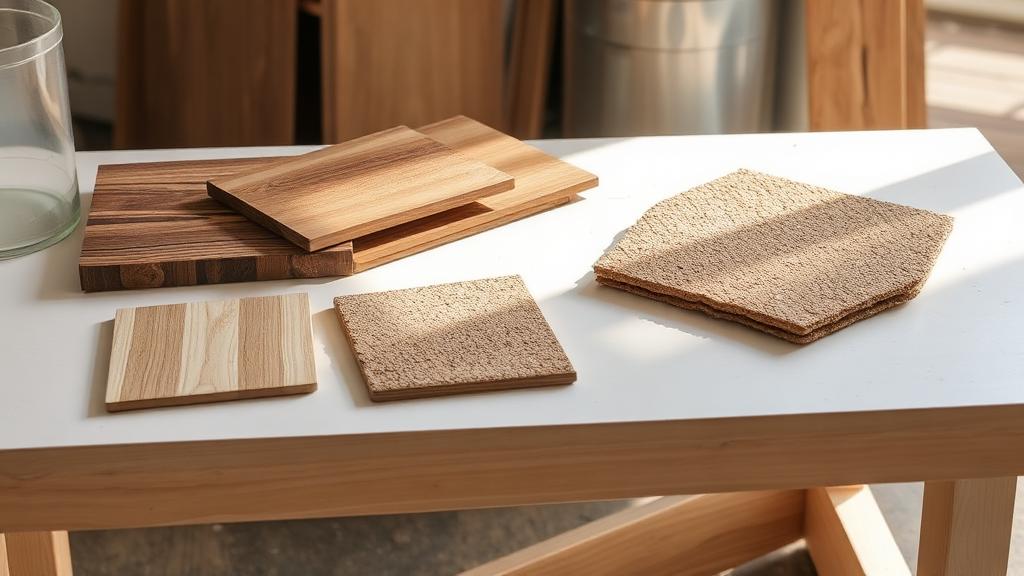
Sustainable materials in home renovation range from genuinely lower-impact and often cost-competitive options to premium-priced products where the environmental benefit is marginal or the claim is loosely defined. Sorting the two apart before committing a renovation budget avoids paying a green premium for a small or unclear benefit.
Materials where sustainability and cost genuinely align
| Material | Why it's a solid choice | Cost vs. conventional |
|---|---|---|
| Reclaimed or salvaged wood | Diverts existing material from landfill or demolition | Often cheaper than new hardwood; sourcing takes more time |
| Cork flooring | Rapidly renewable, harvested without cutting down the tree | Comparable to mid-range hardwood |
| Recycled-content countertops (glass, paper-composite) | Uses waste-stream material, durable | Comparable to mid-to-high-range stone |
| Low-VOC or zero-VOC paint | Reduces indoor air pollutants, now widely standard | Little to no premium over standard paint |
| Wool or natural-fiber insulation | Renewable, biodegradable, good performance | Meaningful premium over fiberglass |
Where the green premium buys less than it seems
- Bamboo flooring is renewable at the growing stage, but manufacturing and adhesive processes vary widely in quality and formaldehyde content — look for a specific certification rather than trusting the word 'bamboo' alone.
- 'Eco-friendly' vinyl or laminate flooring is still a petroleum-based product regardless of marketing language; the sustainability gain over conventional versions is usually small.
- Some certified sustainable lumber costs significantly more than conventional lumber for a similar or identical product, with the certification premium not always reflecting proportional impact.
Local availability also matters more than most buying guides admit — a certified sustainable product shipped across the country carries a transportation footprint that can offset part of its manufacturing advantage, while a conventional material sourced regionally sometimes closes that gap.
Prioritizing when the budget can't cover everything
- Insulation and air sealing first — the energy savings compound every year the home is occupied, unlike a one-time material choice.
- Windows, if the current ones are single-pane or poorly sealed — a major driver of ongoing energy use.
- Flooring and countertops next, where reclaimed and recycled-content options are often cost-competitive anyway.
- Paint and finishes last, since low-VOC options are now close to standard and rarely a hard budget trade-off.
Certifications worth checking for
- FSC (Forest Stewardship Council) certification for responsibly sourced wood products.
- GREENGUARD certification for low chemical emissions, relevant for flooring, furniture, and insulation.
- ENERGY STAR for appliances and windows, tied to measurable energy performance rather than marketing language.
Asking the right question at the supplier
Instead of asking a supplier 'is this sustainable,' ask what specific certification backs the claim, what the expected service life is, and whether end-of-life disposal or recycling is realistic in your area. Those three answers reveal more about actual impact than any marketing label on the product itself.
Recycled and repurposed structural materials
Beyond finishes, structural components like reclaimed steel beams, salvaged brick, and deconstructed lumber from demolished buildings are increasingly available through salvage yards and deconstruction contractors in larger metro areas. These options require more lead time to source and match to a specific project than ordering new material, but they can cost less than new structural lumber while diverting demolition waste that would otherwise go to a landfill.
A worked example: comparing lifetime cost, not just sticker price
A budget laminate floor might cost $2 per square foot and last 8-10 years, working out to roughly $0.20-0.25 per square foot per year. A cork floor at $5-6 per square foot lasting 25 years works out closer to $0.20-0.24 per square foot per year — essentially the same annualized cost, but with a renewable material, better underfoot comfort, and one replacement cycle instead of two or three. Comparing sticker price alone would make the laminate look like the clear budget winner; comparing lifetime cost tells a different story.
Common mistakes
- Paying a premium for a vague 'eco-friendly' label without checking for a specific, verifiable certification.
- Choosing the cheapest certified-sustainable option without checking installation and maintenance requirements that add cost later.
- Prioritizing visible finish materials over insulation and air sealing, which have a far larger long-term impact.
- Assuming all bamboo products are equally low-formaldehyde regardless of manufacturer.
- Ignoring lifespan entirely when comparing the cost of a sustainable material against a conventional one.
Is reclaimed wood harder to work with than new lumber?
It can require extra care — checking for embedded nails, warping, or inconsistent dimensions — but for character-driven projects like flooring or accent walls, it's a well-established and often cost-effective option.
Are recycled-content countertops as durable as granite or quartz?
Quality varies by manufacturer, but well-made recycled-glass and paper-composite countertops perform comparably to mid-range natural stone for typical kitchen use.
Does insulation really matter more than flashy finish materials for sustainability?
Yes — insulation and air sealing reduce ongoing energy use for the life of the home, which typically outweighs the one-time embodied impact of most finish material choices.
End-of-life and disposal considerations
A material's sustainability story does not end at installation — what happens when it is eventually removed matters too. Natural-fiber insulation and untreated reclaimed wood can often be composted, repurposed, or recycled locally, while some composite and vinyl-based 'eco' products still end up in a landfill at end of life regardless of how they were marketed when new. Asking a supplier directly whether a product is recyclable in your specific municipality, rather than assuming a green label guarantees it, avoids a false assumption about the full lifecycle.
Regional availability changes the calculation
| Region type | What tends to be cost-competitive locally |
|---|---|
| Areas with active salvage/deconstruction yards | Reclaimed wood, brick, and fixtures |
| Regions with strong forestry industries | FSC-certified lumber, often at a smaller premium |
| Areas with limited recycling infrastructure | Recycled-content countertops may need to ship farther, raising cost and footprint |
Run the numbers for your own project
- Energy Savings CalculatorWill this upgrade pay for itself?
- Project Cost EstimatorWhat will this project cost me?
Keep reading
- How Much Paint Do You Actually Need for a Room?The tin says 400 square feet. Your wall says otherwise. Here is the arithmetic that actually holds up.
- DIY or Hire a Pro? A Decision Framework That Is Not About MoneyThe labour saving is real. So is the cost of a job done twice — and of tools you use once.
- Storage for Small Rooms That Does Not Make Them SmallerSmall rooms do not need more storage. They need storage that stops interrupting the eye.