Snow and Ice Management That Doesn't Wreck Your Concrete
By Jim Vernon · 5 min read · Last updated
The de-icer that clears ice fastest is often the same one that pits your driveway by spring.
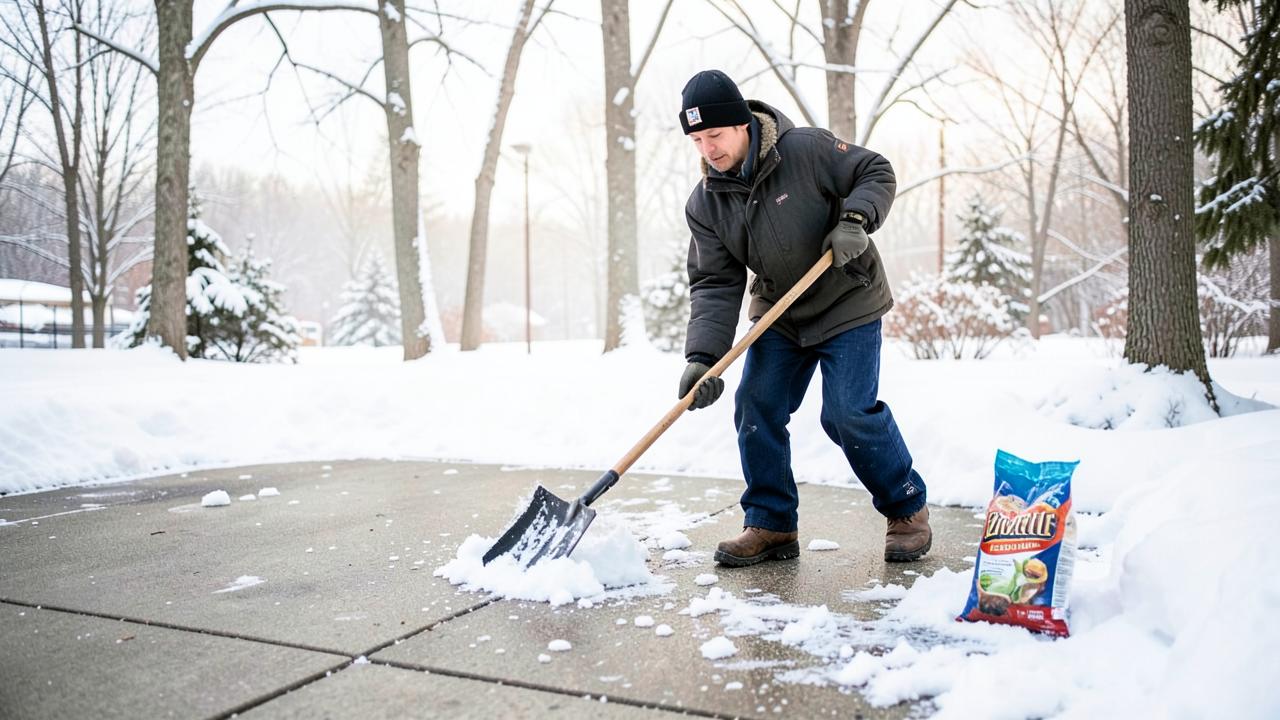
Snow and ice management that doesn't wreck concrete comes down to choosing the right de-icer for the temperature and concrete age, shoveling before ice bonds to the surface, and never using rock salt on concrete less than a year old. The wrong de-icer causes spalling — flaking, pitted concrete — by forcing repeated freeze-thaw cycles into the pores of the slab.
Which de-icers are safe for concrete, and which aren't?
| De-icer | Effective down to | Concrete safety | Cost per lb (approx.) |
|---|---|---|---|
| Calcium magnesium acetate (CMA) | 20°F | Safest for concrete and least corrosive | $1.50-3.00 |
| Calcium chloride | -25°F | Moderate risk if overused; faster acting | $0.60-1.20 |
| Magnesium chloride | -13°F | Lower risk than sodium chloride, less damaging to plants | $0.70-1.30 |
| Sodium chloride (rock salt) | 15-20°F | Higher spalling risk, especially on new or damaged concrete | $0.20-0.50 |
| Sand or kitty litter (no de-icing) | Any temp | No chemical risk; provides traction only, doesn't melt ice | $0.10-0.30 |
Why does rock salt damage concrete?
Rock salt lowers the freezing point of the water sitting in the concrete's surface pores, but as temperatures fluctuate around that new, lower freezing point, water repeatedly refreezes and expands inside the concrete rather than just on top of it. That repeated internal expansion is what flakes off the surface (spalling) over a season or two, and it's worse on concrete less than a year old that hasn't fully cured, and on any concrete with existing hairline cracks that give water a path in.
What's the right shoveling and de-icing sequence?
- Shovel as soon as reasonably possible after snowfall, before foot or vehicle traffic compacts it into ice.
- Apply de-icer before a storm if you know ice is likely (pre-treating prevents bonding) or immediately after shoveling if ice has already formed.
- Use the minimum effective amount — more product doesn't melt ice faster past a certain point and just adds cost and runoff.
- Sweep up de-icer residue once it's done its job rather than letting it track indoors or into garden beds.
Do de-icers harm plants and lawns near the walkway?
Yes — sodium chloride is the most damaging to soil and plant roots because sodium ions displace other nutrients and degrade soil structure over repeated seasons of use, showing up as browned grass edges and stunted growth along driveways and walks each spring. Calcium magnesium acetate and potassium-based de-icers are gentler on soil and plants, though they cost more per pound; if salt damage along a walkway is a recurring problem, switching products is usually more effective than trying to flush the soil afterward.
What about ice melt safety for pets?
- Rock salt and calcium chloride can irritate paw pads and cause stomach upset if licked off paws; rinse pets' feet after walks on treated surfaces.
- Products labeled 'pet-safe' typically use CMA or a modified urea base, which is genuinely gentler but still shouldn't be ingested in quantity.
- Sand provides zero chemical exposure and is the safest choice for high pet-traffic areas, though it doesn't melt ice.
How much does winter de-icer damage typically cost to fix later?
Minor spalling can sometimes be addressed with a concrete resurfacer for $50-150 in materials for a typical driveway section done DIY. Significant spalling or scaling across a large slab often requires professional resurfacing or replacement, running $3-8 per square foot, meaning a spalled two-car driveway can cost $2,000-6,000+ to fully redo — far more than choosing a gentler de-icer for a few winters would have cost.
How much de-icer should you actually use?
Most bagged de-icers are effective at roughly 3-4 ounces (a small handful) per square yard, or about one 50-lb bag covering 400-800 square feet of walkway depending on ice thickness and temperature. Applying more than the label recommends doesn't melt ice meaningfully faster once the pavement is saturated with brine — the excess just runs off into soil and storm drains, adding cost without adding performance, and it's the over-application, more than any single product choice, that does the most damage to nearby lawn and garden beds season after season. A simple hand-held spreader or even a coffee can with holes punched in the lid gives more even coverage than tossing handfuls, which tends to concentrate product in a few spots and waste it in others; even coverage also means using less total product for the same ice-clearing result.
What alternatives exist to chemical de-icers?
- Sand or non-clumping cat litter, which adds traction without any chemical melting action or plant/concrete risk — best for consistently cold spells where the ice won't be melting soon anyway.
- Heated driveway or walkway systems (electric or hydronic), a higher upfront cost ($12-25 per square foot installed) but eliminate de-icer entirely over the system's life, often 20+ years.
- Beet juice or brine-based pre-treatments, increasingly used by municipalities, which lower the effective melting temperature of standard salt and reduce the total chloride needed for the same result.
- Simply shoveling promptly and consistently — in many climates, staying ahead of accumulation reduces or eliminates the need for chemical de-icer altogether.
Is it true that hot water melts ice on a driveway effectively?
It melts the ice temporarily but the water refreezes quickly once temperatures are below freezing, often creating a more dangerous, thinner sheet of ice than before. It's not a substitute for shoveling and appropriate de-icer.
Can I mix de-icer types to save money?
Yes, many commercial ice melt blends combine sodium chloride with calcium chloride or CMA to balance cost and effectiveness. Check the bag's minimum temperature rating and concrete-safety claims rather than assuming a blend is automatically gentler.
How soon after de-icing can I safely walk or drive on the surface?
Granular de-icers typically need 15-30 minutes of contact time to start breaking the ice-surface bond before shoveling or scraping is effective. Liquid pre-treatments applied before a storm work immediately upon snow contact.
Run the numbers for your own project
- Home Maintenance ScheduleWhat should I be doing to my home this month?
- Frost Date LookupWhen is my last frost and how long is my season?
Keep reading
- How Much Paint Do You Actually Need for a Room?The tin says 400 square feet. Your wall says otherwise. Here is the arithmetic that actually holds up.
- DIY or Hire a Pro? A Decision Framework That Is Not About MoneyThe labour saving is real. So is the cost of a job done twice — and of tools you use once.
- Storage for Small Rooms That Does Not Make Them SmallerSmall rooms do not need more storage. They need storage that stops interrupting the eye.