Retaining Walls: Materials, Drainage, and Engineers
By Jim Vernon · 5 min read · Last updated
A wall under 4 feet with proper drainage and setback is usually a confident DIY project; taller than that, hydrostatic pressure calculations belong to an engineer.
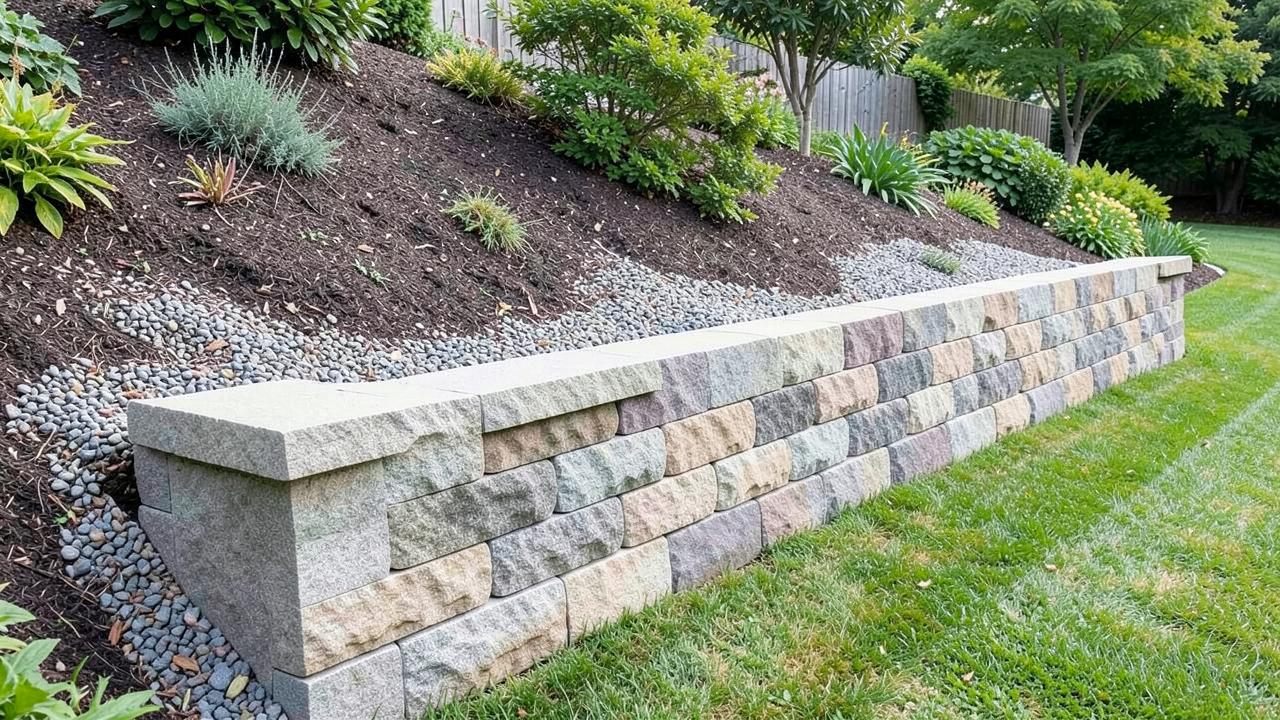
Most retaining wall failures — bulging, leaning, or toppling — trace back to trapped water behind the wall rather than a weak material choice, because saturated soil can exert several times the lateral pressure of dry soil. Segmental concrete block, natural stone, timber, and poured concrete all work as materials, but none of them survive years of hydrostatic pressure without a functioning drainage system behind the wall face.
How do the common retaining wall materials compare?
| Material | Typical cost/sq ft face | Max recommended DIY height | Lifespan |
|---|---|---|---|
| Segmental concrete block (SRW) | $20-35 | 3-4 ft without reinforcement | 50+ years |
| Natural stone (dry-stacked) | $25-45 | 3 ft, skill-dependent | 50-100 years |
| Pressure-treated timber | $15-25 | 3-4 ft | 15-25 years |
| Poured concrete | $25-40 | Not typically DIY above 2-3 ft | 75+ years |
| Gabion (stone-filled wire baskets) | $20-35 | 4 ft | 40-60 years |
Why does wall height change everything about the design?
Lateral soil pressure increases roughly with the square of wall height, so a wall twice as tall doesn't need twice the strength — it needs roughly four times the resistance to overturning and sliding. This is why most jurisdictions require a stamped engineering design and permit for walls over 4 feet tall (measured from the bottom of the footing to the top of the wall, not just the visible face), while shorter walls are often exempt.
What drainage details actually prevent wall failure?
- A gravel backfill zone at least 12 inches wide directly behind the wall, extending the full height, to let water move down rather than pressurize against the wall face.
- A perforated drain pipe (4-inch, perforations down) at the base of the gravel backfill, sloped at least 1% to a daylight outlet or dry well.
- Landscape fabric between the gravel backfill and native soil to prevent soil fines from migrating in and clogging the drainage zone over time.
- Weep holes every 4-6 feet in solid-faced walls (like poured concrete) as a backup outlet if the drain pipe becomes overwhelmed during heavy rain.
- A base of compacted crushed stone (typically 6-12 inches deep) under the first course, extending slightly beyond the wall's footprint for stability.
When does a wall need geogrid reinforcement?
Geogrid — a fabric mesh laid horizontally between courses and extended back into the retained soil — becomes necessary once a wall exceeds roughly 3-4 feet, or sooner if the wall will support surcharge loads like a driveway, patio, or structure above it. Geogrid length typically needs to be 60-80% of the wall's height, meaning a 5-foot wall may need grid extending 3-4 feet back into the slope — a detail that changes how much excavation and regrading the project requires well beyond the wall's footprint.
When should you hire a structural or geotechnical engineer?
- Any wall over 4 feet total height (footing to top), which is also the typical code threshold requiring a permit and stamped design.
- Any wall supporting a driveway, structure, pool, or other significant surcharge load regardless of height.
- Sites with a known high water table, unstable slope history, or expansive clay soil.
- Walls built near a property line where failure could affect a neighboring structure.
- Any situation where a previous wall on the site has already failed or shows bulging or leaning.
What does a typical retaining wall project cost from start to finish?
A DIY segmental block wall 3 feet tall and 30 feet long, including base stone, drain pipe, gravel backfill, and blocks, typically runs $2,500-5,500 in materials. Hiring a contractor for the same wall runs $6,000-12,000 once excavation, professional base compaction, and labor are included, with the range depending heavily on site access and how much soil needs to be hauled away or brought in. An engineered wall over 4 feet, including stamped drawings, permit fees, and geogrid reinforcement, commonly runs $12,000-30,000 or more for a substantial hillside application, since both engineering fees and the added excavation and reinforcement volume increase costs faster than height alone would suggest.
How do you tell if an existing retaining wall is failing and needs attention?
- A visible bulge or bow in the wall face, even a slight one, indicates building pressure behind the wall and should be addressed before it worsens rather than monitored indefinitely.
- Cracks in segmental block joints or a poured concrete wall, especially horizontal cracks, which suggest bending stress rather than simple settling.
- Water seeping through the wall face in random spots rather than at designated weep holes, meaning the intended drainage path is compromised or clogged.
- Soil pulling away from the top of the wall or a gap forming between the wall and the retained slope, a sign the wall has already shifted forward slightly.
- Trees or large shrubs planted close behind the wall, whose roots can both add pressure and, over time, physically dislodge blocks or stones.
Can I build a retaining wall without any drainage if the soil is sandy?
It's still risky. Sandy soil drains faster than clay, but heavy or prolonged rain can still saturate it enough to build dangerous pressure, and skipping drainage removes the margin of safety at almost no cost savings, since the gravel and pipe are inexpensive relative to the wall itself.
How long does a segmental block wall typically last before needing repair?
With functioning drainage and a proper base, 50 years or more is typical; the block units themselves rarely fail structurally. Most repairs needed within 10-20 years trace back to drainage or base settling issues rather than the blocks degrading.
Is timber a bad choice for a retaining wall?
It's a reasonable lower-cost choice for short walls (under 3-4 feet) with a limited lifespan expectation of 15-25 years, since even pressure-treated wood eventually rots at the soil contact line. It's a poor choice for anything load-bearing or intended to last multiple decades.
Run the numbers for your own project
- Project Cost EstimatorWhat will this project cost me?
- Gravel and Path CalculatorHow much gravel do I need for my path or driveway?
- Concrete CalculatorHow much concrete do I need?
Keep reading
- How Much Paint Do You Actually Need for a Room?The tin says 400 square feet. Your wall says otherwise. Here is the arithmetic that actually holds up.
- DIY or Hire a Pro? A Decision Framework That Is Not About MoneyThe labour saving is real. So is the cost of a job done twice — and of tools you use once.
- Storage for Small Rooms That Does Not Make Them SmallerSmall rooms do not need more storage. They need storage that stops interrupting the eye.