Can Your Electrical Panel Handle an EV Charger?
By Jim Vernon · 4 min read · Last updated
The charger is easy. Finding 40-60 amps of spare capacity in a 100-amp panel is the real project.
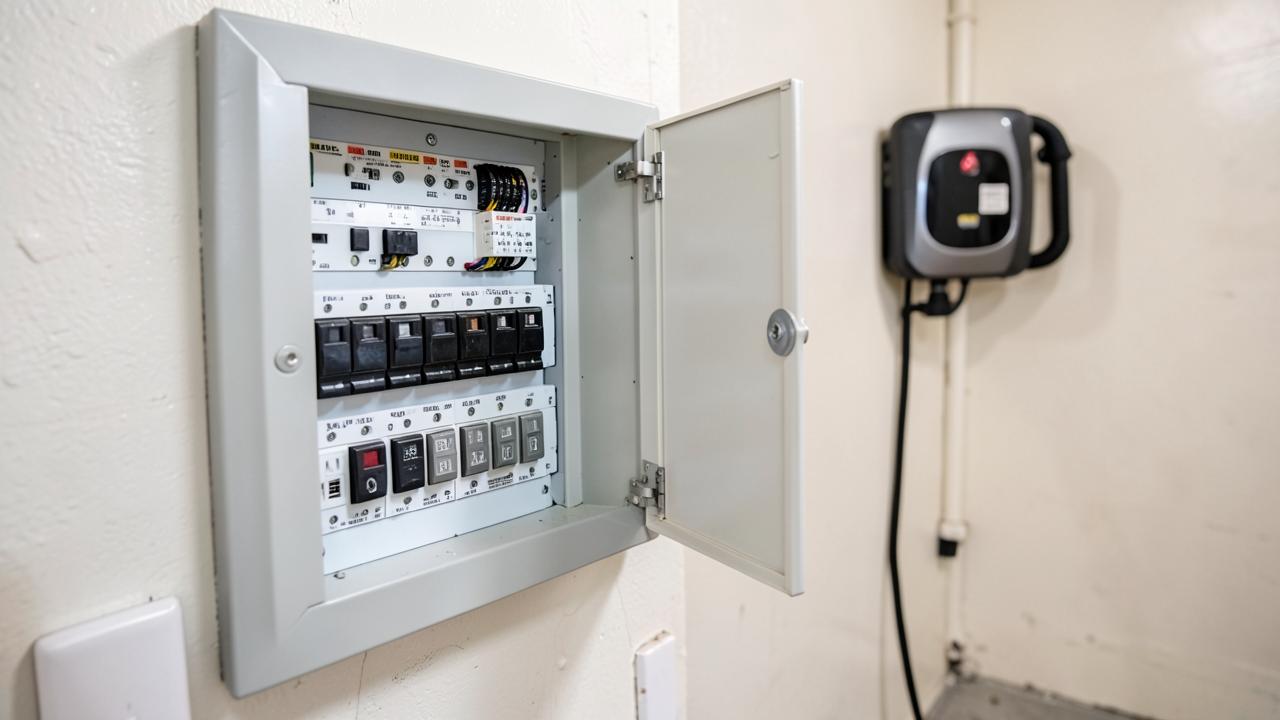
Most Level 2 EV home chargers draw 30-50 amps at 240 volts and need a dedicated circuit, so the first question is whether your panel's total rated amperage minus its existing calculated load leaves enough headroom — a modern 200-amp panel usually has room, while an older 100-amp panel with electric heat, a range, and a water heater already may not, without a panel upgrade or a load management device.
How do you check your panel's capacity yourself?
- Find the main breaker at the top of the panel — it's stamped with the panel's total rated amperage (commonly 100, 150, or 200 amps in US homes).
- Count open, unused breaker slots; an EV charger circuit needs one or two adjacent open slots for a double-pole 40-60 amp breaker.
- List major existing loads: central AC, electric range, electric dryer, electric water heater, and any electric heat — these are the loads that eat into headroom fastest.
- Have an electrician run a load calculation (a standard part of any EV charger installation quote) rather than guessing — it accounts for diversity factors that a simple addition of nameplate amps doesn't.
What are realistic installation scenarios and costs?
| Scenario | What's needed | Typical cost |
|---|---|---|
| 200-amp panel, open slots, garage near panel | New 40-50A double-pole breaker, wire run, charger mount | $500-$1,200 |
| 200-amp panel, panel full, garage near panel | Tandem/mini breakers or a small subpanel to add slots | $800-$1,800 |
| 100-amp panel, already near capacity | Panel upgrade to 200 amp, then new circuit | $2,500-$4,500 |
| Detached garage, long run from house panel | Trenching, conduit, possibly a subpanel | $1,500-$4,000+ |
| Panel with no room, budget-limited | Load management device that shares capacity dynamically | $400-$900 plus install |
What is a load management device and when does it make sense?
An energy management device (sometimes bundled into the charger itself) monitors total home draw in real time and automatically reduces the EV charger's output when other big loads — like the AC and electric dryer — run simultaneously, then ramps back up when they finish. This lets a 100-amp panel host a Level 2 charger without a full panel upgrade, trading a bit of charging speed for a $2,000+ savings versus a panel replacement.
Level 1 vs Level 2: do you even need the upgrade?
- Level 1 (standard 120V outlet, no new wiring): adds roughly 3-5 miles of range per hour — workable for plug-in hybrids or drivers under 30 miles a day, but slow for daily full commutes.
- Level 2 (240V, 30-50A dedicated circuit): adds roughly 20-30 miles of range per hour, enough to fully recharge most EVs overnight.
- If your daily driving is under 30-40 miles and you can plug in every night, Level 1 may genuinely be enough and saves the entire panel and circuit cost.
What amperage does your EV charger actually need?
Most EVs charge fine on a 40-amp circuit (32 amps continuous draw) delivered by a Level 2 charger, adding roughly 25 miles of range per hour, which fully replenishes most daily commutes overnight. Some larger-battery EVs and trucks support 48-60 amp charging for faster overnight top-offs, but that requires a 60-80 amp circuit and a compatible charger, both of which push harder against a limited panel's spare capacity. Buying a charger rated higher than your panel can comfortably support just means it will be programmed down to a lower amperage anyway, so matching the charger to realistic panel headroom rather than the charger's maximum rating avoids overpaying for unused capacity.
What's the timeline for an EV charger installation from quote to charging?
A straightforward install with available panel capacity typically takes 1-2 weeks from initial quote to a working charger: a site visit and load calculation, permit filing (which can take days to a couple of weeks depending on the local building department), the actual installation (usually completed in a single day), and a final inspection. Projects requiring a panel upgrade or utility service changes can stretch to 4-8 weeks because the utility company itself may need to schedule a meter or service line upgrade, which is outside the electrician's control and often the single biggest source of delay.
Are there rebates or incentives that offset the cost?
Many utilities offer $200-$1,000+ rebates for permitted Level 2 charger installations, sometimes with an additional incentive for installing on a time-of-use rate plan that charges overnight during off-peak hours. Some states and municipalities layer on their own EV infrastructure rebates on top of utility programs, and federal tax credits have historically covered a portion of home charger equipment and installation costs, though program details and eligibility change often enough that it's worth checking your specific utility and state program before budgeting the project, rather than assuming a rebate applies.
Frequently asked questions
How much does a full panel upgrade from 100 to 200 amps cost?
Typically $2,000-$4,000 including the new panel, breakers, permit, and inspection, more if the utility service line and meter also need upgrading to handle the higher amperage. It's often bundled with an EV charger install to save on a second service call.
Can two EV chargers share one 200-amp panel?
Often yes with a load management system that splits available amperage between two chargers dynamically, especially if the panel already carries a typical household load. A straight load calculation should confirm this rather than assuming — two dedicated 50A circuits alone can exceed a 200-amp panel's spare capacity.
Does a bigger panel mean a bigger electric bill?
No — panel amperage is capacity, not consumption; you only pay for the electricity you actually use. A 200-amp panel sitting well under its rated capacity costs the same to operate as a 100-amp panel would for the identical usage.
Run the numbers for your own project
- Energy Savings CalculatorWill this upgrade pay for itself?
- Project Cost EstimatorWhat will this project cost me?
Keep reading
- How Much Paint Do You Actually Need for a Room?The tin says 400 square feet. Your wall says otherwise. Here is the arithmetic that actually holds up.
- DIY or Hire a Pro? A Decision Framework That Is Not About MoneyThe labour saving is real. So is the cost of a job done twice — and of tools you use once.
- Storage for Small Rooms That Does Not Make Them SmallerSmall rooms do not need more storage. They need storage that stops interrupting the eye.