How Do You Plan Outdoor and Landscape Lighting?
By Jim Vernon · 5 min read · Last updated
Evenly spaced path lights every four feet reads as an airport, not a garden.
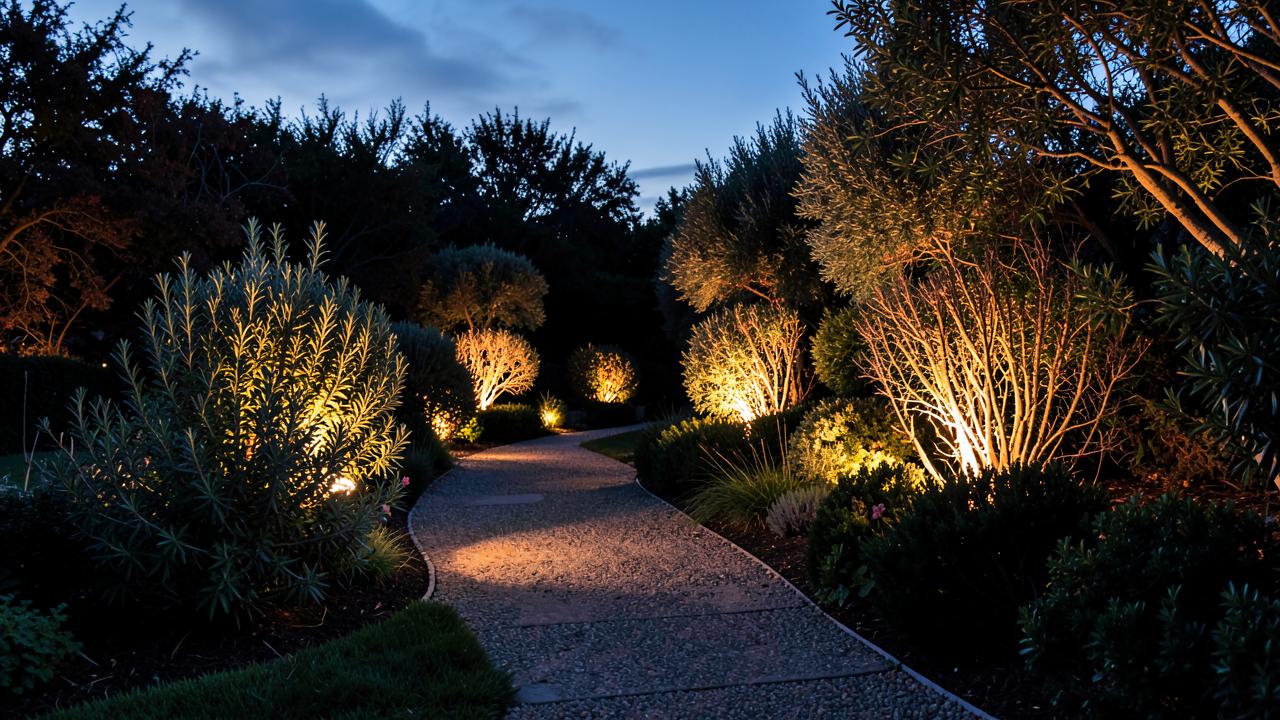
Effective landscape lighting relies on a low-voltage (12V) transformer system, warm 2700-3000K bulbs, and uneven, feature-driven placement rather than uniform spacing along every path edge. The most common mistake is lining a walkway with identical lights at identical intervals, which creates a bright, flat corridor instead of guiding the eye toward specific trees, textures, or architectural details.
What fixture types cover the main landscape lighting jobs?
| Fixture type | Job | Typical placement | Cost per fixture |
|---|---|---|---|
| Path lights | Safety and gentle guidance along walkways/steps | Staggered, alternating sides, 6-10 ft apart, not uniform | $25-60 |
| Uplights (well lights or spikes) | Highlight trees, columns, textured walls | At the base, angled up into the canopy or surface | $30-80 |
| Downlights (moonlighting) | Soft ambient pools of light from tree branches down | Mounted high in mature trees, aimed down through leaves | $35-90 |
| Step/deck lights | Safety on stairs and level changes | Recessed into risers or under rail caps | $20-50 |
| Spotlights/floodlights | Security and broad area coverage | Eaves or corners, motion-activated for security | $40-120 |
Low-voltage or line-voltage — which system should you use?
Low-voltage (12V) systems are the standard for residential landscape lighting: a transformer plugged into a GFCI-protected outdoor outlet steps down household 120V to 12V, and the low-voltage wiring can be buried just a few inches deep without conduit in most jurisdictions, making it far easier and cheaper to install and modify than line-voltage. Line-voltage (120V) outdoor lighting needs conduit-protected wiring, a licensed electrician, and a permit in most areas — reserve it for permanent security floodlights or situations needing very long wire runs where voltage drop on 12V would be a problem.
How do you avoid the 'runway' look?
- Vary spacing — cluster two lights near a feature, then leave a longer dark gap before the next.
- Alternate sides of a path rather than mirroring lights directly across from each other.
- Aim for light overlap, not fixture visibility — you should see glowing ground and foliage, not rows of bright dots.
- Use fewer, stronger uplights on key trees or the house facade instead of many weak lights on everything.
- Keep color temperature consistent across the whole yard at 2700-3000K; mixing warm and cool fixtures looks unplanned.
What does voltage drop mean for a long wire run?
On a 12V system, fixtures far from the transformer (beyond roughly 100 feet of cable) can visibly dim compared to fixtures near it, because voltage drops along the wire length. Fix this by using heavier gauge cable (10-12 AWG instead of 14-16 AWG) for long runs, splitting the layout into multiple shorter runs from a multi-tap transformer, or placing the transformer more centrally in the yard rather than at one corner.
What does a full yard system typically cost?
A DIY low-voltage kit for a modest front yard (transformer, 8-12 fixtures, cable) runs $300-$700 in materials. A professionally designed and installed system for the same scope, including trenching and a smart transformer with app control, typically runs $2,500-$6,000, with larger properties or line-voltage security lighting pushing higher.
How do you choose the right transformer size?
Add up the wattage of every fixture you plan to run (most LED landscape fixtures draw 2-7 watts each), then choose a transformer rated for at least 20-25% more than that total to leave room for adding fixtures later and to avoid running the transformer at its maximum continuous rating, which shortens its lifespan. A modest 10-15 fixture front yard typically needs a 150-300 watt transformer, while larger properties with 25+ fixtures or multiple zones often need a 300-600 watt transformer, sometimes with multiple independently timed outputs so the front yard and backyard can run on different schedules.
How do you keep landscape lighting from becoming a maintenance headache?
- Use connectors rated for direct burial and fill them with dielectric grease or waterproof gel caps — cheap twist-on wire nuts corrode within a season or two buried in damp soil.
- Keep a laminated wiring diagram or photo of the layout before burying cable, since troubleshooting a dark section of the run months later is much faster with a map.
- Choose fixtures with replaceable LED modules or standard bulb bases rather than sealed, non-serviceable units, so a single failed fixture doesn't mean replacing the whole thing.
- Walk the yard at dusk twice a year (spring and fall) to catch tilted uplights, overgrown plants blocking fixtures, and any lenses fogged with condensation before they become a bigger repair.
What's the difference between path lighting for safety and lighting for looks?
Safety-focused path lighting prioritizes even, moderate illumination of walking surfaces and step edges, typically 100-200 lumens per fixture placed close enough together that there are no fully dark gaps a person could misstep into, especially near stairs and grade changes. Aesthetic landscape lighting deliberately embraces contrast and shadow, using fewer, brighter accent lights to create pools of light and darkness that make a yard feel larger and more dramatic at night. Most yards need both: a continuously lit, code-conscious path near stairs and entries, and a separately designed accent layer everywhere else that's allowed to be uneven and moody.
Frequently asked questions
Can I install low-voltage landscape lighting myself?
Yes — low-voltage kits are designed for DIY installation with basic tools: a shovel for shallow trenches, wire strippers, and the included quick-connect clips. The main skill is planning fixture placement well, not the electrical work itself, which involves no exposed high-voltage risk.
How often do landscape lighting transformers or bulbs need maintenance?
LED landscape bulbs typically last 20,000-30,000 hours (many years of dusk-to-dawn use), but fixtures should be checked seasonally for water intrusion, cracked lenses, and settling that tilts uplights off their target, since a shifted uplight can wash light into a neighbor's window instead of a tree.
Is solar landscape lighting a good alternative to wired systems?
Solar path lights work reasonably well for supplemental accent lighting but are noticeably dimmer and less consistent than wired 12V fixtures, especially in winter or shaded yards with less sun exposure. They're a fine low-cost starting point but rarely substitute for a full wired plan on a property you plan to keep long-term.
Run the numbers for your own project
- Energy Savings CalculatorWill this upgrade pay for itself?
- Project Cost EstimatorWhat will this project cost me?
Keep reading
- How Much Paint Do You Actually Need for a Room?The tin says 400 square feet. Your wall says otherwise. Here is the arithmetic that actually holds up.
- Choosing a Fence: Material, Height, and the Rules Nobody ReadsA fence is a twenty-year decision made in an afternoon. Here is what actually differs between the options.
- Flooring Underlayment: What It Does and When You Can Skip ItUnderlayment is the layer nobody sees and the one most likely to cause a callback if it is skipped or mismatched.