Low-Light Houseplants That Actually Survive a Dim Room
By Jim Vernon · 5 min read · Last updated
'Low light' does not mean 'no light.' Here's the difference, and which plants actually close the gap.
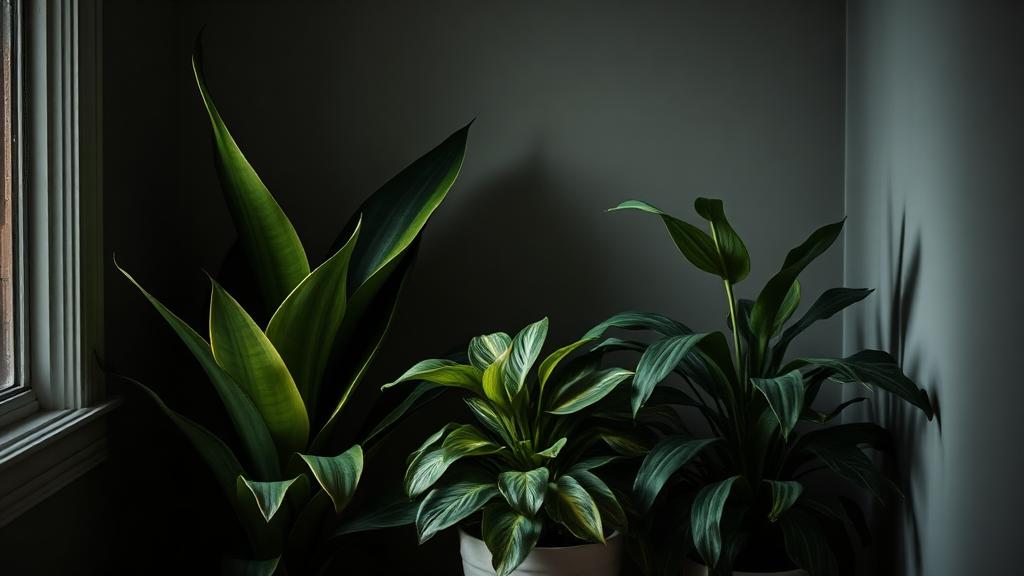
Plant tags and marketing copy use 'low light' loosely, and it leads to a lot of dead plants in windowless bathrooms and dim hallways. There is a real difference between low light — a spot several feet from a window, or a north-facing room — and effectively no light, where a plant receives too little to photosynthesize at all. No houseplant survives long-term in true darkness.
What 'low light' means in practice
A genuinely low-light spot still has enough ambient daylight to read a book comfortably without artificial light during the day. If a room needs a lamp on at midday to see clearly, it's below what any houseplant can sustain long-term without supplemental grow lighting.
Plants that hold up well in true low light
| Plant | Tolerance | Watch for |
|---|---|---|
| Snake plant (Sansevieria) | Excellent — tolerates deep shade | Overwatering, not light, is the main risk |
| ZZ plant | Excellent | Very slow growth in low light is normal, not a problem |
| Pothos | Good, though variegation fades | Solid-green reversion in very low light |
| Cast iron plant (Aspidistra) | Excellent | Slow but extremely tolerant of neglect |
| Peace lily | Good | Wilts dramatically when thirsty, but recovers fast once watered |
| Parlor palm | Good | Prefers even, consistent watering over low light stress |
Plants commonly mislabeled as low-light
- Fiddle leaf fig — needs bright, indirect light and drops leaves quickly in dim rooms.
- Most flowering houseplants, including African violets — flowering requires meaningfully more light than foliage alone.
- Fern varieties like maidenhair — tolerate lower light than sun-lovers but still need bright indirect light, not deep shade.
- Succulents and cacti — nearly all need bright light and struggle badly in low-light rooms despite frequent low-maintenance marketing.
It's also worth noting that leaf size and thinness are rough visual clues to shade tolerance: broad, thin, deep-green leaves generally evolved to capture more light per square inch, while thick, waxy, upright leaves like a snake plant's are built to conserve water in brighter, drier conditions — which is part of why succulents struggle so badly in dim rooms.
Adjusting care for lower light
- Water less often — slower growth means slower water uptake, and low-light soil also dries more slowly, so overwatering risk rises.
- Dust leaves regularly, since dust blocks the already-limited light a plant is receiving.
- Rotate the pot occasionally so growth doesn't lean permanently toward whatever light source exists.
- Skip or reduce fertilizer, since a slow-growing plant in low light has limited use for extra nutrients.
Putting a number on it
Foot-candles give a more useful benchmark than the vague word "low." True low light is roughly 25-75 foot-candles (about 250-800 lux) — a spot several feet back from a north window, or a few feet from an east or west window that never gets direct sun. Medium light runs about 75-200 foot-candles, and bright indirect light, where most tropical foliage plants thrive, is 200-800 foot-candles. Below 25 foot-candles, which is common in interior hallways and windowless bathrooms, only the toughest species — snake plant, ZZ plant, cast iron plant — hold on for more than a few months, and even they eventually decline without at least occasional brighter exposure. A $15-25 lux meter or a basic phone light-meter app gives a rough but genuinely useful reading if you're unsure which category a room falls into.
When a grow light is the honest answer
For a truly windowless room, or for plants that need more than foliage plants tolerate — flowering plants, herbs, or fast growers — a small LED grow light on a timer is often more reliable than hunting for a plant tolerant enough to compensate. It's a more predictable fix than trial-and-error with increasingly shade-tolerant species.
A worked example: measuring your room honestly
Stand where the plant would sit and hold your hand up between the light source and the spot at midday. If it casts a faint, fuzzy shadow, that's typically medium-low light — workable for a pothos or snake plant. If it casts no shadow at all, or the room needs a lamp on to read comfortably at noon, that's the true low-light or no-light zone where only the most tolerant species, or a grow light, will work long-term.
Common mistakes
- Buying a plant tagged 'low light' at a store without checking whether it means low light or merely lower-than-full-sun.
- Compensating for low light by overwatering, on the assumption the plant needs 'something' extra to thrive.
- Expecting a snake plant or ZZ plant in a dark corner to grow at the same rate as one in a bright room.
- Placing flowering plants in low light and blaming the plant when it stops blooming — it's a light problem, not a care problem.
- Skipping leaf dusting, which quietly reduces the already-limited light a low-light plant can use.
Can I move a low-light plant to a brighter spot later?
Yes, but do it gradually over a week or two rather than all at once — a sudden jump to direct sun can scorch leaves that adapted to low light.
Do low-light plants need less water because of the light, or because of slower growth?
Both contribute, but slower growth is the bigger factor — the plant simply isn't using water as fast, and low-light rooms often also have slower evaporation.
Is artificial light as good as natural light for these plants?
A dedicated grow light matched to the plant's needs can fully substitute for natural light. Ordinary room lighting, by contrast, is far too dim to meaningfully help.
Run the numbers for your own project
- Grow Light CalculatorHow high and how long should my grow light run?
Keep reading
- How Much Paint Do You Actually Need for a Room?The tin says 400 square feet. Your wall says otherwise. Here is the arithmetic that actually holds up.
- DIY or Hire a Pro? A Decision Framework That Is Not About MoneyThe labour saving is real. So is the cost of a job done twice — and of tools you use once.
- Storage for Small Rooms That Does Not Make Them SmallerSmall rooms do not need more storage. They need storage that stops interrupting the eye.