How Often Should You Fertilize Houseplants, and With What?
By Jim Vernon · 6 min read · Last updated
More houseplants are damaged by too much fertilizer than by too little — the soil-crust and brown leaf-tip combo is a classic sign of overfeeding.
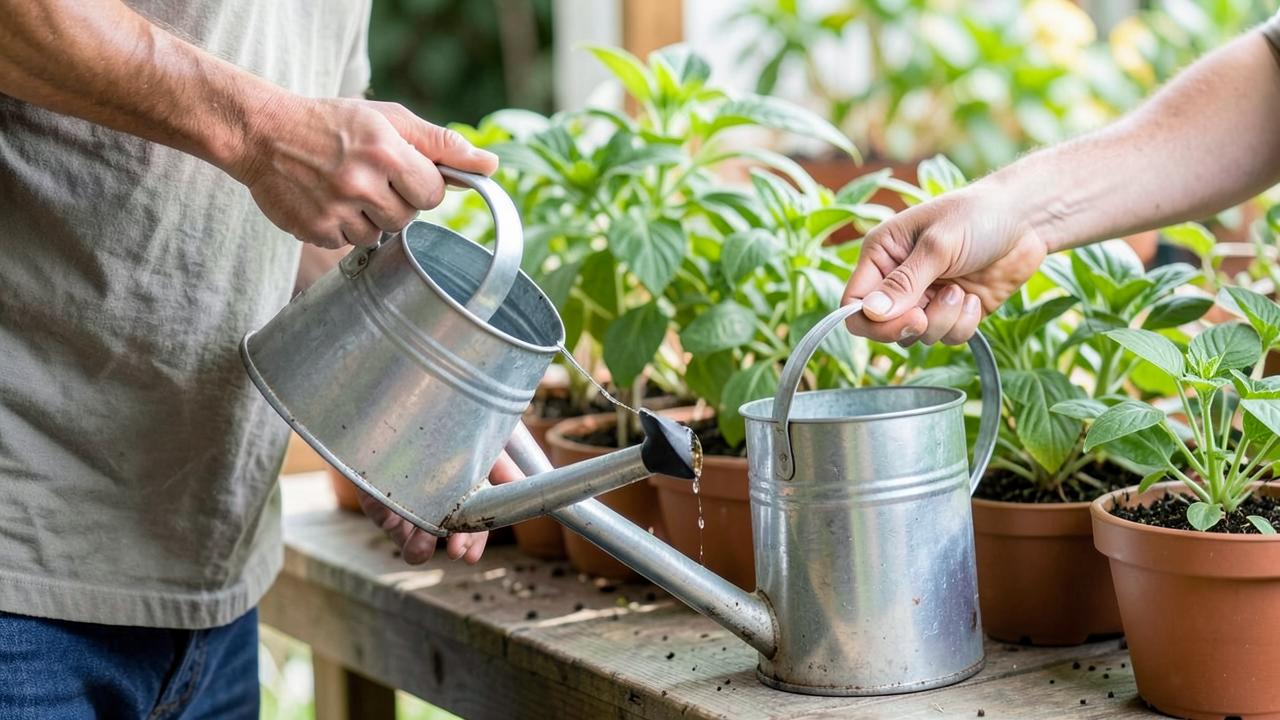
Fertilize most houseplants every four weeks from spring through early fall using a balanced liquid fertilizer diluted to quarter or half strength, then stop or cut back to every 8-10 weeks in winter when growth slows. Potting soil holds enough nutrients for new plants for about six to eight weeks; after that, the plant depends on you to replace what it uses.
What do the three numbers on a fertilizer label mean?
The N-P-K numbers on any fertilizer label are nitrogen, phosphorus, and potassium by percentage. Nitrogen drives leafy green growth, phosphorus supports roots and flowers, and potassium supports overall plant function and disease resistance. For foliage houseplants, a balanced formula like 10-10-10 or one slightly higher in nitrogen works well; for flowering plants like orchids, a formula higher in phosphorus during bud season helps.
| Plant group | Fertilizer type | Frequency (growing season) |
|---|---|---|
| General foliage houseplants | Balanced liquid, 1/2 strength | Every 4 weeks |
| Succulents and cacti | Balanced liquid, 1/4 strength | Every 6-8 weeks |
| Flowering plants (African violets, orchids) | Bloom-formula, higher phosphorus | Every 2-4 weeks while budding |
| Fast growers (pothos, philodendron) | Balanced liquid, 1/2 strength | Every 3-4 weeks |
| All groups, winter | Skip or 1/4 strength | Every 8-10 weeks or not at all |
What happens if you overfertilize?
Excess fertilizer salts build up in the soil and draw water out of roots rather than into them, causing brown, crispy leaf tips and edges, stunted new growth, and sometimes a visible white or yellow crust on the soil surface or pot rim. This is far more common than nutrient deficiency in houseplants, since it's easy to assume more feeding equals more growth.
How do you flush a pot that's been overfed?
- Move the plant to a sink or tub where it can drain freely.
- Pour room-temperature water through the pot slowly, using roughly three times the pot's volume in water.
- Let it drain completely, then repeat once more.
- Hold off on fertilizer for six to eight weeks to let the plant recover.
Do slow-release granules work as well as liquid feed?
Slow-release pellets mixed into the soil surface release nutrients over two to four months and suit people who forget a monthly schedule, but they give less control over timing and dose than liquid fertilizer. Liquid feed lets you skip a feeding when a plant looks stressed; granules keep releasing regardless. Many growers use granules for large, stable plants and liquid feed for anything they're actively coaxing to grow.
Does the type of water you use matter for fertilizing?
Mixing liquid fertilizer with softened water can add sodium that builds up in the soil over repeated feedings, so use regular tap or filtered water for mixing unless your softener specifically uses potassium chloride. Very cold water straight from the tap can shock roots slightly; letting it sit out for an hour to reach room temperature before mixing in fertilizer is a small step that reduces stress, especially for sensitive plants like calatheas and ferns.
How do you adjust fertilizing for a plant that's actively struggling?
Skip fertilizer entirely for any plant showing wilting, significant leaf drop, or signs of pest infestation, since stressed roots absorb fertilizer salts less efficiently and the added concentration can push an already struggling plant toward decline. Resume feeding only once you see healthy new growth for two to three consecutive weeks, starting back at a quarter strength dose even if you'd normally use half strength for that plant.
Do all houseplants need fertilizer at all?
A plant that isn't actively growing — dormant in low winter light, recently repotted, or already fully grown to the size you want — doesn't need fertilizer and won't use it. Fertilizer feeds growth; it doesn't fix problems caused by wrong light or water, and applying it to a stressed plant often makes things worse rather than better.
Does fertilizer schedule change by plant age?
A young, actively rooting plant that was potted up within the last two months usually doesn't need fertilizer yet, since fresh mix still holds nutrients and tender new roots can be burned by even a diluted dose. Mature, well-established plants that have been in the same pot for a year or more benefit from the full recommended schedule, since they've long since used up whatever nutrients came with the original soil. A plant that's been repotted into fresh mix within the past six weeks should skip fertilizer entirely until that window closes.
What are the most common fertilizing mistakes people make?
- Fertilizing at full label strength every time, when most houseplant labels are written for outdoor garden beds, not container plants.
- Feeding on a strict monthly schedule regardless of whether the plant is actively growing or dormant for the season.
- Switching fertilizer brands or formulas frequently, which makes it hard to track whether a plant's response is due to feeding or something else.
- Assuming a droopy or slow-growing plant needs more fertilizer, when the cause is more often light, water, or a pest issue.
- Storing diluted fertilizer solution for weeks, which can degrade or grow bacteria; mix only what you'll use within a day or two.
How do you build a simple fertilizing routine that sticks?
Pick one day a month, tied to something you already do, like the first Saturday grocery run or a recurring phone reminder, and feed everything on the growing-season schedule that day rather than trying to track each plant's individual timing. Group plants by category on a card or spreadsheet — foliage, succulent, flowering — so you're not recalculating dilution ratios from memory each time. Consistency in timing matters more than precision in the exact dose, as long as you're staying within the quarter-to-half-strength range for most houseplants.
Can you use the same fertilizer for all houseplants?
A balanced liquid fertilizer diluted to half strength works safely for most foliage houseplants. Succulents need it more diluted and less often, and flowering plants like orchids benefit from a formula with more phosphorus during their bud and bloom period.
Is fertilizer necessary if you use fresh potting soil every year?
Fresh potting soil supplies nutrients for roughly six to eight weeks, so a plant repotted every year still needs supplemental feeding for the other ten months, just at a lighter, less frequent dose than an older, unrepotted plant.
Should you fertilize a sick or wilting plant?
No. Fertilizer can't fix a light, water, or pest problem and often worsens stress by adding salt concentration to already-struggling roots. Diagnose and correct the underlying issue first, then resume feeding once new healthy growth appears.
How much does a bottle of houseplant fertilizer typically cost?
A concentrated liquid fertilizer bottle runs $8-15 and, diluted to quarter or half strength, lasts most households with a dozen or so plants a full growing season or longer, making it one of the cheaper ongoing costs of houseplant care.
Run the numbers for your own project
- Plant Watering CalculatorHow often and how much should I water this plant?
- Houseplant Light MatcherWhich houseplants suit this window?
Keep reading
- How Much Paint Do You Actually Need for a Room?The tin says 400 square feet. Your wall says otherwise. Here is the arithmetic that actually holds up.
- DIY or Hire a Pro? A Decision Framework That Is Not About MoneyThe labour saving is real. So is the cost of a job done twice — and of tools you use once.
- Storage for Small Rooms That Does Not Make Them SmallerSmall rooms do not need more storage. They need storage that stops interrupting the eye.