How Do You Choose a Kitchen Countertop Material?
By Jim Vernon · 4 min read · Last updated
The showroom sample never tells you which counters actually survive a busy family kitchen.
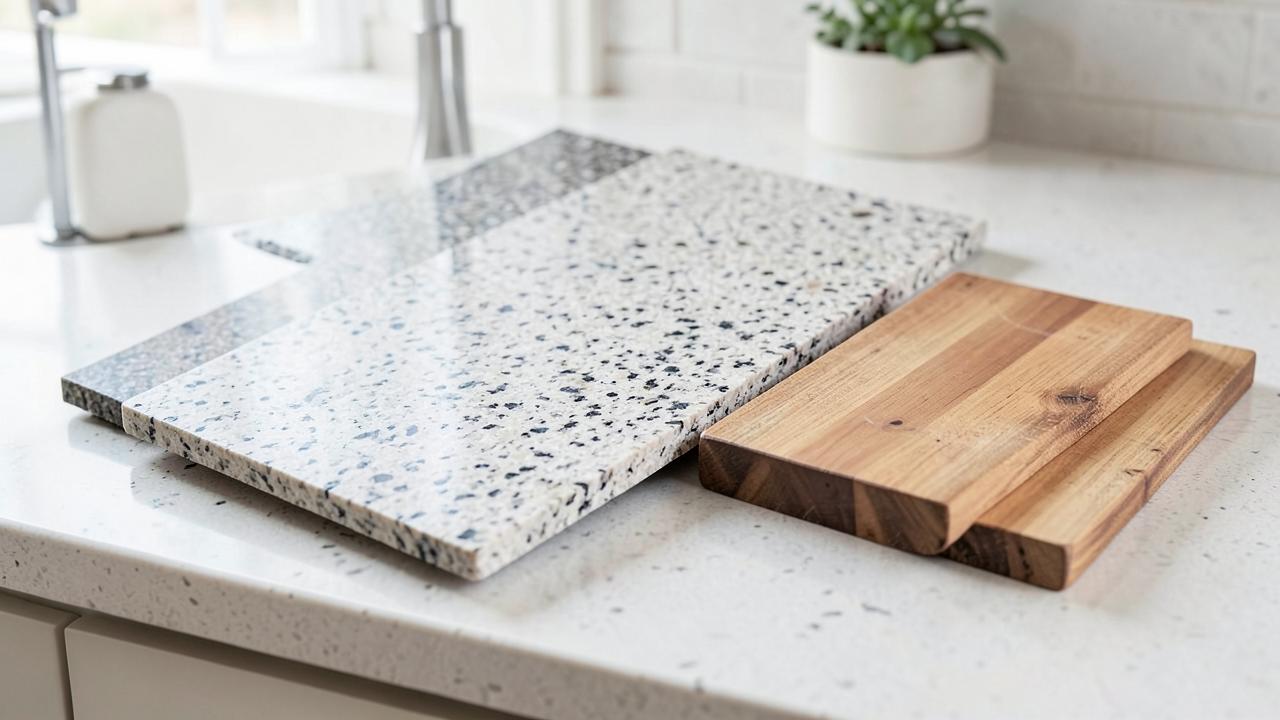
Choose a countertop material by ranking your three biggest risks: heat, scratches, and stains, then matching a material to whichever risk matters most in your kitchen. Quartz resists stains and scratches best with almost no maintenance; granite handles heat well but needs periodic sealing; laminate is the cheapest and least heat-tolerant; butcher block is warm and repairable but needs regular oiling and isn't dishwasher-adjacent friendly.
What does each countertop material actually cost installed?
| Material | Installed cost per sq ft | Heat resistance | Maintenance |
|---|---|---|---|
| Laminate | $20-$50 | Poor, scorches above ~275°F | Wipe clean, no sealing |
| Butcher block | $40-$90 | Poor, scorches, can crack | Oil every 1-3 months |
| Solid surface (acrylic) | $50-$100 | Fair, can discolor from hot pans | Wipe clean, can be sanded |
| Granite | $60-$150 | Excellent | Reseal every 1-3 years |
| Quartz | $70-$150 | Good, but avoid direct pans above 300°F | Wipe clean, no sealing |
| Marble | $75-$200 | Excellent | Reseal every 6-12 months, stains from acid |
Which material holds up best to daily kitchen abuse?
For a busy household that cooks daily and doesn't want a maintenance routine, quartz is usually the best fit because it's non-porous and never needs sealing, though it isn't fully heatproof and a hot pan straight off the burner can still leave a scorch mark or hairline crack near a seam. Granite is the classic choice for people who cook with heavy pans and cast iron since it shrugs off heat, but it does need resealing every 1-3 years to keep resisting oil and wine stains.
When does laminate or butcher block make more sense than stone?
Laminate is the right call for rental properties, flip projects on a tight budget, or any kitchen being fully redone again within 5-10 years, since modern laminate looks convincing from a few feet away at a third of the cost of stone. Butcher block earns its keep on an island used for food prep, chopping, and serving, where its warmth and repairability (sand out a scratch, re-oil) outweigh the fact that it needs more upkeep near a sink.
How do you compare samples honestly before buying?
- Bring a sample home and leave it in your kitchen's actual light for a few days; showroom lighting flatters everything.
- Test a drop of olive oil, red wine, and lemon juice on the sample and let it sit 10 minutes before wiping, to see real stain resistance.
- Set a hot pot holder (not the pan itself) on the sample edge to check for any discoloration.
- Run a key or coin across it firmly to gauge scratch resistance, especially for quartz and solid surface.
- Ask the fabricator specifically where seams will fall in your layout before you sign, since seam placement affects both looks and cost.
How much does a typical kitchen countertop project cost total?
For an average U.S. kitchen with 30-40 square feet of counter, expect $2,000-$4,500 total for granite or quartz including template, fabrication, and install, versus $800-$1,800 for laminate, and $1,500-$3,000 for a butcher block island top plus stone perimeter counters. Removal of old countertops typically adds $150-$400 unless it's part of a full remodel demo.
How do seams and slab size affect the final look and price?
Standard stone slabs run roughly 9-10 feet by 5-6 feet, so any counter run longer than about 9 feet needs at least one seam regardless of budget. Fabricators place seams at the least visible point possible, typically flanking a sink or cooktop rather than crossing the middle of an open run, and a well-fit seam should be nearly invisible to touch and show only a hairline under close light. Expect $200-$500 in extra labor for a large island that needs a seam versus a single continuous slab cut from a jumbo-size sheet, which itself carries a $500-$1,500 upcharge over standard slab sizes.
What warning signs suggest a countertop material won't hold up in your kitchen?
If your household regularly sets hot pots directly on the counter without a trivet, cross laminate and butcher block off the list, since both scorch permanently above roughly 275°F. If acidic spills like tomato sauce, citrus, or wine sit for more than a few minutes before wiping, avoid marble and unsealed granite, which etch or stain even with routine sealing. Heavy chopping directly on the surface will dull knives and scratch quartz and solid surface over time, so a dedicated cutting board area, or a butcher block insert next to a more durable perimeter material, resolves the conflict better than choosing one material to do every job.
Is quartz better than granite for a kitchen?
Neither is universally better; quartz needs no sealing and resists stains slightly better, while granite handles direct heat better and has a more variable natural look. For most families, quartz's low maintenance wins out; for serious cooks who use cast iron directly on the counter, granite is safer.
Can you install a new countertop over existing cabinets without replacing them?
Yes, as long as the cabinets are level, square, and structurally sound. This is a common budget move that saves the cost of new cabinetry while still updating the kitchen's biggest visual surface.
How long does countertop installation take once fabricated?
Physical installation of stone counters usually takes 4-8 hours for an average kitchen, done in a single day, though the templating-to-install lead time is typically 1-3 weeks depending on the fabricator's schedule.
Do laminate counters look cheap now compared to stone?
High-pressure laminate has improved significantly and modern patterns can be mistaken for stone from a few feet away, though the edge profile and seams still give it away up close compared to solid slab stone.
Run the numbers for your own project
- Project Cost EstimatorWhat will this project cost me?
- Kitchen Cabinet Layout PlannerHow many cabinets fit my kitchen wall?
Keep reading
- How Much Paint Do You Actually Need for a Room?The tin says 400 square feet. Your wall says otherwise. Here is the arithmetic that actually holds up.
- DIY or Hire a Pro? A Decision Framework That Is Not About MoneyThe labour saving is real. So is the cost of a job done twice — and of tools you use once.
- Storage for Small Rooms That Does Not Make Them SmallerSmall rooms do not need more storage. They need storage that stops interrupting the eye.