How Do You Soundproof an Interior Door to Block Room-to-Room Noise?
By Jim Vernon · 9 min read · Last updated
If light can get past the edges of your closed door, so can the noise of your family's early morning blender or late-night gaming sessions.
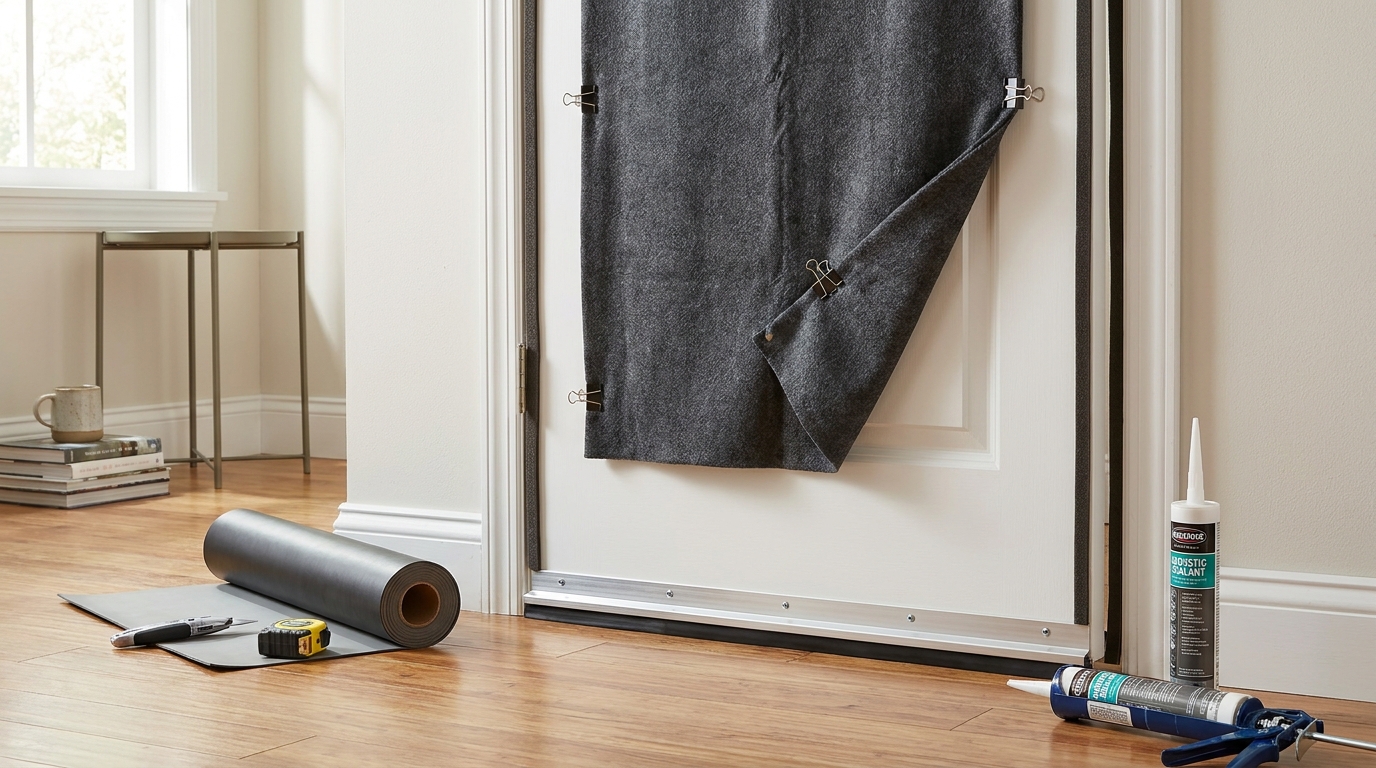
Soundproofing an interior door requires two distinct steps: completely sealing the air gaps around the door's perimeter, and adding physical, heavy mass to the door slab itself. A standard hollow-core bedroom door has a Sound Transmission Class (STC) rating of roughly 20, meaning normal conversation is easily understood through the wood. To effectively block room-to-room noise without tearing out drywall, you must install adhesive acoustic silicone weatherstripping along the jambs, attach an automatic drop sweep at the bottom threshold, and mount a high-density barrier like Mass Loaded Vinyl (MLV) over the door face. Together, these upgrades can push the door's STC rating past 30, effectively cutting perceived noise transfer in half and turning muffled shouts into easily ignored background murmurs.
- Acoustic foam panels only absorb echoes; you must use heavy, dense materials like Mass Loaded Vinyl (MLV) to actually block sound waves from passing through a door.
- Air leaks account for up to 50% of noise transfer. Sealing the door jambs and threshold with silicone and neoprene is mandatory before adding mass.
- Brush sweeps fail to block sound. An automatic drop sweep provides the tight mechanical seal necessary for acoustic isolation.
- Retrofitting a hollow-core door with professional soundproofing materials will cost between $140 and $250 in 2026 dollars.
- Adding an acoustic seal to interior doors also blocks drafts, making it a highly effective DIY project for regulating temperatures in colder USDA Zones.
Why Doesn't Acoustic Foam Block Sound Through a Door?
A classic judgement call a professional acoustician makes differently from a beginner is material selection. A beginner will often buy a pack of cheap egg-crate acoustic foam, staple it to the back of a bedroom door, and expect it to block the TV noise from the living room. It will completely fail. Foam only absorbs high-frequency reflections and echoes inside the room it faces. It lacks the density to stop sound waves from pushing through the physical barrier.
Professionals know that blocking sound transmission requires sheer, dense mass. To stop noise from traveling through a hollow door, you need a heavy, non-porous barrier that forces sound waves to expend their energy. This is why pros skip the foam and immediately reach for Mass Loaded Vinyl (MLV) or specify an upgrade to a heavy, solid-core wood door. If a material isn't heavy enough to strain your back when lifting it, it isn't heavy enough to block low- and mid-frequency noise.
- Acoustic foam improves in-room sound quality (like for recording) but does not block transmission.
- Mass Loaded Vinyl (MLV) is a heavy, flexible rubber-like material engineered specifically to stop sound.
- If you want aesthetics and mass, consider a specialized acoustic door blanket with an MLV core rather than bare foam.
How Do You Seal the Gaps Around the Door Jamb?
Sound acts exactly like water; if there is a tiny leak, the noise will flood right through it. The 1/4-inch (6 mm) to 3/8-inch (9 mm) gap between your door and the jamb is a massive flanking path for sound. Because most interior doors do not have kerfs (slits) for push-in weatherstripping like exterior doors do, you must rely on surface-mounted seals.
To properly seal the jambs, clean the door stops with rubbing alcohol. Apply an adhesive-backed silicone bulb seal directly to the stop molding so that the door compresses the bulb slightly when closed. Alternatively, you can install specialized acoustic stop molding—wood strips fitted with heavy-duty neoprene gaskets—by screwing them directly into the door frame. Ensure the seal runs the entire perimeter with zero breaks at the top corners.
- Use D-shaped or teardrop-shaped silicone bulb seals for the best compression and memory retention.
- Avoid cheap, open-cell foam tape, as sound passes easily through its porous structure.
- Adjust the door's strike plate so the door latches tightly against the new weatherstripping.
How Do You Block Sound From Leaking Under the Door Bottom?
One of the most common failure modes in DIY door soundproofing is installing a standard nylon brush sweep at the bottom threshold. Brush sweeps are designed to stop large dust bunnies and insects, but sound waves pass right through the bristles unimpeded. If you leave a 1/2-inch (1.2 cm) gap at the bottom of an otherwise soundproofed door, the entire project is compromised.
To avoid this, you must install an automatic door bottom. This is a spring-loaded mechanical device that mounts to the face or bottom edge of the door. When the door closes, a small plunger presses against the door jamb, dropping a heavy neoprene rubber seal firmly against the floor or threshold. When you open the door, the seal automatically retracts so it doesn't drag on your carpet or scratch your hardwood.
- Purchase an automatic door bottom that matches the exact width of your door, typically 30, 32, or 36 inches (76, 81, or 91 cm).
- Surface-mounted automatic bottoms are easiest for DIYers, while mortised versions require a router and sit hidden inside the door.
- If you have deep pile carpet, install a low-profile wood or metal threshold directly under the door so the sweep has a hard surface to compress against.
How Do You Add Mass to a Hollow-Core Door Without Replacing It?
Most interior doors are basically two thin sheets of wood veneer glued over a honeycomb cardboard core. They weigh barely 30 pounds (13.6 kg) and vibrate easily, acting like a drum skin for noise. To add mass without buying a new door, you can mount a sheet of Mass Loaded Vinyl (MLV) directly to the door's surface.
You will need MLV rated at 1 pound per square foot (4.8 kg/m²). For a standard 80-by-32-inch door (203 by 81 cm), the vinyl alone will weigh about 18 pounds (8.1 kg). Because of this weight, you cannot just glue it. You must secure it with heavy-duty staples or roofing nails with wide plastic washers. Cut the MLV to the exact dimensions of the door slab minus 1/4-inch (6 mm) on all sides to prevent it from binding in the frame. Cover the bare vinyl with an aesthetic fabric or a thin wood veneer if you want to hide the industrial look.
- Never stretch MLV drum-tight; hanging it slightly loose allows it to better absorb and dissipate sound vibrations.
- Ensure your door hinges are securely screwed into the framing to handle the extra 18 to 20 pounds (8 to 9 kg) of weight.
- Seal the edges of the cut MLV with acoustic sealant to prevent any sound from slipping behind the barrier.
How Do You Treat the Door Frame Itself for Hidden Sound Leaks?
Even if you modify the door slab perfectly, noise can still travel through the walls. During construction, builders leave a rough opening that is larger than the door frame, resulting in a hollow void behind the decorative trim (casing) that surrounds your door. This empty channel acts as an echo chamber for noise traveling between rooms.
Carefully pry off the door casing using a stiff putty knife and a pry bar. You will likely see a 1/2-inch (1.2 cm) gap between the door jamb and the drywall. Fill this gap completely with specialized acoustic sealant or non-hardening acoustical caulk. Do not use standard high-expansion spray foam, as it is too light and rigid to block sound waves effectively. Once the gap is filled, reinstall the trim and caulk the edges.
- Use backer rod (foam rope) to fill gaps wider than 3/8-inch (9 mm) before applying acoustic sealant.
- Acoustical sealant remains permanently rubbery, allowing it to move with the house framing without cracking.
- Pry trim off gently by placing a scrap block of wood behind your pry bar to avoid denting the drywall.
Does Upgrading to a Solid-Core Door Make a Better Sound Barrier?
If the idea of nailing black industrial vinyl to your bedroom door doesn't appeal to you, replacing the hollow-core slab with a solid-core wood or MDF door is the best permanent alternative. A solid-core door weighs between 70 and 90 pounds (31 to 40 kg) and naturally provides the mass needed to block low-frequency sounds.
Swapping the slab will instantly upgrade your baseline STC rating from a 20 to approximately a 30. However, buying a solid door does not give you a free pass on sealing air leaks. A heavy solid-core door with a 1/2-inch (1.2 cm) gap at the bottom will still let in nearly as much noise as a hollow door. You must still install the silicone jamb seals and the automatic drop sweep to reap the benefits of the heavy wood.
- Solid MDF doors offer excellent acoustic dampening properties and are often cheaper than solid hardwood.
- You can usually buy just the "slab" and reuse your existing door frame if it is square and plumb.
- Always replace standard hinge screws with 3-inch (7.6 cm) screws driven into the wall studs to support the heavier solid door.
What Is the True Cost of Soundproofing an Interior Door in 2026?
The cost of your project depends entirely on whether you choose to retrofit your existing hollow-core door or replace it with a solid-core slab. The required acoustic weatherstripping for the jambs will cost between $15 and $30. A high-quality surface-mounted automatic drop sweep ranges from $45 to $85. Therefore, simply sealing the air gaps around an existing door will cost roughly $60 to $115 in materials.
If you want to add mass to a hollow door, a roll of 1 lb/sq ft MLV will add another $50 to $90 to the project. Alternatively, purchasing a new solid-core MDF door slab will cost between $150 and $250. Factoring in the seals and sweep, a full solid-core upgrade will run between $250 and $400. In both scenarios, the investment is a fraction of the cost of tearing open walls to install acoustic insulation.
- Basic air-sealing (Sweep + Weatherstripping): $60 - $115.
- Full DIY Retrofit (Sweep + Seals + MLV): $140 - $250.
- Solid-Core Replacement (Door + Sweep + Seals): $250 - $400.
| Door Configuration | Estimated STC Rating | Perceived Noise Reduction | 2026 DIY Cost Range |
|---|---|---|---|
| Standard Hollow-Core (Unsealed) | 20 | Baseline (Loud speech understood) | $0 |
| Hollow-Core + Seals & Automatic Sweep | 24 - 26 | Noticeable (Speech muffled) | $60 - $115 |
| Hollow-Core + Seals + MLV Sheet | 28 - 31 | Significant (Speech mostly blocked) | $140 - $250 |
| Solid-Core Door + Seals & Sweep | 32 - 35 | Excellent (Shouting is barely heard) | $250 - $400 |
Frequently asked questions
Can I just hang a heavy moving blanket over the door to stop noise?
A standard moving blanket will only muffle very high-frequency sounds, like a hissing radiator or a ticking clock. It lacks the heavy mass required to block mid-frequency voices or low-frequency bass from a TV. If you want a blanket solution, you must purchase a specialized acoustic door blanket with an internal core of Mass Loaded Vinyl or fiberglass, which weighs 15 pounds or more.
Does adding acoustic weatherstripping make an interior door hard to close?
Yes, initially. Silicone bulb seals and neoprene stops require physical compression to form an airtight, sound-blocking seal. You will likely need to push the door slightly harder to latch it. If the door refuses to latch, you may need to unscrew the metal strike plate on the jamb and move it outward by 1/8-inch (3 mm) to accommodate the new thickness of the weatherstripping.
What is STC and why does it matter for doors?
STC stands for Sound Transmission Class. It is a standardized rating that measures how well a building material attenuates airborne sound. A hollow door has an STC of about 20. A solid wall has an STC of around 35 to 40. In acoustics, an increase of 10 STC points feels like the perceived noise has been cut exactly in half. Pushing your door from STC 20 to STC 30 makes a massive difference in room comfort.
Will expanding spray foam around the door frame block sound?
Standard expanding polyurethane foam (like Great Stuff) is extremely lightweight and full of air bubbles. It stops drafts beautifully but does not block sound waves. To block noise in the gaps behind your door casing, you must use a heavy, dense material like acoustical sealant, non-hardening caulk, or tightly packed mineral wool insulation.
Keep reading
- How Much Paint Do You Actually Need for a Room?The tin says 400 square feet. Your wall says otherwise. Here is the arithmetic that actually holds up.
- DIY or Hire a Pro? A Decision Framework That Is Not About MoneyThe labour saving is real. So is the cost of a job done twice — and of tools you use once.
- Storage for Small Rooms That Does Not Make Them SmallerSmall rooms do not need more storage. They need storage that stops interrupting the eye.