How Do You Paint an Exterior Brick House So It Breathes and Doesn't Peel?
By Jim Vernon · 11 min read · Last updated
Slapping a cheap coat of latex paint over exterior brick is a guaranteed recipe for trapped moisture, flaking paint, and permanently crumbling masonry.
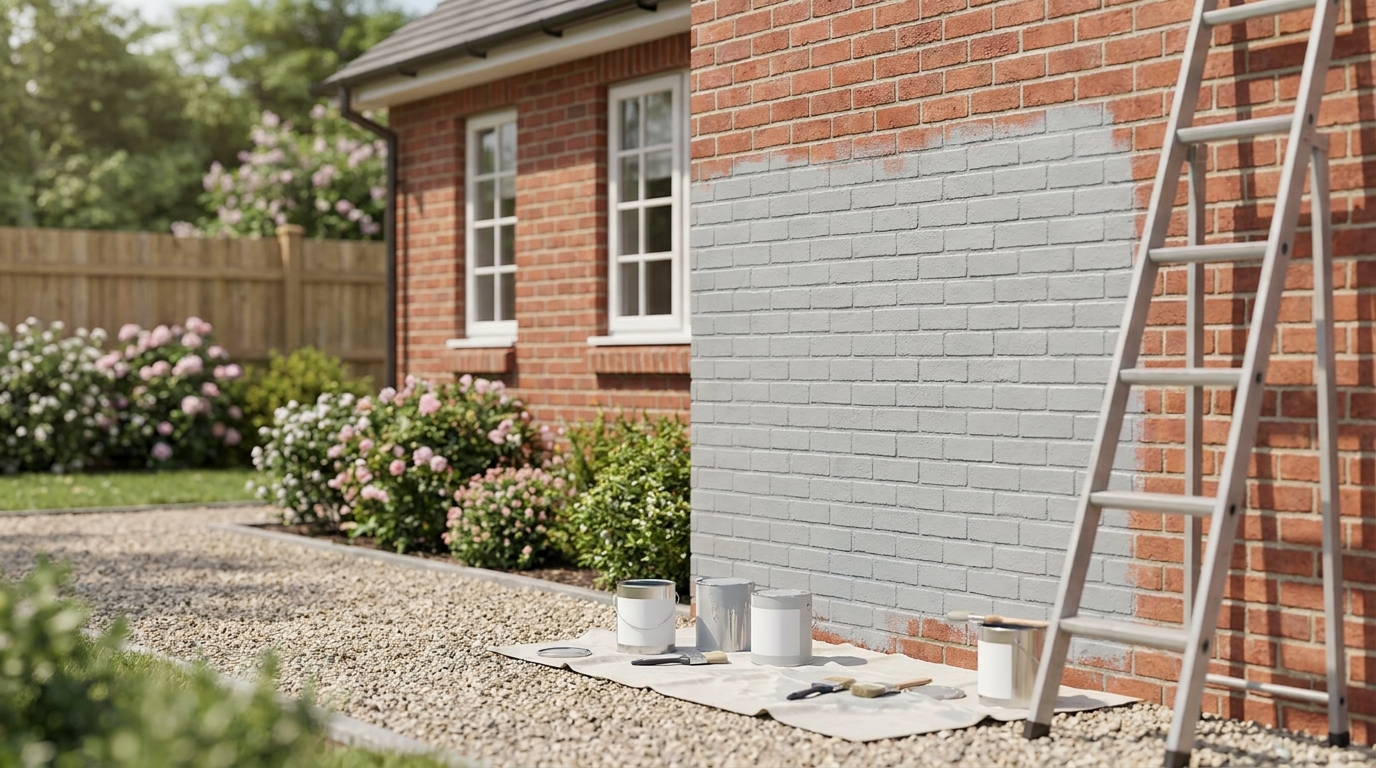
To safely paint an exterior brick house without causing the masonry to rot or peel, you must use a highly vapor-permeable coating like mineral silicate paint or limewash instead of standard acrylic latex paint. Traditional house paints create a plastic film over the wall, trapping moisture inside the porous brick. When that moisture freezes, it breaks the face off the brick entirely in a destructive process called spalling. By skipping the latex and applying two coats of breathable potassium silicate paint, you create a permanent, weatherproof bond that allows the brick to release moisture naturally as a vapor. This ensures your exterior finish lasts for decades without ever flaking, chipping, or bubbling. Painting brick is a permanent decision, so proper cleaning, meticulous mortar repair, and investing in high-grade mineral coatings are mandatory to maintain the structural integrity of your home.
- Never use standard acrylic or elastomeric latex paints on exterior brick; they trap moisture and cause the brick faces to shatter during freezes.
- Choose potassium silicate paint for a permanent, opaque finish that chemically bonds to the brick and lasts 50+ years.
- Opt for limewash if you want a historically accurate, chalky finish that slowly weathers and wears away over 5 to 7 years.
- Repair damaged mortar with a matching Type N or Type O mortar before painting; never use hard Type S Portland cement on vintage brick.
- Strip any existing latex paint completely using chemical peel-away strippers before applying breathable mineral paints.
Why does standard house paint destroy exterior brick?
Brick and mortar are inherently porous materials designed to absorb rainwater and ground moisture, holding it temporarily before releasing it back into the air as a vapor. This exchange requires a coating with a high vapor permeability rating. Standard exterior acrylic latex paints, and especially thick elastomeric paints, have very low vapor permeability (often less than 10 perms). They act like a plastic trash bag wrapped around your house. While they stop rain from hitting the brick directly, they also completely block internal moisture from escaping.
The most common failure mode when painting brick is trapping moisture behind this plastic-like film. Moisture inevitably enters the wall system through roof leaks, window frames, or capillary action from the soil. Once inside, it tries to evaporate but hits the latex barrier. In cold climates, this trapped water freezes and expands. Because the ice has nowhere to go, it literally blows the hard, protective outer face off the brick in a catastrophic process known as spalling. Once the soft interior of the brick is exposed, the wall will degrade rapidly.
To prevent this, exterior brick requires a coating with a vapor permeability of at least 60 perms. Mineral paints and limewashes exceed this rating, allowing moisture vapor to pass right through the coating as if the brick were still completely bare.
- Standard latex paint acts as a moisture vapor barrier.
- Trapped moisture expands during freeze-thaw cycles, destroying the brick.
- Spalling is irreversible and requires cutting out and replacing the ruined bricks.
Should you choose mineral silicate paint or limewash?
This is the ultimate judgment call a professional mason makes differently from an eager beginner. A beginner heads to the big box store, buys a heavy-duty masonry primer and an exterior acrylic, and attempts to 'seal' the brick against the weather. A pro understands that brick walls must breathe, so they choose either a potassium silicate paint or a traditional slaked limewash, depending on the desired lifespan of the finish.
Limewash is made from crushed limestone that has been burned and mixed with water to create lime putty. When applied to brick, it reacts with carbon dioxide in the air to calcify into a hard, breathable crust. However, limewash is designed to slowly erode. It typically lasts 5 to 7 years before it needs a recoat, creating a beautiful, distressed, old-world patina as it weathers. If you want a uniform, solid color that never changes, limewash will disappoint you.
Potassium silicate paint, often called liquid glass, is the ultimate choice for a permanent, opaque finish. Instead of just drying on the surface, the silicate reacts chemically with the silica in the brick and mortar, petrifying into a permanent microcrystalline bond. Mineral silicate paint will never peel, flake, or blister, and it easily lasts 50 to 80 years. It provides the solid, uniform look of standard house paint but maintains 100% of the brick's natural breathability.
- Limewash gives a distressed, chalky look and requires reapplication every 5-7 years.
- Silicate paint provides a permanent, solid color that lasts 50+ years.
- Both options are highly breathable and physically bond to the masonry.
How do you clean and repair brick before painting?
Before applying any mineral coating, the brick must be completely bare, clean, and structurally sound. Start by washing the wall to remove dirt, efflorescence (white salt stains), and algae. Never use a high-pressure washer above 1,500 psi (103 bar) with a zero-degree nozzle, as this will blast the protective fire-skin off the brick. Instead, use a pump sprayer to apply a specialized masonry cleaner or a diluted TSP (trisodium phosphate) solution, scrub with a stiff nylon bristle brush, and rinse gently with a garden hose.
Once the wall is clean and dry, inspect the mortar joints. Mineral paints will not bridge gaps or fix crumbling mortar. Any loose, sandy, or missing mortar must be ground out to a depth of 3/4 inch (19 mm) and repointed. It is critical to use the correct mortar for your brick's age. For homes built before 1930, use a softer, high-lime Type O mortar. For modern homes, use Type N. Never use high-strength Type S Portland cement on vintage brick, as it is harder than the brick itself and will cause the brick to crack as the house settles.
After repointing, you must wait a minimum of 20 to 30 days for the new mortar joints to fully cure. Applying silicate paint or limewash over uncured mortar will disrupt the chemical bonding process and lead to blotchy, discolored patches.
- Keep pressure washers below 1,500 psi (103 bar) to protect the brick face.
- Repoint damaged mortar with Type N or Type O mix, avoiding hard Type S.
- Allow all new mortar repairs to cure for 30 days before painting.
What tools and materials do you need to paint brick?
Painting exterior brick requires specific application tools that can handle the rough texture and liquid consistency of mineral coatings. Because silicate paints and limewashes are thinner than acrylic paints, standard rollers will splatter aggressively. You will need a thick 3/4-inch (19 mm) to 1-inch (25 mm) nap roller cover designed specifically for rough masonry. Lambswool or high-density polyester blends work best for holding the watery paint and working it into the recessed mortar joints.
For cutting in around windows, doors, and rooflines, ditch the standard angled trim brush. You need a 4-inch (10 cm) block masonry brush with stiff bristles. This allows you to stipple the paint deep into the porous surface of the brick rather than just wiping it across the top. You will also need heavy-duty canvas drop cloths. Mineral paints are highly alkaline, and if you drip them onto glass, aluminum window frames, or concrete patios, they will permanently etch the surface if not wiped up immediately.
In terms of materials, expect to purchase a dedicated silicate primer (often called a base coat or diluent) and the topcoat paint. Leading brands in the US include Romabio and Keim. In 2026, a gallon of premium potassium silicate paint costs between $120 and $160, and it generally covers 150 to 200 square feet (14 to 18 sq meters) per gallon on unpainted, highly porous brick.
- Use a 3/4-inch (19 mm) or 1-inch (25 mm) nap roller for rough textures.
- Apply paint with a stiff 4-inch (10 cm) masonry block brush for edges.
- Protect glass and metal meticulously, as silicate paint permanently etches them.
How do you properly apply mineral silicate paint?
Applying potassium silicate paint is a two-coat process that requires specific weather conditions. The ambient and surface temperatures must remain between 50°F and 85°F (10°C to 29°C) for the duration of the painting and the initial 12-hour drying period. Do not paint in direct, blazing sunlight, as the heat will flash-dry the paint before it has a chance to chemically bond with the brick.
The first coat is your primer and bonding layer. For unpainted brick, the first coat of silicate paint must usually be diluted by 10% to 20% using the manufacturer's specific silicate thinner (never use tap water, which contains minerals that disrupt the chemical reaction). Work in small 4-by-4 foot (1.2-by-1.2 meter) sections, cutting in the edges first and immediately rolling the center. Always maintain a 'wet edge.' If you let a section dry and then try to overlap wet paint onto it, you will create permanent, visible lap marks.
Allow the first coat to dry and cure for exactly 12 hours. The second coat is applied undiluted straight from the bucket. Use the same technique, pressing the thick nap roller firmly against the wall to ensure the paint saturates every crevice of the mortar joints. Once the second coat is dry to the touch, it is waterproof, though the full petrification process inside the brick takes up to 14 days to complete.
- Paint only when temperatures are steadily between 50°F and 85°F (10°C to 29°C).
- Dilute the first coat by 10-20% with the manufacturer's specialized thinner.
- Wait 12 hours between coats and always maintain a wet edge to avoid lap marks.
Can you apply breathable paint over previously painted brick?
If your brick house has already been painted with a standard acrylic latex, you cannot simply paint over it with mineral silicate paint or limewash. Silicate paint requires bare, porous masonry to achieve its chemical bond. If you apply it over old latex, it will simply slide off or peel within a few months because the plastic film blocks the petrification process.
To switch to a breathable coating, you must completely strip the old paint. This is a labor-intensive and expensive process. You cannot use abrasive sandblasting, which ruins the brick. Instead, you must use heavy-duty chemical paint strippers, such as Peel Away 1 or Dumond Smart Strip. These thick alkaline pastes are troweled onto the wall, covered with specialized paper, and left to dwell for 24 hours.
Once the old paint softens, it is carefully scraped off, and the residue is washed away with a hot water pressure washer set to a low psi. The wall must then be neutralized with a mild acid wash before any new mineral paint can be applied. If stripping the whole house is out of the budget, you are unfortunately locked into continuing to use latex exterior paints, though you should choose one with the highest vapor permeability rating possible.
- Mineral paints cannot bond to brick that is covered in acrylic latex.
- Old paint must be removed with chemical strippers, never by sandblasting.
- Walls must be neutralized after chemical stripping before repainting.
How much does it cost to paint a brick house properly in 2026?
Because specialized mineral paints are a premium product, the material costs are significantly higher than walking out of a hardware store with standard exterior latex. For a standard 2,000-square-foot (185 sq meter) single-story house with roughly 1,500 square feet (139 sq meters) of exterior brick, you will need approximately 15 gallons of silicate paint to complete both the diluted first coat and the undiluted second coat.
At $120 to $160 per gallon, your paint materials will cost between $1,800 and $2,400. Factoring in specialized thinners, heavy-duty rollers, masonry brushes, drop cloths, and masonry cleaner, a DIY project will run close to $2,500 to $3,000 in materials alone.
If you hire a professional masonry painting crew, the labor costs increase the budget significantly. Proper prep, mortar repair, masking, and meticulous application will push the total cost of a professional silicate paint job to between $7,000 and $10,500. While this is steep compared to a $4,000 latex paint job, the mineral finish is a one-time, permanent investment. You will never have to scrape, patch, or repaint your brick again in your lifetime.
- DIY material costs for a 2,000-sq-ft home average $2,500 to $3,000.
- Professional application ranges from $7,000 to $10,500.
- Mineral paint is a permanent application, eliminating future repainting costs.
| Feature | Standard Acrylic Latex | Traditional Limewash | Mineral Silicate Paint |
|---|---|---|---|
| Vapor Permeability | Low (<10 perms) - Traps moisture | High (70+ perms) - Fully breathable | High (70+ perms) - Fully breathable |
| Spalling Risk | High (Causes freeze-thaw damage) | Zero | Zero |
| Lifespan | 5 to 10 years (Peels and blisters) | 5 to 7 years (Weathers naturally) | 50+ years (Permanent chemical bond) |
| Finish Look | Plastic film, uniform color | Chalky, distressed patina | Flat, uniform, natural stone look |
| 2026 Material Cost per Gallon | $40 - $70 | $60 - $90 | $120 - $160 |
Frequently asked questions
Can you tint mineral silicate paint to any color?
Yes, mineral silicate paint can be tinted to almost any color, but it must be done using inorganic mineral pigments. Standard liquid colorants used at hardware stores for acrylic paints will destroy the silicate chemistry. Always order pre-tinted paint directly from the manufacturer.
How long does a painted brick house take to dry before it can rain?
Silicate paint needs about 12 to 24 hours of dry weather to become rain-resistant. However, the chemical petrification process inside the brick continues for 14 days. Avoid painting if heavy rain is forecast within the next 48 hours.
Does painting brick lower the value of a house?
Painting brick with standard latex often lowers the value of a historic home because buyers know it traps moisture and causes expensive spalling damage. However, using a high-end, permanent mineral paint or limewash is generally viewed favorably because it modernizes the exterior without compromising the structure.
Can I spray mineral paint instead of rolling it?
Yes, but you must use a professional airless sprayer with a large tip (e.g., .019 to .021) and remove all internal filters from the spray gun to prevent the thick mineral particles from clogging the machine. Even if sprayed, the first coat must still be back-rolled vigorously to push the paint into the masonry.
Keep reading
- How Much Paint Do You Actually Need for a Room?The tin says 400 square feet. Your wall says otherwise. Here is the arithmetic that actually holds up.
- DIY or Hire a Pro? A Decision Framework That Is Not About MoneyThe labour saving is real. So is the cost of a job done twice — and of tools you use once.
- Storage for Small Rooms That Does Not Make Them SmallerSmall rooms do not need more storage. They need storage that stops interrupting the eye.