How Do You Install a Stair Runner Over Hardwood Without Ruining the Treads?
By Jim Vernon · 10 min read · Last updated
A bare hardwood staircase is a beautiful architectural feature right up until a slipped sock turns it into a dangerous slide.
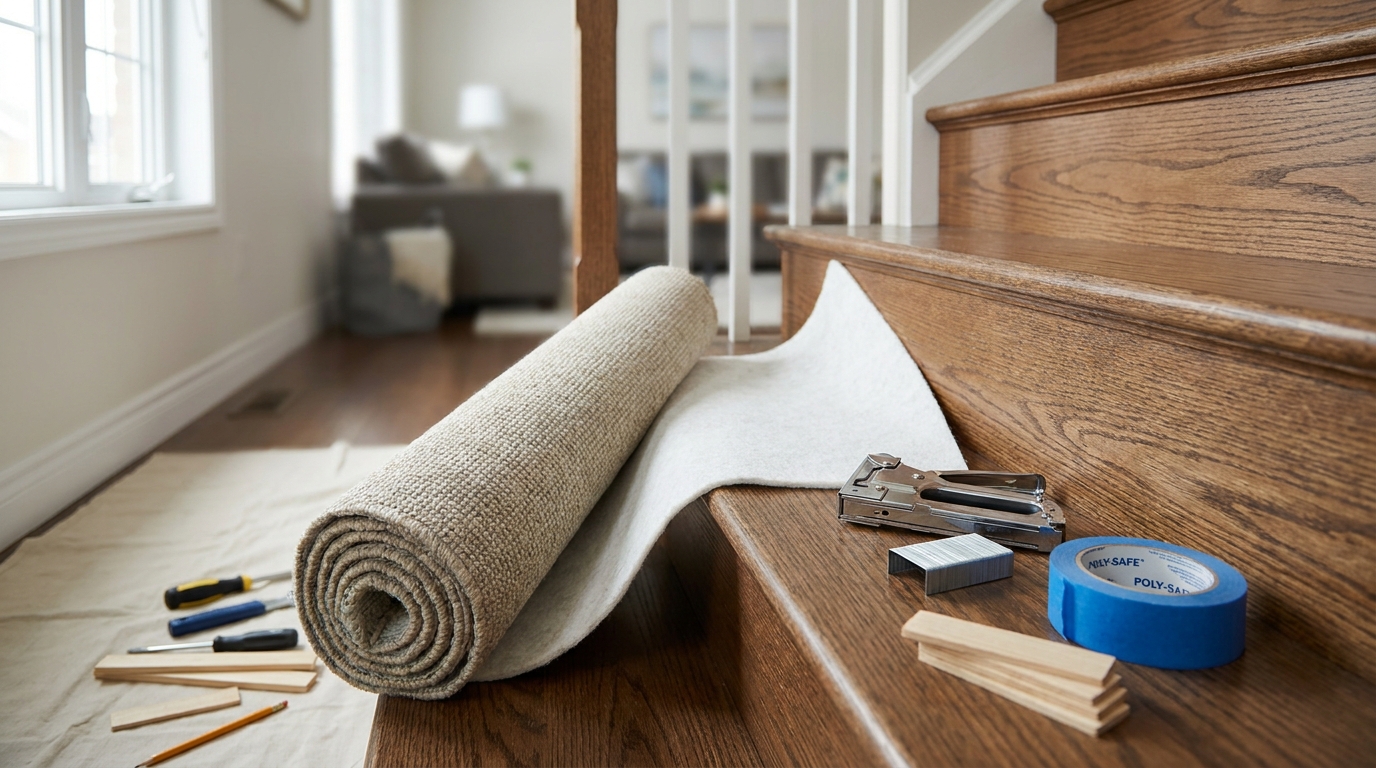
To install a stair runner without ruining your hardwood treads, you must secure the carpet exclusively in the tight joint where the tread meets the riser and directly beneath the overhanging bullnose using a narrow-crown pneumatic stapler and 9/16-inch staples. This approach, known as the Hollywood installation style, entirely avoids driving fasteners into the highly visible flat surfaces of your wooden steps. Adding a runner reduces slipping hazards, protects the high-traffic center of your stairs from scratches, and deadens house noise, but many homeowners hesitate to start this project because they fear permanently damaging expensive oak or maple finishes. By using polyurethane-safe acrylic carpet tape instead of heavy glue or staples for the under-pad, and hiding a minimal number of fine-wire staples deep in the shadow lines of the stair joints, you can safely carpet your stairs today and retain the option to easily revert to pristine hardwood in the future.
- Use a pneumatic upholstery stapler with an extended nose to drive staples deep into the stair crevices where holes remain invisible.
- Fasten the carpet pad with dual-sided acrylic tape, not rubber-based tape or staples, to prevent damaging the polyurethane floor finish.
- Cut the under-pad 2 inches narrower than the runner and stop it 1 inch short of the bullnose to avoid a sloppy, bulky edge.
- Never splice two carpet rolls together in the middle of a step; always hide seams in the tight corner where the tread meets the back riser.
What Materials and Tools Do You Need to Install a Stair Runner?
A successful stair runner installation requires tools that deliver precision without brute force. A standard flight of 13 stairs typically requires 18 to 22 feet (5.5 to 6.7 meters) of continuous runner carpet. Woven wool and synthetic blends are the easiest to bend around tight corners, while stiff jute or sisal runners will fight you on every step.
The biggest judgement call a professional makes differently from a beginner is tool selection. Beginners frequently attempt this project with a standard manual hammer-tacker or a heavy-duty T50 staple gun. Manual staplers lack the force to drive flush into dense woods like red oak or maple, causing the stapler to bounce, bend the wire, and leave sharp metal loops sticking out to snag socks. Professionals always use a 20-gauge or 22-gauge pneumatic upholstery stapler equipped with an extended nose. The extended nose is critical because it fits tightly into the 90-degree corner of the stair crotch, ensuring staples are driven flush at exactly the right angle.
- 20-gauge pneumatic upholstery stapler with an air compressor
- 9/16-inch (14 mm) narrow-crown upholstery staples
- Dense 1/4-inch (6 mm) thick felt carpet pad (avoid cheap foam)
- Polyurethane-safe, double-sided acrylic carpet tape
- Carpet tucking tool or a dull, broad 5-inch putty knife
- Heavy-duty carpet shears or a fresh utility knife
How Do You Center and Measure a Runner on Standard Stairs?
Precision alignment is the most visible element of a quality runner job. If the runner drifts even a quarter-inch left or right as it climbs, the entire staircase will look crooked. Most residential stair treads are 36 inches (91 cm) wide, while standard prefabricated runners are either 27 inches (68 cm) or 30 inches (76 cm) wide. To find your margins, subtract the runner width from the tread width, then divide the remaining number by two.
For a 36-inch stair and a 27-inch runner, you will have exactly 4.5 inches (11.4 cm) of bare hardwood exposed on each side. Rather than using a tape measure on every single step, cut a piece of scrap wood to exactly 4.5 inches to act as a spacer block. As you work your way up the staircase, push this block against the stair skirt board or wall to quickly and perfectly align the edge of the runner on every tread.
- Measure the exact width of your stair treads and your chosen runner.
- Calculate the reveal by subtracting the runner width from the tread width and dividing by two.
- Cut a wooden spacer block exactly to the width of the reveal.
- Use painter's tape to visually mark the edges before you begin stapling.
What Is the Best Way to Install the Carpet Pad Without Damaging the Wood?
The under-pad adds cushioning and extends the life of your runner by preventing the hard edge of the stair from slicing through the carpet backing over time. However, you cannot staple the pad to the floor. Staples in the flat face of the tread will be visible if you ever remove the runner, and the runner needs to float smoothly over the pad rather than being pinched down.
Instead, secure the pad using a high-quality, dual-sided acrylic carpet tape. Ensure the ambient room temperature is at least 65°F (18°C) so the acrylic adhesive bonds properly. Cut each pad strip 2 inches (5 cm) narrower than the runner (leaving a 1-inch or 2.5 cm gap on each side) so the pad never peeks out from under the carpet edges. For the depth, cut the pad so it rests against the back riser and ends 1 inch (2.5 cm) shy of the front bullnose edge. Wrapping thick felt pad completely over the bullnose creates a bulging, rounded profile that wears out quickly and looks unprofessional.
- Cut felt pads 2 inches (5 cm) narrower than your carpet runner.
- Stop the pad 1 inch (2.5 cm) before the overhanging bullnose of the stair.
- Use acrylic-based double-sided tape, not rubber-based tape which degrades polyurethane.
- Press the tape firmly onto the bare tread, then peel the backing and press the pad into place.
How Do You Staple the Runner to Avoid Ruining the Bullnose?
The most severe failure mode in a DIY stair runner installation is stapling directly into the prominent curve of the bullnose. Homeowners often stretch the carpet over the rounded edge and drive staples straight into the flat, forward-facing curve of the wood. Not only does this leave highly visible damage on the most prominent part of the step, but foot traffic naturally pushes down and outward on the edge, causing these poorly placed staples to rip right through the carpet backing within months.
To avoid this, use the Hollywood installation method. Start at the bottom and work your way up. Pull the carpet tightly over the bullnose, push it flat against the vertical riser beneath, and shoot your 9/16-inch (14 mm) staples straight upward into the hidden underside of the bullnose overhang. Next, pull the carpet down the face of the riser to the tread below. Use your carpet tucking tool or dull putty knife to forcefully jam the carpet tight into the 90-degree crotch where the tread meets the riser. Drive staples into this deep corner at a 45-degree angle, placing one staple every 3 inches (7.6 cm) across the width. This locks the carpet in place entirely in the shadows.
- Always start stapling from the bottom of the staircase and work your way to the top.
- Pull the carpet over the edge and staple upward into the hidden underside of the bullnose.
- Use a tucking tool to press the carpet tightly into the 90-degree crotch of the stairs.
- Drive staples at a 45-degree angle into the crotch every 3 inches (7.6 cm).
How Do You Splice Two Runner Rolls Together Invisibly?
Because runners typically come in standard lengths of 8 feet (2.4 meters) or 12 feet (3.6 meters), you will almost always need to join two pieces together on a standard staircase. You must never make a splice in the middle of a flat tread or anywhere on a bullnose, as the seam will be glaringly obvious and prone to fraying under foot traffic.
Always locate your seams deep in the tight corner where the back of a tread meets the vertical riser. To splice seamlessly, fold the raw end of the exhausting roll under itself by 1 inch (2.5 cm) and staple it securely into the corner. Then, take the new roll, fold its starting edge under by 1 inch (2.5 cm), place it directly over the previous fold, and drive staples down through both folded layers into the exact same 90-degree corner. If your runner features a geometric pattern or a continuous stripe, you must trim the raw ends precisely so the pattern matches up and continues without visual interruption.
- Never place a seam on a flat tread or over a curved bullnose.
- Hide all splices in the 90-degree corner where the tread meets the riser.
- Fold the raw edges of both pieces underneath themselves to prevent fraying.
- Carefully align geometric patterns before driving your final staples.
How Do You Finish the Bottom and Top Edges of the Staircase?
The very top and bottom of the staircase require special attention to prevent fraying and eliminate tripping hazards. At the bottom of the stairs, where the first vertical riser meets the main floor, cut the runner 1 inch (2.5 cm) longer than the floor line. Fold this extra inch of raw edge underneath itself to create a clean, doubled-over hem. Push this hem tightly against the floor-to-riser joint, and drive staples directly into the base of the wood riser, ensuring no fasteners go into the floor planks themselves.
At the top landing, stop the runner directly under the nose of the top floor edge. Fold the raw edge underneath itself and staple it straight upward into the underside of the landing's bullnose. Do not bring the runner up and over onto the flat surface of the hallway floor, as the elevated transition creates a thick lip that is easy to trip over in the dark.
- Create a clean hem at the bottom by folding 1 inch (2.5 cm) of carpet underneath itself.
- Staple the bottom hem into the base of the bottom riser, not the floor.
- End the runner at the very top by stapling underneath the top landing bullnose.
- Do not wrap the runner onto the flat surface of the top hallway floor.
What Does a DIY Stair Runner Cost in 2026?
Professional stair runner installation typically ranges from $1,200 to $2,500 depending on the complexity of the staircase and the quality of the carpet. Choosing to do it yourself can easily save you between $500 and $1,000 in labor charges, allowing you to invest in a higher quality material.
In 2026, a durable woven wool or high-end synthetic runner generally costs between $25 and $60 per linear foot. For a standard 13-step staircase requiring 22 feet (6.7 meters) of material, the carpet alone will cost between $550 and $1,320. Dense felt padding for the treads adds about $50 to $80. If you do not already own one, buying a capable pneumatic upholstery stapler, along with poly-safe double-sided tape and 9/16-inch (14 mm) staples, will add another $75 to $100. Overall, expect a total DIY project cost ranging from $675 for budget materials to $1,500 for premium wools.
- Woven runner materials: $25 to $60 per linear foot.
- Felt under-pad and acrylic tape: $75 to $110 total.
- Pneumatic upholstery stapler and narrow-crown staples: $75 to $100.
- Total expected 2026 DIY project cost: $675 to $1,500.
| Installation Style | Profile Look | Staple Placement | Best Carpet Type |
|---|---|---|---|
| Hollywood | Contoured tightly to every angle of the step | Under the bullnose and deep in the crotch | Thinner, woven flat-weave carpets |
| Waterfall | Drops straight from the bullnose to the next tread | Only in the 90-degree crotch of the stair | Thick, plush, or stiff-backed carpets |
Frequently asked questions
Do I need to acclimate the carpet runner before installing it?
Yes, unroll the carpet runner and let it sit flat in your house at a normal room temperature of 68°F (20°C) for at least 48 hours before installation. This relaxes the backing materials and prevents the carpet from shrinking or stretching after you have permanently stapled it down.
Can I use a manual staple gun to install a stair runner?
No, a manual staple gun will not generate enough force to drive staples flush into dense hardwoods like oak or maple. The staples will bend halfway in, leaving sharp edges that snag on socks, and a manual stapler's bulky nose cannot reach deep enough into tight stair corners to hide the fasteners.
How do I clean a stapled-down stair runner?
Vacuum the runner weekly using a brush attachment or a stick vacuum with the spinning beater bar turned off to avoid pulling loops out of the weave. Spot clean spills immediately with mild dish soap and warm water, blotting the stain rather than scrubbing to prevent pushing moisture deep into the felt pad.
What do I do if my staircase has a pie-shaped landing or winder stairs?
Winder stairs require you to cut the carpet on an angle and splice it together on each irregular step to force the runner to turn the corner. This requires advanced pattern matching and careful seaming deep in the crotch of the winder step; beginners should order at least 20 percent extra material to account for the complex angled cuts.
Keep reading
- How Much Paint Do You Actually Need for a Room?The tin says 400 square feet. Your wall says otherwise. Here is the arithmetic that actually holds up.
- DIY or Hire a Pro? A Decision Framework That Is Not About MoneyThe labour saving is real. So is the cost of a job done twice — and of tools you use once.
- Storage for Small Rooms That Does Not Make Them SmallerSmall rooms do not need more storage. They need storage that stops interrupting the eye.