How Do You Install a French Drain to Stop Yard Flooding?
By Jim Vernon · 8 min read · Last updated
A soggy, mosquito-breeding swamp in your backyard won't fix itself, but moving that water away is easier than you think if you obey gravity and use the right pipe.
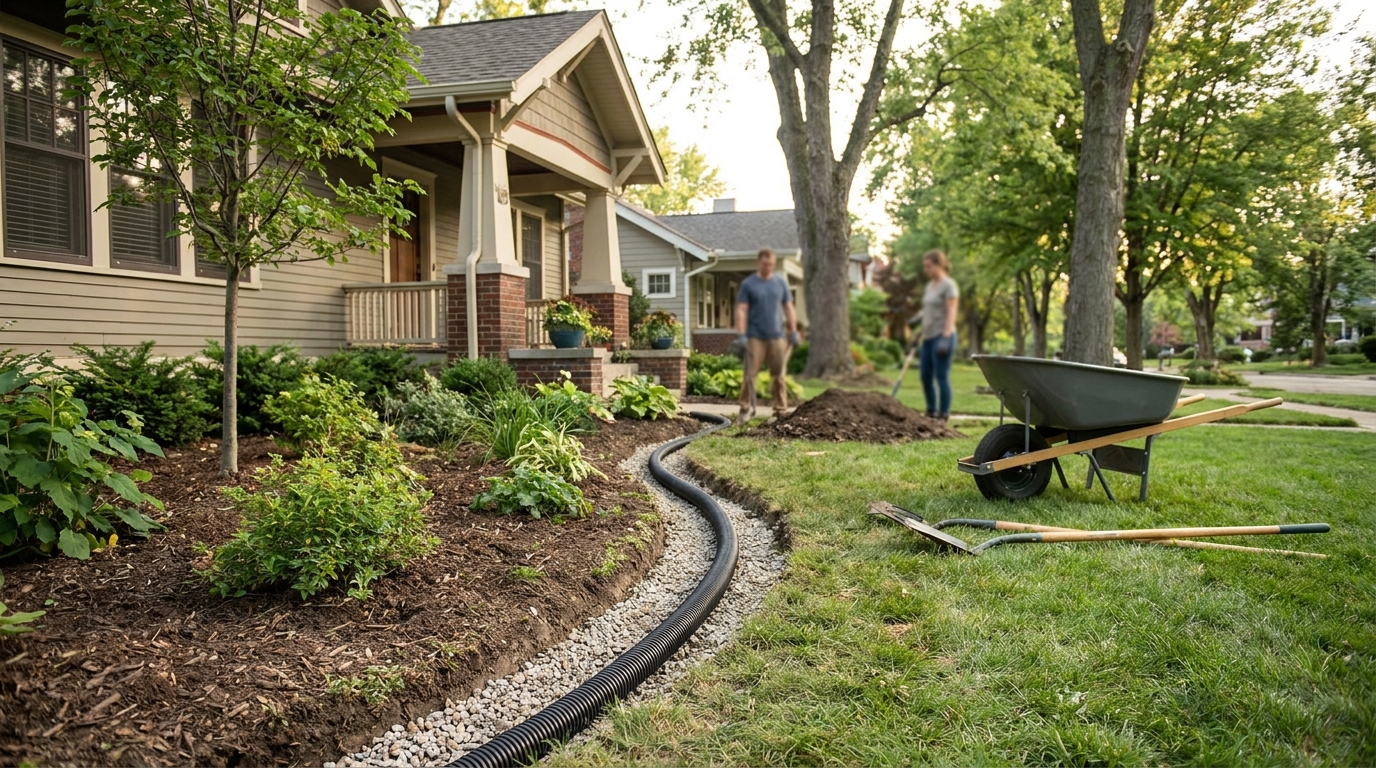
A French drain stops yard flooding by capturing surface and subsurface water in a gravel-filled trench and redirecting it downhill through a perforated pipe. To build one, you must dig a trench at least 18 inches (45 cm) deep, line it entirely with non-woven landscape fabric, maintain a downward slope of exactly 1 inch for every 10 feet (2.5 cm per 3 m) of length, lay a 4-inch (10 cm) perforated pipe holes-down, and cover it with washed drainage gravel. Expect to pay between $25 and $40 per linear foot in 2026 if you hire a professional landscaping crew, or about $8 to $12 per foot if you buy the materials and dig it yourself.
- Always point the pipe perforations downward so water enters from the bottom as the trench fills.
- Maintain a strict 1 percent slope to keep water moving without clogging the system with silt.
- Use heavy-duty, non-woven geotextile fabric to fully wrap the gravel trench, never wrap the pipe itself.
Why is my yard pooling water in the first place?
Surface water pools when your soil absorbs rainfall slower than it falls, a problem common in USDA Hardiness Zones 5 through 9 where heavy clay soils dominate. Clay particles are tightly packed, leaving almost no pore space for water to percolate downward. Beyond soil type, poor grading is the primary culprit. Building codes dictate the ground should drop 6 inches (15 cm) over the first 10 feet (3 m) away from your foundation. Over time, soil settles and DIY landscaping projects block natural drainage paths. A French drain artificially creates a lower path of least resistance underground to pull that trapped water away.
- Dense clay soils physically block water from percolating downward into the local water table.
- Grading settles over time, turning previously sloped areas into shallow bowls that hold rainwater.
How deep and wide should a French drain trench be?
The standard dimensions for a residential French drain are 12 inches (30 cm) wide and 18 to 24 inches (45 to 60 cm) deep. The 12-inch width gives you enough room to place a 4-inch (10 cm) pipe in the center and surround it with a 4-inch (10 cm) buffer of gravel on both sides. Depth depends entirely on your target discharge point. Because water obeys gravity, your trench must get progressively deeper as it travels. If you start digging at a depth of 18 inches, and run your trench 50 feet (15 m), the discharge end must be at least 23 inches (58 cm) deep.
- Dig exactly 12 inches (30 cm) wide to minimize labor while leaving adequate space for the gravel buffer.
- Never dig shallower than 18 inches (45 cm) or heavy lawnmowers and foot traffic will crush the pipe over time.
What kind of pipe is best for a French drain?
This is the most common judgement call a professional makes differently from a beginner. First-time DIYers almost always buy flexible, corrugated black plastic pipe in 50-foot (15 m) rolls. It bends easily and fits in a car trunk, but the interior ridges aggressively trap dirt and shingle grit, eventually clogging the line. A professional installer uses rigid 4-inch (10 cm) SDR-35 or Schedule 40 PVC pipe with pre-drilled holes. While it requires primer and cement for the 10-foot (3 m) sections, the smooth interior walls flush sediment rapidly. Furthermore, a plumber can easily clear rigid PVC with a mechanical snake, a tool that would instantly shred a flexible corrugated plastic pipe.
- Corrugated pipe is cheaper and easier to transport, but highly prone to holding standing water and debris.
- Rigid PVC costs more upfront but lasts decades longer because it can be mechanically cleaned.
Should the holes in the drain pipe face up or down?
The holes must always face down. Pointing the perforations upward is a persistent DIY myth based on the incorrect assumption that water falls like rain directly through the dirt and into the pipe. In reality, a French drain works by raising the local water table inside your excavated trench. As water flows through the soil into your gravel, it pools at the absolute bottom of the dirt trench. As that water level rises, it enters the pipe through the bottom holes. Once inside the smooth pipe, the water encounters zero friction and shoots down the slope. Pointing the holes up forces the trench to fill with 4 inches (10 cm) of standing water before a single drop drains out.
- Holes facing up guarantees that the bottom 4 inches (10 cm) of your trench is permanently filled with stagnant water.
- Holes facing down allows the system to begin draining the moment water hits the bottom of the trench.
What is the biggest mistake people make with landscape fabric?
The absolute quickest way to fail at building a French drain is wrapping the perforated pipe directly in landscape fabric. When you wrap the pipe itself, silt and clay particles carried by groundwater get trapped in the fabric weave right against the plastic. Within two years, this forms an impenetrable mud barrier, turning your perforated pipe into a solid tube that collects zero water. To avoid this failure mode, wrap the entire trench, not the pipe. Line the bare earth with a heavy-duty, non-woven geotextile fabric, leaving excess draped over the sides. Add a base of gravel, lay the pipe, add the rest of the gravel, and fold the fabric completely over the top like a burrito.
- Wrapping the pipe directly ensures early failure by sealing the entry holes with packed mud.
- Burrito-wrapping the entire trench filters out dirt at the soil line, keeping the inner gravel and pipe completely clean.
How do you calculate and dig the correct slope?
Gravity is the only engine your drain has, so precision is mandatory. You need a minimum slope of 1 percent, which translates to a 1-inch drop in elevation for every 10 feet of length (2.5 cm per 3 m). If you dig a 60-foot (18 m) trench, the bottom at the exit point must be exactly 6 inches (15 cm) deeper than the starting point. Do not rely on your naked eye to judge an underground grade. Drive a wooden stake at both ends, tie a mason line tightly between them, and hang a lightweight line level. Measure down from the perfectly level string to the trench floor at 10-foot (3 m) intervals to ensure the drop is consistent.
- A 1 percent slope is the minimum required to keep water moving fast enough to flush out tiny sediment particles.
- Using a taut mason line and line level eliminates the optical illusions caused by naturally uneven yards.
What type of gravel do you actually need, and how much?
You must use washed gravel ranging from 1 inch to 1.5 inches (2.5 to 3.8 cm) in diameter. Do not use crushed concrete, pea gravel, or standard driveway gravel, which is often sold as crushed run or #57 stone. Unwashed stone contains high amounts of fine stone dust and sand that will immediately wash into your pipe, settle in low spots, and reduce the system's lifespan. A trench 12 inches (30 cm) wide and 18 inches (45 cm) deep requires roughly one cubic yard of gravel for every 20 linear feet (6 m). In 2026, a cubic yard of washed drainage rock delivered to a residential driveway costs between $60 and $95.
- Washed round rock provides the maximum amount of empty pore space for water to flow freely.
- Always order 15 percent more gravel than your mathematical calculation dictates to account for uneven trench walls and settling.
Where is it safe to discharge the collected water?
The discharge point must be at least 10 feet (3 m) away from your home's foundation and positioned so water naturally flows away from any structures. A pop-up emitter is an excellent solution for flat yards. It stays flush with your lawn for easy mowing, but the pressure of the underground water pushes the lid open during a storm to disperse runoff safely over the grass. Never direct your discharge toward a neighbor's property line or a public sidewalk. In most jurisdictions, dumping concentrated runoff onto adjacent private property violates nuisance laws and quickly triggers civil liability.
- Pop-up emitters offer a hidden, trip-free way to daylight a drain in the middle of a manicured lawn.
- Verify your property lines before digging to ensure all discharged water remains entirely on your own lot.
| Feature | Corrugated Plastic (Beginner) | Rigid PVC (Pro) |
|---|---|---|
| Material Cost (Per 100 ft in 2026) | $70 to $90 | $150 to $200 |
| Clog Resistance | Low (interior ridges trap silt heavily) | High (smooth walls flush sediment away) |
| Ability to be Snaked/Cleaned | None (metal snake shreds thin walls) | Excellent (handles heavy-duty augers) |
| Tree Root Intrusion Risk | High (roots easily pierce thin plastic) | Low (thick walls and glued joints block roots) |
Frequently asked questions
Do I need a permit to build a French drain?
In most residential areas, a basic backyard French drain does not require a building permit unless you are tying into a municipal storm sewer system, crossing a public sidewalk, or digging within a dedicated public utility easement. However, you must always call 811 a few days before digging to have all underground utilities professionally marked.
Can I route my gutter downspouts directly into a French drain?
You should never dump concentrated roof runoff into a perforated French drain pipe, as it will simply push massive volumes of water backward out into your yard's soil. Instead, lay a second, solid non-perforated pipe in the exact same trench to carry gutter water all the way to the final discharge point without leaking.
How long does a properly built French drain last?
A French drain built with rigid PVC, washed gravel, and a fully burrito-wrapped geotextile fabric trench will easily last 20 to 30 years without major maintenance. Conversely, systems built by directly wrapping corrugated pipe in cheap weed barrier often clog and fail completely within 3 to 5 years.
Keep reading
- How Much Paint Do You Actually Need for a Room?The tin says 400 square feet. Your wall says otherwise. Here is the arithmetic that actually holds up.
- Choosing a Fence: Material, Height, and the Rules Nobody ReadsA fence is a twenty-year decision made in an afternoon. Here is what actually differs between the options.
- Flooring Underlayment: What It Does and When You Can Skip ItUnderlayment is the layer nobody sees and the one most likely to cause a callback if it is skipped or mismatched.