How Do You Fix a Wobbly Ceiling Fan That Shakes on High Speed?
By Jim Vernon · 8 min read · Last updated
A ceiling fan that thrashes like a helicopter taking off isn't just annoying—it is slowly tearing its mounting bracket out of your ceiling joist.
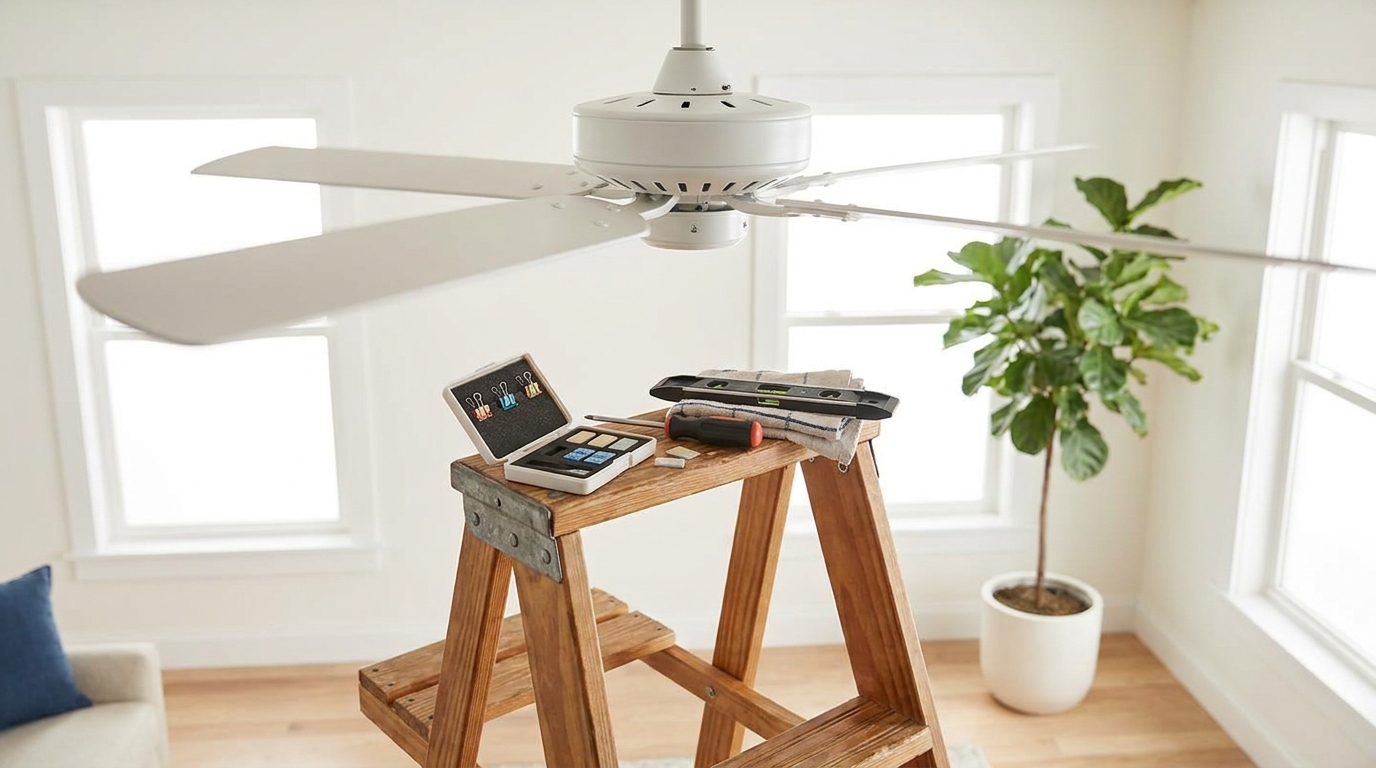
To fix a wobbly ceiling fan, first tighten all blade screws and the mounting bracket hardware, then measure the distance from the ceiling to each blade tip to locate warped blades, and finally use a $5 balancing kit's weighted clip to test the blades one by one until the shake stops. Once you locate the lightest blade, you adhere a permanent 0.1-ounce (3-gram) lead weight to its top center to permanently eliminate the wobble. Shaking almost never means the fan motor is broken; it usually means the spinning mass is out of equilibrium or the anchor point is loose. Taking the time to properly diagnose the root cause instead of just guessing will restore your fan to smooth, silent operation in less than an hour.
- Tightening loose hardware and clearing dust solves a massive percentage of wobbly fan problems before you even need to open a balancing kit.
- A difference of just 1/4 inch (6.4 mm) in blade height can cause severe shaking on high speeds.
- Never use a plastic electrical box to support a ceiling fan; they require metal fan-rated brace boxes to handle the spinning torque.
- Professionals always check the downrod ball joint seating in the ceiling canopy before assuming the blades are warped.
Why Do Ceiling Fans Actually Wobble in the First Place?
A ceiling fan wobbles because the rotational weight of the spinning blades is no longer perfectly distributed around the motor's center axis. This centrifugal imbalance can be triggered by surprisingly small discrepancies. A difference of just 0.1 ounces (3 grams) between blades, or a vertical warp of just 1/4 inch (6.4 mm) on a single blade, is enough to cause violent shaking when the fan operates on its highest speed setting.
Over time, constant micro-vibrations slowly back out the factory-installed Phillips head screws that secure the metal blade arms—called irons—to the motor housing. Additionally, blades made from medium-density fiberboard (MDF) or wood composites can absorb moisture in rooms with humidity consistently over 60 percent, causing them to sag unevenly. Dust accumulation also plays a major role; a thick layer of dust on the leading edge of a 52-inch (1.3 m) fan blade adds localized weight that throws off the delicate factory calibration.
How Do You Check the Mounting Bracket and Hardware for Safety?
Before you even think about sticking weights onto your fan blades, you must inspect the structural integrity of the mount. A beginner will usually buy a balancing kit immediately and start guessing at weight placement. A pro makes a different judgement call: they drop the ceiling canopy first to inspect the hanger ball. The ball at the top of the downrod has a specific vertical slot that must sit perfectly locked into a metal tab on the mounting bracket. If the ball was bumped and rotated out of this slot, the entire fan will swing violently. Reseating this ball fixes the wobble instantly without any weights.
While the canopy is down, check for a critical failure mode: the electrical box. If you see a standard round plastic lighting box instead of a metal, fan-rated brace box, stop immediately. Plastic boxes are designed to hold 10-pound (4.5 kg) static light fixtures, not the dynamic torque of a spinning 35-pound (15.8 kg) fan. The constant vibration will eventually shear the plastic threads, dropping the spinning fan into the room. If you find plastic, install an expanding metal retrofit brace—which costs between $25 and $35 in 2026—before proceeding.
- Ensure the hanger ball slot is locked perfectly over the bracket tab.
- Confirm the ceiling box is metal and explicitly stamped as fan-rated.
- Verify the two long bolts holding the bracket to the box are fully tightened.
How Do You Measure Blade Alignment and Find Warps?
If the mount is secure and the hardware is tight, your next step is to check for warped blades or bent metal irons. Grab a rigid yardstick or a stiff tape measure. Choose a single fixed point on the ceiling, preferably right above the tip of one blade. Manually rotate the fan so the first blade aligns with your measuring tool, and record the exact distance from the ceiling to the trailing edge of the blade tip. Rotate the next blade into that exact same position and measure again.
If any blade sits more than 1/4 inch (6.4 mm) higher or lower than the rest, you have found the source of the wobble. You can often correct a minor deviation by firmly grasping the metal iron—not the wooden blade—and gently pressing up or down to bend it back into alignment with the others. If a blade is severely bowed from moisture damage, balancing it will be nearly impossible, and you should order a replacement set of blades from the manufacturer.
How Do You Use a Ceiling Fan Balancing Kit Properly?
If all screws are tight and the blades measure perfectly level but the fan still shakes, you have a weight distribution problem. You will need a ceiling fan balancing kit, which costs between $5 and $8 at any hardware store in 2026. The kit contains a plastic U-shaped clip and several self-adhesive metal weights.
Your goal is to test the rotating mass systematically to find the lightest point on the fan. Turn the fan on its highest speed setting and observe the wobble. Turn the fan off and wait for it to completely stop. Slide the plastic test clip onto the trailing edge of the first blade, positioning it halfway between the motor housing and the blade tip. Turn the fan back on High. Pay close attention: did the wobble get worse, improve slightly, or stay exactly the same? Turn the fan off, move the clip to the second blade, and repeat the test. Continue this process around the entire fan until you identify the specific blade where the clip causes the most significant reduction in shaking.
- Turn the fan on High to establish a baseline for the wobble.
- Turn the fan off, wait for it to stop, and attach the clip midway down the first blade.
- Turn the fan back on High and observe if the shaking improves or worsens.
- Repeat this test systematically on every single blade until you locate the lightest one.
Where Should You Place the Permanent Balancing Weights?
Finding the lightest blade is only half the battle; you must now find the exact optimal position for the weight on that specific blade. Leave the test clip on the problem blade, but slide it closer to the motor housing. Turn the fan on and observe. Turn it off, slide the clip closer to the outer tip, and test again. You are looking for the exact millimeter placement along that edge where the wobble completely vanishes.
Once you find the sweet spot, leave the clip in place as a visual marker. Thoroughly clean the top surface of the blade directly adjacent to the clip using a rag and rubbing alcohol to remove dust and greasy residue. Peel the paper backing off one of the permanent 0.1-ounce (3-gram) metal weights from your kit. Press the sticky side firmly onto the top center line of the blade, directly parallel to where the test clip is sitting. Hold it down with strong thumb pressure for 15 seconds to ensure the adhesive bonds fully, then remove the plastic test clip.
Can You Fix a Fan Wobble With Household Items?
If you do not have access to a store-bought balancing kit, you can easily replicate the process using pocket change and standard tape. A standard United States quarter weighs 5.67 grams, while a nickel weighs exactly 5.00 grams. These coins make excellent substitute balancing weights.
Use a small, rolled piece of painter's tape to temporarily stick a coin to the top center of a blade to act as your test weight. Move the taped coin from blade to blade, and then up and down the lightest blade, exactly as you would with a plastic test clip. Once you find the spot that stops the shaking, you must secure the coin permanently. Use a heavy-duty double-sided foam mounting tape or a dab of clear silicone caulk. Never use super glue or cyanoacrylate adhesives; these dry into a brittle, glass-like state that shatters under constant vibration, turning your metal coin into a dangerous projectile.
What If the Fan Still Shakes After Balancing Everything?
If you have tightened the hardware, seated the hanger ball properly, aligned the blade irons, and run the balancing clip diligently on every single blade with absolutely no improvement, the issue is mechanical. In rare cases, the internal motor bearings are worn out, or the main vertical motor shaft is permanently bent. This type of damage almost always occurs because the fan was struck by a flying object or hit by a tall piece of furniture being moved through the room.
A bent motor shaft cannot be bent back into alignment without destroying the internal magnetic coils. At this point, no amount of external balancing will counteract the internal off-center rotation. You will need to replace the entire fixture. Depending on the size, finish, and cubic feet per minute (CFM) airflow rating, a quality replacement ceiling fan in 2026 will cost between $120 and $350, excluding professional installation labor.
| Symptom | Likely Cause | First Fix |
|---|---|---|
| Wobbles instantly when turned on | Unseated hanger ball | Rotate downrod until ball locks into bracket tab |
| Wobbles only on highest speed setting | Unbalanced blade weight | Use a $5 balancing kit to apply lead weights |
| Clicking noise accompanied by wobble | Loose blade iron screws | Tighten all Phillips head screws at the motor housing |
| Whole fixture sags away from ceiling | Plastic or failing electrical box | Remove fan and install metal fan-rated brace box |
Frequently asked questions
Is a slight wobble normal for a ceiling fan on high speed?
Yes, a wobble of 1/8 inch (3.2 mm) or less is generally considered acceptable on high speed for standard downrod-mounted fans. However, flush-mount or hugger fans should have zero visible wobble when operating.
Can changing the light bulbs cause a fan to become unbalanced?
Yes. If you replace heavy glass incandescent bulbs with lightweight plastic LED bulbs unevenly, or leave a glass shade off one side of the light kit entirely, the unequal weight distribution will cause an immediate wobble.
Do outdoor ceiling fans warp faster than indoor ones?
Outdoor fans are built with weather-resistant ABS plastic blades specifically to prevent warping. If you mistakenly install an indoor fan with wooden or MDF blades on a damp covered porch, the outdoor humidity will warp them drastically within a single season.
Keep reading
- How Much Paint Do You Actually Need for a Room?The tin says 400 square feet. Your wall says otherwise. Here is the arithmetic that actually holds up.
- DIY or Hire a Pro? A Decision Framework That Is Not About MoneyThe labour saving is real. So is the cost of a job done twice — and of tools you use once.
- Storage for Small Rooms That Does Not Make Them SmallerSmall rooms do not need more storage. They need storage that stops interrupting the eye.