How Do You Fix a Stuck Pocket Door Without Tearing Open the Drywall?
By Jim Vernon · 9 min read · Last updated
A pocket door that screeches, drags, or jumps its track can make a room practically unusable, but you rarely need a sledgehammer to fix it.
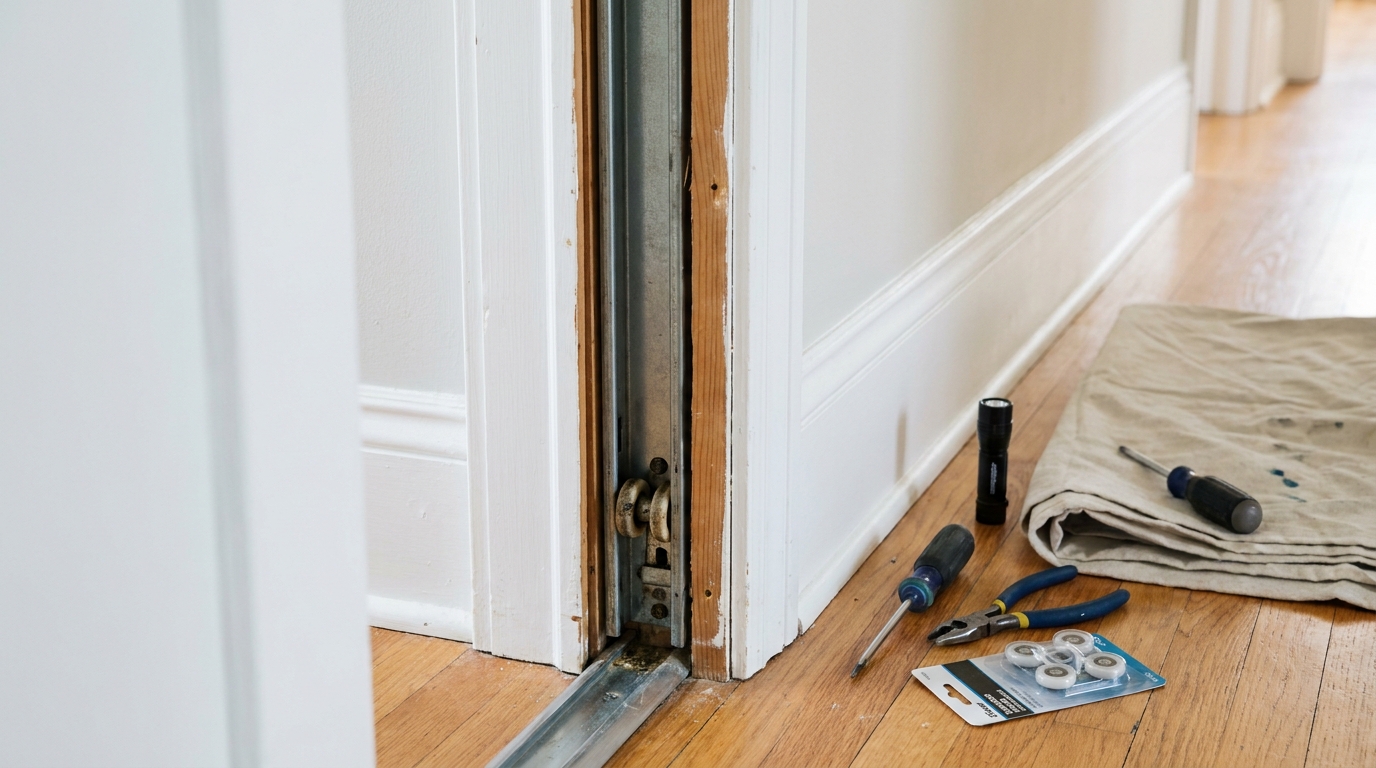
You can fix a stuck pocket door without destroying your drywall by removing the top piece of door trim to access the hidden track, then using an offset pocket door wrench to release the door from its hanger pins. Most sticking issues are caused by loose adjustment nuts dropping the door so it drags on the floor, or by old nylon rollers shattering inside the aluminum channel. By pulling the door slab out, vacuuming the overhead track, and swapping in a new set of ball-bearing rollers for about $35 to $50, you can restore a silent, smooth glide in under two hours without having to patch and paint a single sheet of drywall.
- Removing the top piece of door trim (head casing) gives you the clearance needed to lift the door off its track.
- A $10 offset pocket door wrench is mandatory; standard pliers will strip the thin adjustment nuts.
- Never use WD-40 on pocket door tracks; it attracts dust and permanently seizes the new rollers.
- Replacing old plastic wheels with heavy-duty ball-bearing rollers costs under $50 and permanently solves track jumping.
Why Do Pocket Doors Suddenly Drag or Jump the Track?
Pocket doors hang from a single aluminum or steel overhead track hidden inside the wall cavity. The door is suspended by two wheel carriages, usually three-wheel or four-wheel assemblies, that slot into a mounting plate screwed to the top edge of the door slab. Over years of opening and closing, the constant vibration causes the lock nuts on the hanger pins to slowly back off. When this happens, the entire door drops by 1/4 inch (6.3 mm) to 1/2 inch (1.2 cm), causing the bottom of the door to scrape aggressively against the floor guides or the finished flooring.
If the door isn't just dragging but is physically jumping out of the track, the problem is almost always mechanical failure. Standard builder-grade pocket doors use unsealed nylon wheels. After 10 to 15 years, the heat and friction cause this nylon to become brittle and crack. A single flattened or missing wheel will cause the carriage to bind inside the track, making the door feel like it is locked in place.
- Lock nuts vibrating loose causes the door to drop and drag on the floor.
- Brittle, cracked nylon wheels cause the door to physically jump the track.
How Do You Access the Rollers Without Cutting the Wall?
You do not need a drywall saw to get to the pocket door track. Instead, you need to remove the top horizontal door trim, known as the head casing, on the side of the door where you want to work. Take a sharp utility knife and carefully score the caulk line where the top trim meets the drywall and where it meets the door jamb. Scoring the caulk prevents the paint from peeling off the wall when you pull the trim. Next, use a stiff putty knife and a small pry bar to gently pry the head casing away from the wall.
Once the casing is off, you will see a thin strip of wood running along the top inside of the door frame, called the top stop. Pry this off as well. Removing this stop creates a 1-inch (2.5 cm) to 1.5-inch (3.8 cm) gap at the top of the doorway. Look into this gap with a flashlight, and you will have full visual and physical access to the track, the wheel carriages, and the adjustment nuts. If you happen to snap the trim during removal, a replacement piece of standard pine casing costs about $15 to $20 in 2026.
- Score the caulk lines with a utility knife to prevent peeling the wall paint.
- Remove the head casing and the top stop molding on one side of the doorframe.
- A replacement piece of standard pine casing costs $15 to $20 in 2026 if it breaks during removal.
How Do You Lift a Pocket Door Off Its Track?
With the trim removed, slide the door so it is almost fully closed and pulled out of the pocket. You will see the two hanger mechanisms holding the door to the wheeled carriages. Most modern pocket doors use a locking clasp. You flip a small metal lever on the side of the mounting plate, which opens the clasp and allows the mounting pin to slip out. Here is a crucial judgement call: A beginner will usually try to support the 60-pound (27 kg) solid core door with one hand while wrestling the tight latch with the other, often dropping the door, gouging the floor, or bending the track. A pro will slide a pair of wooden or composite shims under the bottom edge of the door until they are snug. This transfers the entire weight of the door to the floor, leaving both hands completely free to disengage the hanger clasps with a pair of needle-nose pliers. Once both clasps are open, pull the top of the door slightly toward you and lift it off the pins.
- Slide shims under the door to support the 60-pound (27 kg) weight.
- Use needle-nose pliers to flip the locking clasp on the mounting plate.
- Tilt the door slightly outward to disengage it from the overhead hanger pins.
What Is the Best Way to Clean a Pocket Door Track?
With the door removed, the wheel carriages will still be sitting in the overhead track. Roll them out of the opening. Now you have an empty track that is likely packed with decades of dust, pet hair, and sawdust. Tape a 1/2-inch (1.2 cm) piece of flexible vinyl tubing to the end of your shop vacuum hose to create a micro-nozzle that fits perfectly inside the track. Vacuum the entire length, pushing the tubing as deep into the wall pocket as it will go. Next, wrap a microfiber cloth around a wooden paint stir stick, dampen it lightly with rubbing alcohol, and slide it back and forth through the track to cut through accumulated grime. A major failure mode for DIYers is spraying WD-40 or heavy grease into a sticky pocket door track. Petroleum-based lubricants act as a dirt magnet, quickly turning airborne dust into a thick sludge that will permanently seize the new rollers. If you must lubricate the track, use a dry PTFE spray or a dry silicone spray that leaves no wet residue behind.
- Tape flexible vinyl tubing to a vacuum hose to clean deep inside the pocket track.
- Use a microfiber cloth wrapped around a paint stir stick to wipe away stubborn grime.
- Never use petroleum lubricants like WD-40; use dry PTFE or silicone spray instead.
Should You Replace the Rollers or Just Realign Them?
If you have gone through the effort of removing the door slab, you should absolutely replace the roller carriages. Reusing 15-year-old plastic wheels is a false economy. Drive to the hardware store or go online and purchase a heavy-duty ball-bearing roller kit. In 2026, a high-quality set of four-wheel, sealed ball-bearing carriages costs between $35 and $50. Check your track type before buying, as the most common tracks are J-tracks or boxed I-beam tracks, and the carriages must match the track profile. Look for rollers rated for at least 150 lbs (68 kg), even if your door is lighter. The heavier duty rating means the bearings are larger and will glide flawlessly for decades. Slide the new carriages into the open end of the track. If the track end is blocked, you may need to back out the first track screw to drop the end of the track by 1/2 inch (1.2 cm) just enough to feed the new carriages in.
- Upgrade to four-wheel, sealed ball-bearing carriages rated for 150 lbs (68 kg).
- A high-quality replacement roller kit costs between $35 and $50 in 2026.
- Match the new carriages to the specific profile of your existing track.
How Do You Adjust a Pocket Door So It Plumbs With the Jamb?
Slide the door back into the opening, rest it on your shims, and engage the new carriage pins into the door's mounting plates. Lock the clasps securely. Now, you need a specialized pocket door wrench. This is a small, offset 3/8-inch or 5/16-inch wrench that slips into the narrow gap at the top of the door. Using standard pliers here will quickly round off the thin, soft metal adjustment nuts. Turn the nut on the rear hanger to set the overall height of the door, ensuring it clears the floor by at least 3/8 inch (9.5 mm). Then, pull the door almost completely closed and look at the gap between the edge of the door and the strike jamb. Turn the nut on the front hanger to raise or lower the front edge until that gap is perfectly even from top to bottom, ideally around 3/16 inch (4.7 mm). Once the door is plumb and gliding smoothly, reinstall the top stop and the head casing using 18-gauge brad nails, and touch up the caulk.
- Use an offset pocket door wrench to turn the adjustment nuts without stripping them.
- Adjust the rear hanger to set the overall floor clearance to at least 3/8 inch (9.5 mm).
- Adjust the front hanger to ensure the door gap against the strike jamb is an even 3/16 inch (4.7 mm).
When Do You Actually Need to Cut the Drywall?
While 90 percent of pocket door problems can be solved by replacing the rollers through the door opening, there are rare cases where drywall removal is unavoidable. If the house has settled significantly and the structural wooden framing above the door has bowed downward, the door will bind in the middle of the track regardless of how the rollers are adjusted. Alternatively, if the screws holding the aluminum track to the ceiling joists have stripped out deep inside the wall cavity, the track itself will wobble and drop. In these cases, you must cut an access panel in the drywall near the top of the pocket to re-secure the track or reframe the header. If you have to cut, measure carefully and cut a neat rectangle from stud to stud. This makes the eventual drywall patch much easier to back with wood blocking, tape, and feather out with joint compound.
- Drywall removal is required if the structural wooden header above the track is sagging.
- Stripped track screws deep inside the pocket also require cutting an access panel.
- Always cut drywall access panels cleanly from stud to stud to make patching easier.
| Roller Type | Weight Capacity | 2026 Cost (Pair) | Best Application |
|---|---|---|---|
| Standard Nylon | 50 lbs (22 kg) | $12 - $18 | Lightweight hollow-core interior doors. |
| Ball-Bearing Nylon | 100 lbs (45 kg) | $25 - $35 | Standard solid-core bedroom and bathroom doors. |
| Steel Ball-Bearing | 150+ lbs (68+ kg) | $35 - $50 | Heavy solid wood doors or high-traffic areas. |
Frequently asked questions
Can you adjust a pocket door without removing the trim?
Yes, if you only need to make minor height adjustments. You can slip an offset pocket door wrench into the narrow gap at the top of the door to turn the hanger nuts. However, if the door has jumped the track or needs new rollers, the trim must come off.
Why does my pocket door scrape the sides of the door frame?
Scraping on the side jambs is usually caused by broken or missing floor guides. These are small plastic or metal brackets screwed to the floor at the opening of the pocket that keep the door slab centered as it slides.
What size wrench do I need to adjust a pocket door?
Most standard pocket doors require a 3/8-inch or 5/16-inch offset wrench, often sold as a dedicated pocket door wrench for $8 to $12. Standard pliers are too thick to fit in the gap and will easily strip the soft metal edges of the adjustment nut.
Keep reading
- How Much Paint Do You Actually Need for a Room?The tin says 400 square feet. Your wall says otherwise. Here is the arithmetic that actually holds up.
- DIY or Hire a Pro? A Decision Framework That Is Not About MoneyThe labour saving is real. So is the cost of a job done twice — and of tools you use once.
- Storage for Small Rooms That Does Not Make Them SmallerSmall rooms do not need more storage. They need storage that stops interrupting the eye.