How Do You Build a Gravel Shed Foundation That Won't Wash Away or Settle?
By Jim Vernon · 8 min read · Last updated
If you set a heavy wood shed directly on grass or loose topsoil, you are just counting down the days until the doors stop binding and the floor joists rot.
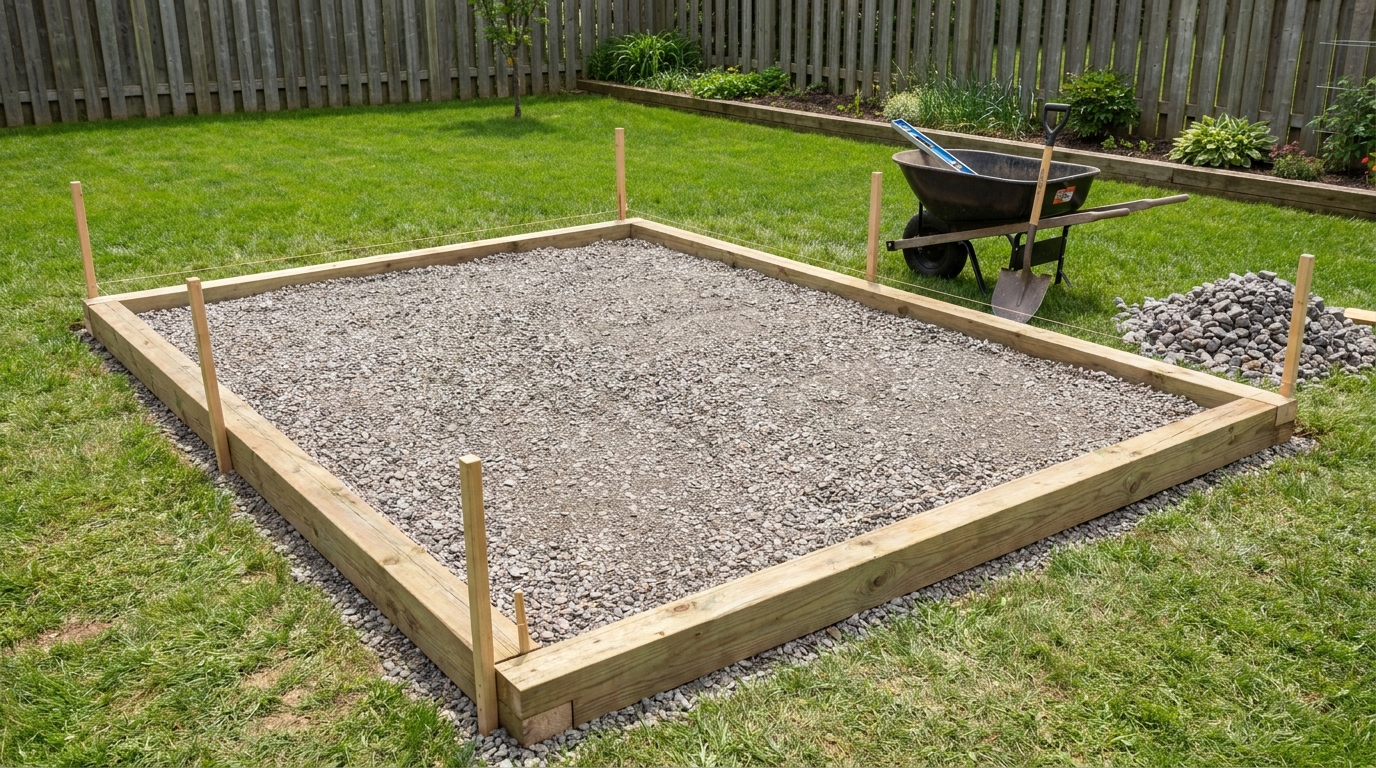
To build a gravel shed foundation that won't settle or wash away, you must dig out 4 to 6 inches (10 to 15 cm) of topsoil, line the excavation with heavy-duty woven geotextile fabric, build a pressure-treated timber frame pinned with rebar, and fill it with compacted 3/4-inch crushed stone containing rock dust. This specific combination creates a flat, self-draining pad that distributes the shed's weight evenly across the subsoil. A dirt foundation or loose blocks will inevitably shift during freeze-thaw cycles, but a properly boxed and tamped gravel pad locks together like concrete. It allows rainwater to pass straight through, keeping your shed’s wood framing bone-dry and rot-free for decades.
- Dig out at least 4 inches (10 cm) of topsoil to reach stable, mineral subsoil before building your frame.
- Extend the gravel pad 12 inches (30 cm) past the shed walls on all sides to prevent rain splashback from rotting the siding.
- Always use woven geotextile driveway fabric under the gravel to stop the stone from sinking into the mud over time.
- Use 3/4-inch minus crushed stone (crusher run), which contains jagged edges and dust to lock together, rather than smooth river rock.
- Expect to spend between $350 and $550 in 2026 for the materials to build a 10x12 foot (3x3.6 m) pad yourself.
Why Choose a Gravel Pad Over Concrete Blocks?
The biggest judgement call a professional shed builder makes differently from a beginner is how they handle the foundation. A beginner will often try to level a shed by throwing down concrete patio blocks on the grass and shimming the shed skids on top of them. This creates extreme point-loading. The sheer weight of the structure, plus heavy lawnmowers or tools inside, forces all that weight onto a few small footprints. After one heavy rain or a spring thaw, those blocks punch right into the topsoil, throwing the shed out of square and causing doors to jam.
A professional knows that a gravel pad acts as a load-distributing mattress. By spreading thousands of pounds evenly across 100 square feet or more of compacted crushed stone, you virtually eliminate settling. Gravel also facilitates rapid drainage, meaning ground moisture never has a chance to wick up into the wooden skids of your shed. It provides 90 percent of the stability of a poured concrete slab for a fraction of the cost.
- Concrete blocks sink unevenly due to point-loading and frost heave.
- Gravel distributes weight across the entire footprint of the shed.
- A porous stone bed keeps wooden skids dry, preventing premature rot.
What Are the Exact Dimensions You Need to Dig?
Your gravel pad must be larger than the footprint of your shed. The golden rule is to extend the foundation 12 inches (30 cm) past the shed walls on all four sides. If you are building an 8x10 foot (2.4x3 m) shed, your gravel pad needs to be 10x12 feet (3x3.6 m). This extra perimeter serves a critical function: when rain sheets off the shed roof, it hits the gravel instead of mud, preventing dirty water from splashing back up onto your siding and causing rot.
You must dig down 4 to 6 inches (10 to 15 cm) to remove the organic topsoil. Topsoil is spongy because it is full of decomposing roots and organic matter. It will compress under weight. You need to excavate until you hit the harder, lighter-colored mineral subsoil. Use a flat-transfer shovel to keep the bottom of the excavation as flat and undisturbed as possible.
- Add 24 inches (60 cm) to the length and width of your shed to determine pad size.
- Dig down 4 to 6 inches (10 to 15 cm) to remove all spongy organic topsoil.
- Check the excavation with a 4-foot (1.2 m) level to ensure the subsoil floor is roughly flat.
How Do You Build and Level the Timber Perimeter Frame?
The gravel needs a rigid retaining wall to keep it from washing out into your yard. Construct a perimeter frame using 4x6 or 4x4 pressure-treated timbers. Ensure the lumber is rated for ground contact, typically stamped UC4A or UC4B. Set the timbers into your trench, using a laser level or a long straight-edge to ensure the frame is perfectly level. You can dig out a little subsoil or add a little gravel under the timbers to dial in the level.
Fasten the corners using 6-inch (15 cm) exterior-grade timber screws. For maximum strength, drill a 1/2-inch (1.2 cm) hole vertically through the timbers every 4 feet (1.2 m). Sledgehammer a 24-inch (60 cm) piece of #4 rebar (1/2-inch diameter) through each hole and deep into the subsoil. This pins the frame to the earth, ensuring the frost cycle will never push your retaining wall out of square.
- Use ground-contact rated (UC4A/UC4B) pressure-treated 4x4 or 4x6 timbers.
- Screw corners together with heavy-duty 6-inch (15 cm) structural timber screws.
- Pin the frame to the ground using 24-inch (60 cm) #4 rebar driven flush with the wood.
Why Is Geotextile Fabric the Step You Can Never Skip?
The most common failure mode in DIY shed foundations is skipping the landscape fabric. If you dump heavy crushed stone directly onto dirt, the two layers will eventually mix. Moisture, gravity, and the vibration of you walking inside the shed will cause the stone to migrate downward into the mud, while the soil works its way up. Within five years, your pristine gravel pad will turn into a sunken, muddy mess, and your shed will start to lean.
To prevent this, you must install a barrier layer of heavy-duty woven geotextile fabric. Do not use the cheap, thin spun weed-barrier from a big box garden center; it will tear instantly under the weight of the stone. Buy a woven driveway fabric designed for soil separation. Run it across the dirt floor and up the inside walls of your timber frame, overlapping any seams by at least 12 inches (30 cm). This fabric allows water to drain through but permanently stops the gravel from sinking into the subsoil.
- Skipping fabric allows stone and mud to mix, causing severe foundation settling.
- Use woven geotextile driveway fabric, not thin garden weed barrier.
- Overlap fabric seams by 12 inches (30 cm) and staple it to the inside of the timber frame.
Which Type of Gravel Locks Together Best?
Never use pea gravel or smooth river rock for a foundation. Smooth stones act like ball bearings under pressure; they never compact and will constantly shift under the shed's skids. The only material you should use is 3/4-inch minus crushed stone, commonly sold as crusher run, road base, or Item 4. The word minus means the mix contains 3/4-inch jagged rocks all the way down to fine stone dust.
When you place crusher run inside your timber frame, the jagged edges lock together while the stone dust fills the microscopic voids. Fill the frame in 3-inch (7.5 cm) lifts, tamping each layer before adding the next. For a small shed, a hand tamper works, but renting a vibratory plate compactor for $60 a day is worth the investment. Once fully compacted, a crusher run pad is so hard you can bounce a hammer off it, yet it remains completely porous to rainwater.
- Never use smooth river rock or pea gravel; it will not lock together or compact.
- Order 3/4-inch minus crushed stone (crusher run) with stone dust included.
- Compact the gravel in 3-inch (7.5 cm) layers using a plate compactor or hand tamper.
How Much Does It Cost to Build a Gravel Shed Pad in 2026?
Building a gravel foundation is highly cost-effective, particularly when you compare it to the price of a poured concrete slab, which often requires professional forming, a pump truck, and exceeds $1,500. For a standard 10x12 foot (3x3.6 m) gravel pad, designed for an 8x10 shed, a DIYer can expect to spend between $350 and $550 in 2026, depending on local delivery fees.
The breakdown is straightforward. You will need about $120 for pressure-treated 4x6 timbers. A roll of commercial woven geotextile fabric costs around $60. Heavy-duty screws and rebar will run about $40. The gravel itself is cheap, but delivery is not. You will need roughly 2.5 to 3 tons of crusher run for a 4-inch (10 cm) depth. The stone usually costs $25 per ton, but a local quarry will likely charge a $75 to $100 drop fee, bringing your stone total to about $175.
- Pressure-treated timbers: $100 to $140.
- Woven geotextile fabric and hardware: $80 to $110.
- 3 tons of delivered crusher run gravel: $150 to $225.
- Total 2026 DIY material cost: $330 to $475.
| Foundation Type | Average Cost (10x12) | Drainage Capability | Load Distribution | DIY Difficulty |
|---|---|---|---|---|
| Concrete Slab | $1,500 - $2,500 | Poor (Water pools at edges) | Excellent | Very High |
| Gravel Pad (Crusher Run) | $350 - $550 | Excellent (Water passes through) | Excellent | Moderate |
| Concrete Blocks on Dirt | $50 - $100 | Fair | Poor (Point-loads and sinks) | Low |
Frequently asked questions
Can I just put gravel directly on top of the grass?
No. The grass and topsoil are organic materials that will decompose and compress over time. If you place gravel directly on the grass, the weight of the shed will cause the foundation to sink unevenly, guaranteed.
How many tons of gravel do I need for a 10x12 foot pad?
To calculate tons, find your cubic footage first. A 10x12 foot pad dug 4 inches (0.33 feet) deep requires roughly 40 cubic feet of stone (10 x 12 x 0.33 = 39.6). Since one cubic yard (27 cubic feet) of gravel weighs about 1.4 tons, you will need approximately 2.1 tons. Always round up to 2.5 or 3 tons to account for compaction.
Do I need a building permit for a gravel shed foundation?
In most US municipalities, a temporary stone foundation for a shed under 120 square feet does not require a building permit. However, local zoning laws heavily regulate how close a shed can be to the property line (setbacks), so you must always verify with your local building department before digging.
How do I secure the shed to a gravel foundation?
Sheds sitting on a gravel pad are typically secured using mobile home earth anchors. You drive these steel augers 30 inches (76 cm) into the ground just outside or inside the gravel footprint, and then bolt the heavy steel strapping over the shed's floor skids to protect against high winds.
Keep reading
- How Much Paint Do You Actually Need for a Room?The tin says 400 square feet. Your wall says otherwise. Here is the arithmetic that actually holds up.
- DIY or Hire a Pro? A Decision Framework That Is Not About MoneyThe labour saving is real. So is the cost of a job done twice — and of tools you use once.
- Storage for Small Rooms That Does Not Make Them SmallerSmall rooms do not need more storage. They need storage that stops interrupting the eye.