Gutter Guards Compared: Mesh, Screen, Foam, Brush and Reverse-Curve
By Jim Vernon · 4 min read · Last updated
No gutter guard means no gutter maintenance ever. The right one turns twice-a-year ladder work into a quick check.
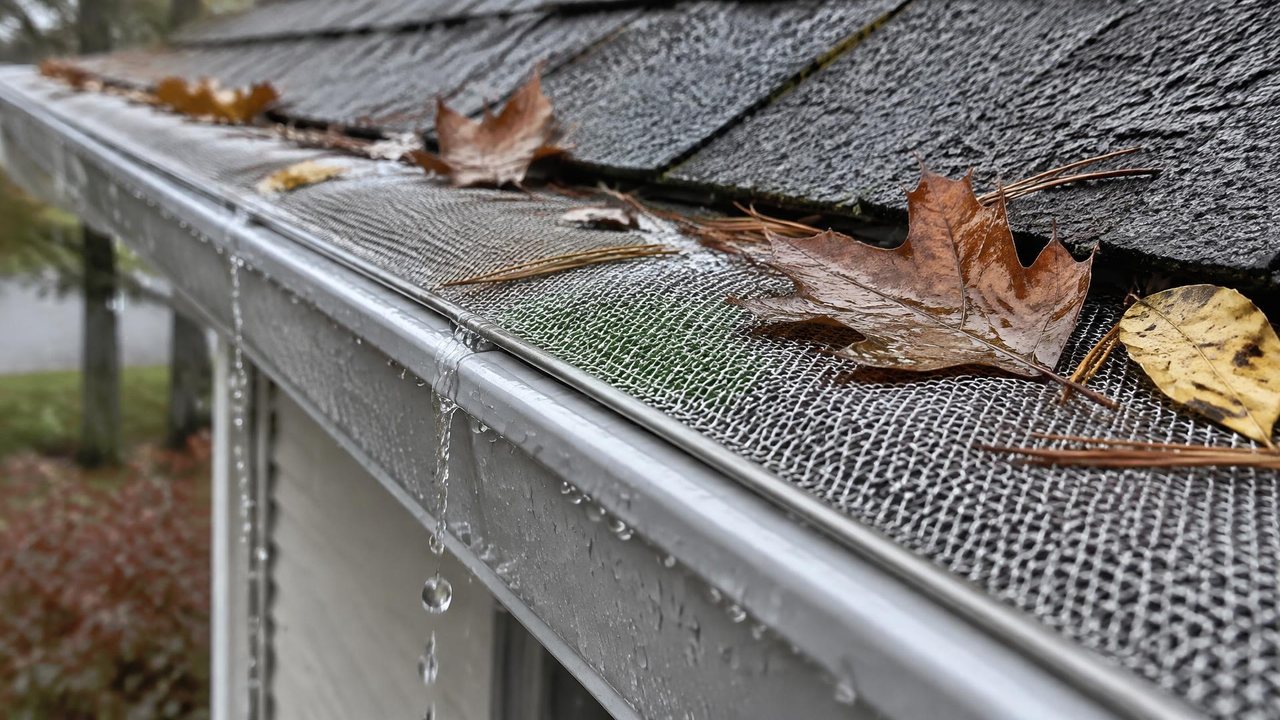
Gutter guards cover the open top of a gutter so leaves stay out while water still gets in. They fall into five main types: fine mesh, perforated screens, foam inserts, brush inserts and reverse-curve hoods. Fine stainless mesh handles the widest range of debris, including pine needles, while screens and foam are cheaper but clog sooner. All of them still need occasional cleaning, so the real goal is less work, not no work.
How do the five types compare?
| Type | Best at | Weak spot | Typical cost per foot |
|---|---|---|---|
| Fine stainless mesh | Leaves, pine needles, seeds and shingle grit | Pollen and fine dirt can film over the top | $3-7 DIY, $15-40 installed |
| Perforated metal or vinyl screen | Large leaves | Pine needles and seeds lodge in the holes | $1-4 DIY |
| Foam insert | Cheap, quick, no tools | Breaks down in sun and grows seedlings on top | $2-4 DIY |
| Brush insert | Large leaves, easy removal | Needles and small debris tangle in the bristles | $3-5 DIY |
| Reverse-curve hood | Heavy leaf fall on gentle roofs | Can overshoot in downpours; visible from the street | $15-30 installed |
Which guard handles pine needles?
Only fine mesh reliably stops pine needles, because the openings are smaller than a needle's width. Needles slide straight into the holes of perforated screens, stick in brush bristles and pile up on foam. If you have pines, firs or spruce near the roof, budget for micro-mesh or plan on cleaning more often.
Will a gutter guard overflow in heavy rain?
Any guard can overflow when water runs off the roof faster than it can pass through the guard, but undersized gutters and downspouts cause far more overflow than guards do. Mesh and screens let water through across their whole surface. Reverse-curve hoods rely on water following the curved lip, which works on gentle rain but can shoot water past the gutter on steep roofs in a downpour. Before buying guards, check that your gutters and downspouts are sized for your roof area and local rainfall.
How are gutter guards attached?
- Under the first row of shingles: common for screens and some mesh. Lifting shingles can break seals and may affect a roof warranty, so check the shingle maker's rules first.
- Onto the front lip and the fascia or roof edge, without touching shingles: the method most roofers prefer.
- Dropped inside the gutter: foam and brush inserts simply sit in the trough.
- Integrated hoods that replace the gutter top entirely: usually a professional install.
How much maintenance do gutter guards still need?
Plan on an inspection each spring and fall. On mesh, a soft brush or a garden hose on the roof side clears the film of pollen and grit that builds up. Screens need debris brushed off the top, and foam and brush inserts need pulling out and shaking or rinsing every year or two. Foam typically needs replacing after a few years of sun exposure.
Are gutter guards worth it?
They pay off most on two-story homes where every cleaning means a tall ladder or a paid service, under heavy tree cover, and on homes where overflowing gutters have already caused fascia rot, basement seepage or ice dams. On a single-story home with few trees, a twice-a-year cleaning from a short ladder may cost less over ten years than professional guards.
How do you choose the right guard?
- Identify the debris: broad leaves, needles, seeds or mainly shingle grit.
- Check your roof pitch and whether you can reach the gutters safely yourself.
- Measure the total length of gutter, including any second-story runs.
- Pick fine mesh for needles or mixed debris; screens or brush inserts for occasional broad leaves on a budget.
- Choose a mounting method that leaves the shingles undisturbed when possible.
What should you check before buying guards?
Measure every run of gutter and count the inside and outside corners, because corners and end caps are where cheap guards leave gaps. Check the gutter width, as most guards are sold for 5 in or 6 in gutters and will not fit oversized commercial troughs. Look at the roof edge too: drip edge, shingle overhang and the condition of the fascia decide which mounting style will sit flat. Finally, check whether your roof's warranty allows anything to be slid under the shingles.
How do guards change winter performance?
In cold climates, snow and ice can sit on top of guards and slide off as a unit, sometimes bending lightweight screens. Stainless mesh in a rigid aluminum frame holds up best. Where heavy snow is normal, choose guards fastened to the front lip and fascia with screws rather than snap-in inserts, and inspect them after the first big thaw each spring.
Do gutter guards stop ice dams?
No. Ice dams come from heat escaping into the attic and melting snow on the roof. Guards can sometimes make ice buildup in the gutter worse, so fix attic insulation and ventilation first.
Can I install gutter guards myself?
On a single-story home with a safe ladder setup, yes. Drop-in and snap-on guards take an afternoon. Leave second-story and steep-roof work to a pro.
How long do gutter guards last?
Stainless mesh and aluminum hoods often last 20 years or more, vinyl screens around 5-10 years, and foam inserts only a few years.
Run the numbers for your own project
- Gutter and Downspout CalculatorHow much gutter and how many downspouts does my roof need?
Keep reading
- How Much Paint Do You Actually Need for a Room?The tin says 400 square feet. Your wall says otherwise. Here is the arithmetic that actually holds up.
- DIY or Hire a Pro? A Decision Framework That Is Not About MoneyThe labour saving is real. So is the cost of a job done twice — and of tools you use once.
- Storage for Small Rooms That Does Not Make Them SmallerSmall rooms do not need more storage. They need storage that stops interrupting the eye.