Fixing Squeaky Floors From Above or Below
By Jim Vernon · 4 min read · Last updated
A squeak is friction between two pieces of wood that used to be tight. The fix is to make them tight again, not to muffle the sound.
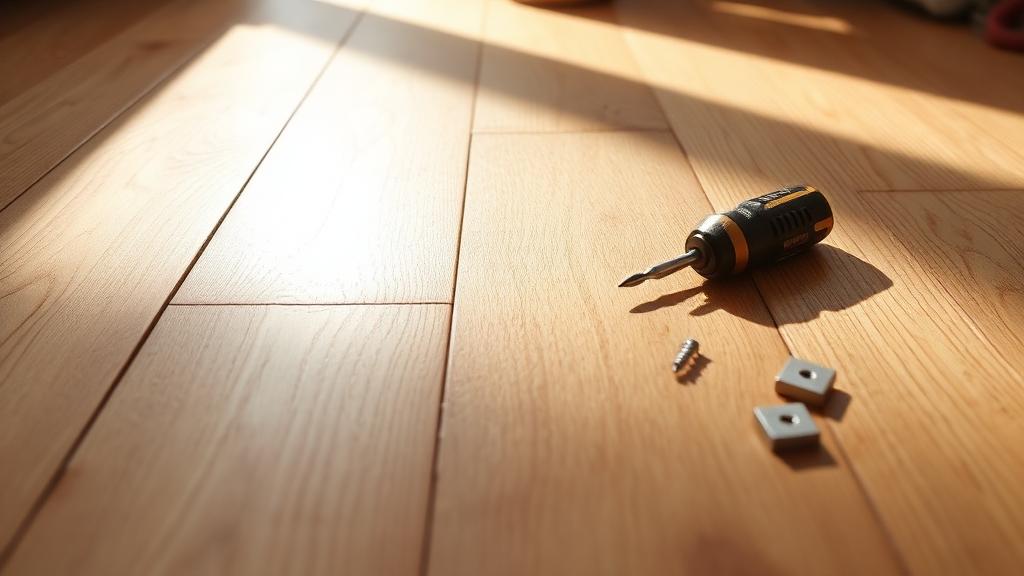
Squeaky floors come from subfloor panels rubbing against joists, floorboards rubbing against each other, or fasteners that have backed out slightly and no longer hold wood tight against wood. The fix depends entirely on whether the joists underneath are accessible.
Access from below (basement or crawlspace)
This is the easier and less invasive fix, since it avoids disturbing the finished flooring above. Have someone walk the floor slowly above while you watch from below to find exactly where the subfloor flexes away from the joist.
- Locate the squeak precisely by having someone walk the floor while you watch the joists from below.
- Where the subfloor has gapped away from the joist, install a squeak-fixing bracket or screw a construction screw up through the subfloor into the floorboard above, being careful not to go so deep it pokes through the finished floor.
- Where the subfloor rubs against the joist itself, a bead of construction adhesive run into the gap, or a shim tapped gently into a visible gap and lightly glued, closes the movement.
- For a floor joist that has slightly bowed, a wood block screwed and glued perpendicular between two joists (blocking) can stiffen it.
Access from above (no basement access, or finished ceiling below)
This route deals with the finished floor surface directly, so it is more visible if not done carefully but works when there is no way to get underneath.
- For squeaks between floorboards, specialty squeak-repair screw kits drive a screw through the floor and snap off cleanly below the surface, leaving a barely visible hole to fill.
- Locate the joist first with a stud finder set for joists, since screwing only into subfloor without hitting the joist below does little.
- Talcum powder or powdered graphite worked into the gaps between boards can temporarily quiet friction-based squeaks without any fasteners, though it is a short-term fix.
- For squeaks under carpet, carpeted squeak-fix kits use a jig to guide a screw through the carpet and pad into the joist without needing to lift the carpet.
| Squeak cause | Best access | Typical fix |
|---|---|---|
| Subfloor gapped from joist | Below | Screw or bracket pulling subfloor to joist |
| Floorboards rubbing together | Above | Screw kit through boards into joist below |
| Loose baseboard or trim near floor edge | Above | Re-nail or screw trim to framing |
| Squeak under carpet | Above (through carpet) | Carpeted squeak-fix screw kit |
When squeaks come back seasonally
Worked example: a squeak near a bedroom doorway
A single squeak right at a bedroom threshold, with basement access below, is usually one subfloor panel edge that has separated slightly from the joist over years of foot traffic concentrated at the doorway. Walking the floor while a helper watches from the basement usually narrows it to a 6-12 inch stretch. One or two squeak-fixing screws driven up through the subfloor into the floorboard, spaced a few inches apart along that stretch, typically resolves it in under 15 minutes once located.
- Confirm basement or crawlspace access is realistic before planning a from-below fix.
- Mark the squeak's exact location with tape on the floor above while a helper watches from below.
- Choose the correct screw length so it reaches the floorboard without protruding through the finished surface.
- Test the floor after each fastener, since one or two screws often solve what seemed like a wider squeaky area.
- Common mistake: assuming a squeak needs a wide repair area when it is usually one small gap.
- Common mistake: driving screws from below without checking finished floor thickness, causing a screw tip to poke through above.
- Common mistake: ignoring a squeak because it's minor, until the subfloor gap widens further and starts to flex visibly underfoot.
When squeaks come back seasonally
Wood expands and contracts with humidity, so a squeak fixed in summer can reappear in a dry winter as boards shrink slightly. This is normal and does not mean the repair failed; a small amount of seasonal movement is expected in wood-framed floors and is rarely worth chasing beyond one or two touch-up fixes a year.
Can I fix a squeak without any tools beyond what I have at home?
Talcum powder worked into board gaps is a genuine no-tool temporary fix, though it will need repeating and does not address the underlying looseness.
Is a squeaky floor a structural problem?
Almost always no — it is a friction and fastening issue, not a sign of structural failure, unless accompanied by visible sagging or bounce, which warrants a closer inspection.
Will fixing a squeak from below leave any visible marks upstairs?
Usually none, since the work stays entirely below the finished floor. It is the reason basement or crawlspace access is always the preferred method when available.
Will fixing a squeak from below leave any visible marks upstairs?
Usually none, since the work stays entirely below the finished floor. It is the reason basement or crawlspace access is always the preferred method when available.
How many squeak-fix screws does one squeak usually need?
Often just one or two spaced a few inches apart along the gap. Adding more than that rarely helps if the first two are placed correctly and driven snug.
Do carpeted squeak-fix kits actually work as well as removing the carpet?
Yes for most cases — the guided jig drives a screw precisely through the pad and backing into the joist, which is usually as effective as lifting the carpet for a spot repair.
Run the numbers for your own project
- Flooring CalculatorHow many boxes of flooring should I buy?
- Project Cost EstimatorWhat will this project cost me?
Keep reading
- How Much Paint Do You Actually Need for a Room?The tin says 400 square feet. Your wall says otherwise. Here is the arithmetic that actually holds up.
- DIY or Hire a Pro? A Decision Framework That Is Not About MoneyThe labour saving is real. So is the cost of a job done twice — and of tools you use once.
- Storage for Small Rooms That Does Not Make Them SmallerSmall rooms do not need more storage. They need storage that stops interrupting the eye.