Engineered or Solid Hardwood: Which Actually Fits Your Home?
By Jim Vernon · 5 min read · Last updated
The deciding factor usually isn't looks — it's what floor level and moisture conditions the room has.
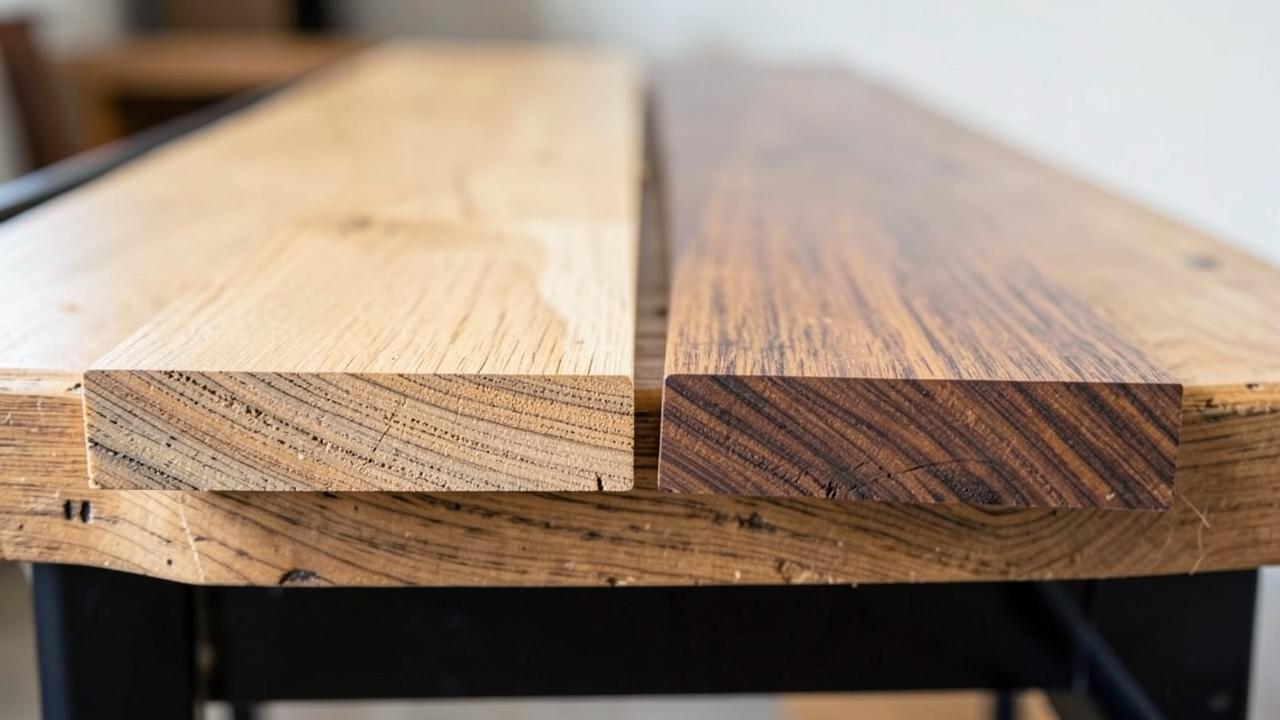
Solid hardwood is milled from a single piece of wood, can be sanded and refinished 4-6 times over its life, but reacts strongly to humidity and generally can't go below grade or over concrete slabs. Engineered hardwood has a real hardwood veneer over a plywood or high-density fiberboard core, resists moisture-driven expansion much better, and can go over concrete or radiant heat, but usually only tolerates 1-3 refinishings depending on veneer thickness.
What's actually different in the construction?
Solid hardwood is typically 3/4 inch thick, tongue-and-groove milled from one species of wood top to bottom. Engineered hardwood ranges from 3/8 to 9/16 inch thick with a veneer layer (called the wear layer) that runs anywhere from 0.6mm on economy products to 4mm+ on premium lines — that wear layer thickness directly determines how many times it can be sanded down and refinished before hitting the plywood core.
| Factor | Solid hardwood | Engineered hardwood |
|---|---|---|
| Cost installed | $8-$16 per sq ft | $6-$14 per sq ft |
| Refinishes over lifetime | 4-6 times (3/4 in thickness) | 1-3 times (depends on veneer thickness) |
| Can install over concrete slab? | No, generally | Yes, glue-down or floating |
| Can install below grade (basement)? | No | Yes, with proper moisture barrier |
| Humidity/expansion sensitivity | High — gaps and cupping possible | Low to moderate — more dimensionally stable |
| Compatible with radiant heat | Rarely recommended | Yes, many products rated for it |
| Expected lifespan | 50-100+ years with refinishing | 20-40 years typical |
Where does each type actually make sense?
- Solid hardwood: main-level rooms over a wood-framed subfloor, in climates without extreme humidity swings, where long-term refinishing flexibility matters.
- Engineered hardwood: basements, homes on a concrete slab, rooms with radiant floor heating, and coastal or humid climates where dimensional stability prevents gapping and cupping.
- Either can work in kitchens if you accept that no hardwood, engineered or solid, is fully waterproof — standing water from a dishwasher or fridge leak damages both.
Why does engineered wood handle humidity better?
The plywood core's cross-laminated layers run in alternating grain directions, which cancels out the expansion and contraction that happens when solid wood absorbs or releases moisture. Solid wood expands and contracts almost entirely across the grain, which is why solid hardwood installers leave an expansion gap at the walls and why solid floors need to acclimate on-site for 5-7 days before installation — engineered flooring typically needs only 48-72 hours of acclimation since it moves less.
How does long-term cost compare?
Solid hardwood costs more upfront to refinish each time (sanding and finishing a 300 sq ft room runs $1,200-$2,500) but can be refinished more times, stretching total lifespan past 75-100 years in a stable home. Engineered hardwood is often cheaper per square foot initially and needs less frequent refinishing decisions, but once the wear layer is gone, the floor must be replaced rather than refinished — a full replacement of that same 300 sq ft room runs $2,500-$5,500 installed.
How do warranties differ between the two products?
Solid hardwood warranties mostly cover finish wear (typically 5-25 years depending on the factory finish) since the wood itself is expected to be refinished periodically rather than warrantied for life. Engineered hardwood warranties often bundle structural warranty (against delamination of the plywood core, typically 25 years to lifetime) with a separate, shorter finish-wear warranty, and many explicitly exclude damage from standing water or installation over an untested slab — read the moisture-related exclusions carefully before assuming a long warranty period covers every failure mode.
Does resale value differ between the two?
Appraisers and most buyers can't visually distinguish good engineered hardwood from solid once installed, and both are typically listed simply as 'hardwood flooring' on a listing. The value difference shows up more in inspection reports and buyer due diligence on older homes, where solid hardwood's multi-refinish history is sometimes seen as a selling point in high-end markets.
How do installation methods differ between the two?
Solid hardwood is almost always nailed or stapled down over a wood subfloor, which requires a compatible flooring nailer ($150-$300 to buy, $40-$60/day to rent) and doesn't work over concrete without an additional plywood subfloor layer first. Engineered hardwood offers more flexibility: it can be nailed, glued down, or floated with a click-lock system depending on the product, which is part of why it's the more common choice for DIY installers and for rooms where a wood subfloor doesn't already exist.
What acclimation mistakes cause the most problems?
Bringing hardwood into a home before the HVAC system is running normally, or storing it in a garage rather than the actual installation room, is the most common acclimation mistake — flooring acclimates to the specific humidity and temperature of the room it will live in, not just 'indoors' generally. Installing during an unusually dry winter week without letting the home's humidity stabilize near its normal year-round range (ideally 30-50% relative humidity) can cause both solid and engineered floors to show gaps once summer humidity returns and the wood expands back to its intended size.
Can engineered hardwood be installed in a basement?
Yes, engineered hardwood is one of the few genuine wood-look options rated for below-grade installation, provided a proper vapor barrier is used and the concrete slab has been tested for moisture emission first. Solid hardwood should not be installed below grade under any circumstances.
How do I know how many times my floor has already been refinished?
A flooring contractor can measure remaining wood thickness above the tongue-and-groove joint with a small probe at a vent or floor register gap. If less than about 1/8-3/16 inch remains above the groove, another full sanding refinish risks exposing nails or breaking through.
Is engineered hardwood as durable as solid for everyday wear?
The surface hardness is identical since both use the same wood species on top — a white oak engineered floor and a white oak solid floor dent and scratch the same way day to day. The durability difference only shows up over decades, in how many times each can be restored versus needing full replacement.
Run the numbers for your own project
- Flooring CalculatorHow many boxes of flooring should I buy?
- Project Cost EstimatorWhat will this project cost me?
Keep reading
- How Much Paint Do You Actually Need for a Room?The tin says 400 square feet. Your wall says otherwise. Here is the arithmetic that actually holds up.
- DIY or Hire a Pro? A Decision Framework That Is Not About MoneyThe labour saving is real. So is the cost of a job done twice — and of tools you use once.
- Storage for Small Rooms That Does Not Make Them SmallerSmall rooms do not need more storage. They need storage that stops interrupting the eye.