Driveway and Patio Base Prep: Why It Matters Most
By Jim Vernon · 5 min read · Last updated
A patio poured on 2 inches of loose gravel will crack within a couple of winters; the same slab on properly compacted 4-6 inch base can last decades.
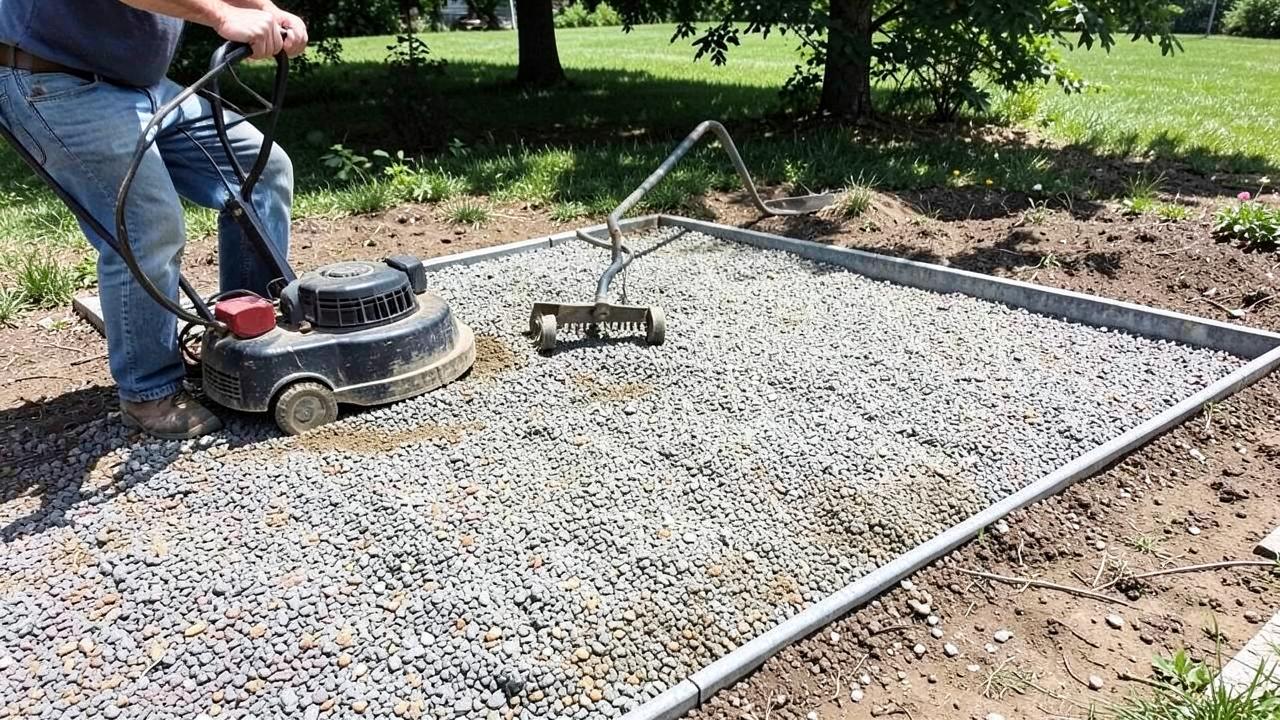
Base prep, not the concrete or paver quality on top, is the single biggest factor in whether a driveway or patio stays flat and crack-free. A proper base is 4-6 inches of compacted crushed stone (commonly 3/4-inch minus, sometimes called crusher run) laid in 2-inch lifts and compacted with a plate compactor to at least 95% of maximum density, over subgrade soil that has also been compacted and, where soil is soft or clay-heavy, sometimes stabilized with geotextile fabric.
How thick should the base layer be for different projects?
| Project | Recommended base depth | Base material | Compaction target |
|---|---|---|---|
| Patio (foot traffic only) | 4 in. | 3/4-in. crushed stone | 95% standard proctor |
| Walkway | 3-4 in. | 3/4-in. crushed stone | 90-95% standard proctor |
| Residential driveway (cars) | 6 in. | 3/4-in. crushed stone | 95% standard proctor |
| Driveway with occasional heavy vehicles/RV | 8-10 in. | 3/4-in. crushed stone, sometimes two lifts | 95-98% standard proctor |
| Paver patio (with bedding sand layer) | 4-6 in. base + 1 in. bedding sand | 3/4-in. crushed stone + coarse sand | 95% standard proctor |
Why does compaction matter more than base depth alone?
Six inches of loosely dumped gravel provides almost no more support than two inches, because uncompacted stone continues settling under load for months or years after installation, especially under freeze-thaw cycling. Compacting in 2-inch lifts — rather than dumping the full depth and compacting once — is what actually achieves density throughout the layer; a single pass over a thick lift only compacts the top inch or two and leaves the rest loose.
What causes cracking and heaving even with a good base?
- Poor subgrade drainage — water trapped under the base freezes and expands, heaving the slab or pavers unevenly (frost heave).
- Skipping geotextile fabric over clay or organic soil, which allows the base stone to migrate down into the soft subgrade over time, called 'pumping.'
- Concrete poured without control joints spaced at roughly 2-2.5 times the slab thickness in feet (a 4-inch slab needs joints every 8-10 feet), letting shrinkage cracks form randomly instead of at planned joints.
- Tree roots growing under an existing slab or paver base years after installation, especially from species with aggressive shallow root systems planted too close to the pavement.
- Base material contaminated with fines or clay rather than clean crushed stone, which holds water and loses strength when saturated.
How does base prep differ between concrete and pavers?
Concrete slabs need a uniform, well-compacted base because the rigid slab will crack if it settles unevenly, but the slab itself spans small base irregularities somewhat. Paver systems have no rigid structure holding them together, so base uniformity and a properly screeded bedding sand layer (typically 1 inch, never more than 1.5 inches loose) matter even more — inconsistent bedding sand thickness is the most common cause of individual pavers settling unevenly within the first year.
What does proper base prep cost compared to skipping it?
Renting a plate compactor runs $60-100 per day, and crushed stone delivered costs roughly $35-55 per ton, adding perhaps $300-600 in materials and equipment to an average 400-square-foot patio project — a small fraction of the $3,000-8,000 total project cost. Skipping or shortcutting base prep to save that amount routinely leads to cracking or settling within 2-4 years, at which point the paved surface often needs to be fully removed and redone, effectively doubling the total cost.
How does climate change base prep requirements?
In freeze-thaw climates, base depth and drainage matter more than in frost-free regions, since any water trapped in or under the base expands roughly 9% when it freezes and can lift a slab or paver section unevenly each winter. Northern installers often add a capillary break — a layer of coarser open-graded stone below the standard base — specifically to keep groundwater from wicking upward into the base by capillary action. In arid, expansive-clay regions like parts of Texas or Colorado, the bigger risk is the subgrade soil itself swelling and shrinking with moisture changes; a geotextile-separated base and, in severe cases, a soil stabilization treatment or deeper base section help limit how much that movement transmits to the surface.
How do you check an existing driveway or patio for base problems before repaving?
- Look for a network of cracks following no particular pattern, which often indicates subgrade movement rather than normal concrete shrinkage cracking at control joints.
- Check for a hollow or drummy sound when tapping a paver or walking heavily near a joint — a sign that the bedding sand or base beneath has washed out or settled.
- Note any area where water visibly ponds after rain rather than draining, which points to either an inadequate slope or a compacted, low base zone.
- Look at fence posts, adjacent walkways, or steps for the same tilt or settlement pattern as the pavement, which suggests a broader site drainage or soil issue rather than a base-only problem confined to the pavement.
Can I skip the gravel base on well-drained sandy soil?
Not recommended even on sandy soil, because the base layer's job is load distribution as much as drainage. Sandy soil alone compacts unevenly under point loads like tires or furniture legs, leading to localized settling even where drainage is not an issue.
How do I know if my compaction was adequate without lab testing?
A simple field check: walk across the compacted base in work boots — a properly compacted surface leaves no visible boot indentation and feels solid underfoot, not springy or shifting. It's not as precise as a proctor density test but catches most under-compaction issues.
Does geotextile fabric go under or over the base stone?
Geotextile fabric goes directly on the prepared subgrade, before any base stone is placed, separating the soil from the stone above it. Placing it elsewhere in the layer sequence doesn't prevent the soil-stone intermixing it's designed to stop.
Run the numbers for your own project
- Concrete CalculatorHow much concrete do I need?
- Gravel and Path CalculatorHow much gravel do I need for my path or driveway?
- Project Cost EstimatorWhat will this project cost me?
Keep reading
- How Much Paint Do You Actually Need for a Room?The tin says 400 square feet. Your wall says otherwise. Here is the arithmetic that actually holds up.
- DIY or Hire a Pro? A Decision Framework That Is Not About MoneyThe labour saving is real. So is the cost of a job done twice — and of tools you use once.
- Storage for Small Rooms That Does Not Make Them SmallerSmall rooms do not need more storage. They need storage that stops interrupting the eye.