Dehumidifier and Air Purifier Sizing: Picking Capacity
By Jim Vernon · 5 min read · Last updated
Sizing by square footage alone gets both dehumidifiers and air purifiers wrong more often than it gets them right.
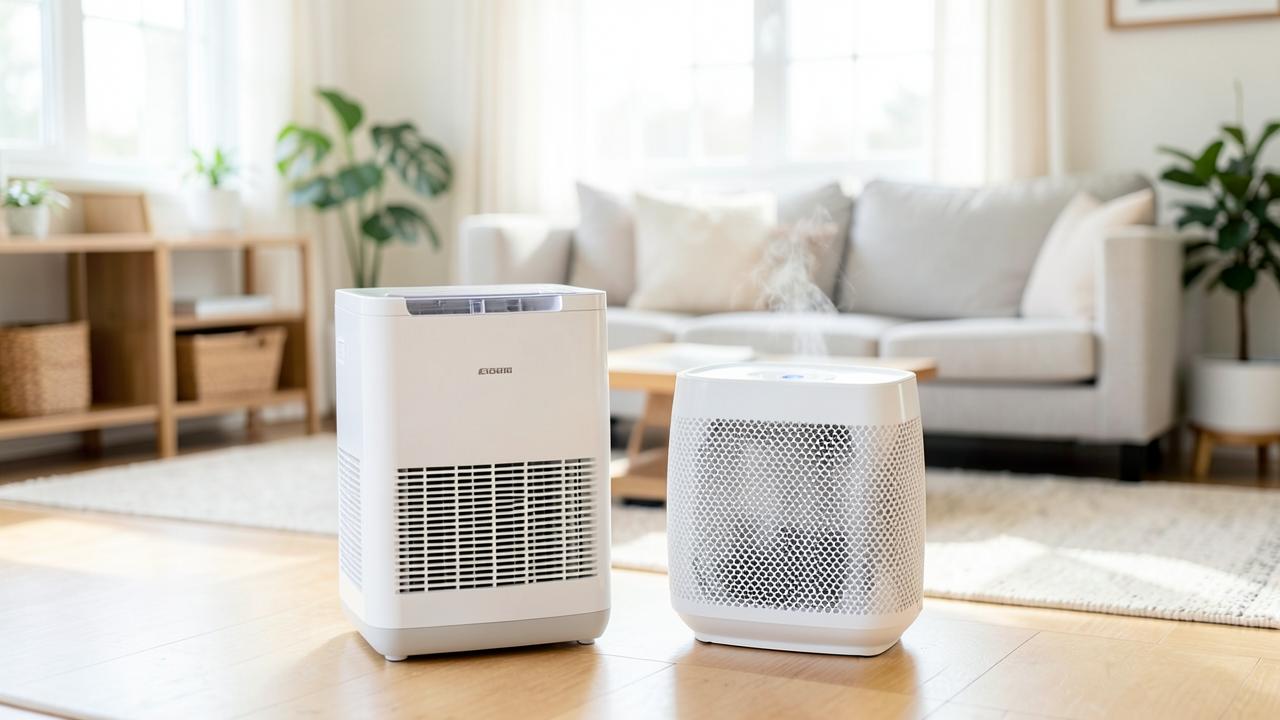
Dehumidifiers are sized by pints removed per day matched to square footage and dampness level, while air purifiers are sized by CADR (Clean Air Delivery Rate) matched to room square footage and desired air changes per hour — and both are commonly undersized because shoppers default to whatever fits their budget rather than checking the manufacturer's coverage chart against their actual space and conditions. An undersized unit of either type runs constantly, wears out faster, and never quite reaches its target.
How do you size a dehumidifier correctly?
| Space size & condition | Recommended capacity (pints/day, old DOE rating) | Typical unit cost |
|---|---|---|
| 500 sq ft, moderately damp (musty smell, damp feel) | 30-40 pints/day | $180-280 |
| 500 sq ft, very damp (standing moisture, wet walls) | 40-50 pints/day | $220-320 |
| 1,200 sq ft basement, moderately damp | 50-60 pints/day | $250-350 |
| 1,200 sq ft basement, very damp or flooding history | 70+ pints/day, consider a ducted whole-space unit | $350-700+ |
Note that dehumidifier capacity ratings changed under a 2019 DOE testing standard, so a unit now labeled '30 pints' performs roughly like an older '50 pint' unit tested under the previous standard — check the manufacturer's coverage area in square feet directly rather than comparing pint numbers across old and new listings.
How do you size an air purifier correctly?
Match a purifier's CADR (usually listed separately for smoke, dust, and pollen) to your room's square footage using the rule that CADR should be at least two-thirds of the room's area in square feet for smoke, per AHAM guidelines, to achieve roughly 4-5 air changes per hour — the level generally considered effective for meaningful particulate reduction. A 300 sq ft room, for example, needs a smoke CADR of at least 200 to perform well, not merely a purifier 'rated for large rooms' on marketing copy alone.
| Room size | Minimum smoke CADR needed | Typical purifier cost |
|---|---|---|
| 150 sq ft (bedroom) | 100 | $80-150 |
| 300 sq ft (living room) | 200 | $150-280 |
| 500 sq ft (open living/dining) | 330 | $250-450 |
| 1,000+ sq ft (open concept main floor) | 670+, often needs 2 units | $500-900+ |
What conditions push you toward a bigger unit than the basic size chart suggests?
- Basements and crawlspaces run cooler than the rest of the house, and standard dehumidifiers lose capacity below about 65°F — look for a unit rated for low-temperature operation if the space stays cool.
- Homes with pets, smokers, or wildfire smoke exposure benefit from CADR at the higher end of the range or a dedicated second unit for the main bedroom.
- A recently flooded or persistently damp space may need a commercial-grade dehumidifier (rented or purchased, $600-1,500) for initial drying before stepping down to a standard residential unit for maintenance.
- Open floor plans without doors between rooms effectively increase the square footage a single air purifier needs to cover, even if it's nominally 'one room.'
How do you know a unit is correctly sized once it's running?
- For a dehumidifier, it should cycle on and off (not run continuously) once it reaches its target humidity setting within a reasonable time, typically a few hours in a moderately damp space.
- Check a hygrometer daily for the first week; a correctly sized unit should bring the space to your 40-50% target and hold it with normal cycling.
- For an air purifier, run it on a lower fan speed for continuous operation rather than max speed constantly — if you need max speed around the clock to keep up, the unit is undersized for the room.
- Replace or clean filters on the manufacturer's schedule regardless of size — even a correctly sized unit underperforms badly with a clogged filter.
How much does it cost to run a dehumidifier or air purifier continuously?
A 50-pint dehumidifier draws roughly 500-700 watts and, run 12-16 hours a day during a humid season, costs about $20-45 per month at typical electricity rates — a real ongoing cost worth factoring in alongside the purchase price when comparing a portable unit to a ducted whole-house system. A typical air purifier on a HEPA setting draws far less, often 30-80 watts, costing $3-10 per month for continuous operation, which is one reason running a purifier around the clock at a moderate speed is usually more cost-effective than running it on high intermittently.
What maintenance keeps either type of unit performing at its rated capacity?
- Clean or replace a dehumidifier's air filter monthly during heavy-use season; a clogged filter reduces airflow across the coil and can cut moisture removal by 20% or more.
- Check and clean the coil periodically, since dust buildup on the coil reduces heat transfer efficiency the same way it does in an AC system.
- Replace HEPA filters on the manufacturer's schedule, typically every 6-12 months depending on usage and air quality, and check pre-filters monthly since they catch larger particles first.
- Keep dehumidifiers and purifiers away from walls and furniture by at least 6-12 inches to maintain proper intake and exhaust airflow, which the unit's rated capacity assumes.
Will a bigger dehumidifier or purifier than needed cause any problems?
Not functionally — an oversized unit simply reaches its target faster and cycles more, which is generally fine, though it costs more upfront than necessary. The main downside of oversizing is wasted purchase cost, not performance.
Do HEPA filters matter as much as CADR when choosing a purifier?
True HEPA filtration (99.97% of particles at 0.3 microns) is the filtration standard worth looking for, but CADR tells you how much filtered air actually moves through the room per minute — a HEPA filter in an undersized unit still won't clean a large room quickly.
How often should I empty or drain a dehumidifier?
Most residential units with a built-in pump can drain continuously via a hose to a floor drain or sump, which is worth setting up in a basement to avoid manually emptying a tank daily during humid months. Without a drain hose, a 50-pint unit in a very damp basement can fill its tank within 12-24 hours.
Run the numbers for your own project
- Home Air Quality and Ventilation CalculatorDoes my home get enough fresh air ventilation?
- Home Maintenance ScheduleWhat should I be doing to my home this month?
Keep reading
- How Much Paint Do You Actually Need for a Room?The tin says 400 square feet. Your wall says otherwise. Here is the arithmetic that actually holds up.
- DIY or Hire a Pro? A Decision Framework That Is Not About MoneyThe labour saving is real. So is the cost of a job done twice — and of tools you use once.
- Storage for Small Rooms That Does Not Make Them SmallerSmall rooms do not need more storage. They need storage that stops interrupting the eye.