Deck Framing and Joist Spacing: Spans That Hold
By Jim Vernon · 4 min read · Last updated
A 2x8 joist spanning 12 feet at 16-inch spacing will feel noticeably bouncier than the same joist at 12-inch spacing — spacing changes stiffness more than most people expect.
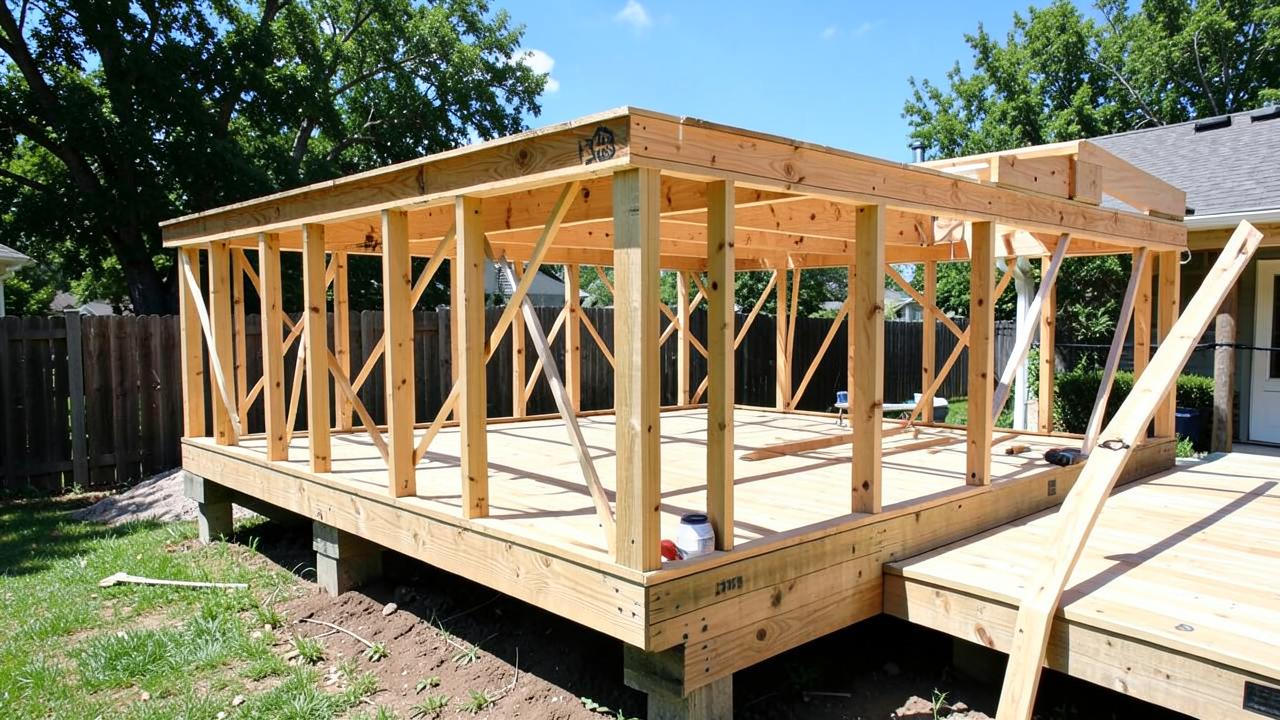
Deck joist spacing and spans are governed by lumber species, size, decking material, and local building code, but the widely used baseline for pressure-treated Southern Pine is: 2x8 joists at 16 inches on center span up to about 12 feet 6 inches, while 2x10 joists at the same spacing span up to about 15 feet 8 inches — always confirm against your jurisdiction's current span table before finalizing a plan, since values shift with lumber grade and code edition.
What joist size and spacing do most decks actually need?
| Joist size | Spacing (on center) | Max span (No. 2 SYP, treated) | Notes |
|---|---|---|---|
| 2x6 | 16 in. | 9 ft 11 in. | Common for small platforms, low decks |
| 2x8 | 16 in. | 12 ft 6 in. | Most common residential deck joist |
| 2x8 | 12 in. | 13 ft 8 in. | Tighter spacing for stiffer feel or composite decking |
| 2x10 | 16 in. | 15 ft 8 in. | Larger decks, longer spans between beams |
| 2x12 | 16 in. | 18 ft 0 in. | Long spans; check beam and footing sizing scales up too |
Why does composite decking often require closer joist spacing?
Most composite decking manufacturers require 12-inch on-center joist spacing for straight installations and sometimes 16 inches maximum even in-line, versus the 16- or 24-inch spacing sometimes used with solid wood decking. Composite boards are more flexible than wood and can develop a visible wave or 'trampoline' feel between joists if spaced too far apart — check the specific product's span chart, since requirements vary by brand and board thickness.
How are beams and footings sized to support the joists?
- Beam spans depend on the joist span they carry — a beam supporting 12 feet of joist span on each side (24 ft total tributary width) needs to be sized larger than one supporting a narrow single-joist-span deck.
- A doubled 2x10 beam typically spans 6-8 feet between posts under moderate tributary loads; a tripled 2x12 can reach 10-12 feet, but always verify against your local span table and load conditions.
- Footings need to reach below the frost line — as deep as 42-48 inches in cold northern climates, versus 12 inches in frost-free southern regions — and be sized to the tributary load, commonly 12-inch diameter for light loads up in to 20 inches for heavier point loads.
- Post-to-beam and beam-to-footing connections need rated hardware (post bases, caps) rather than toe-nailing alone, which is a frequent inspection failure point.
What causes a bouncy deck even when spans look code-compliant?
Deflection that meets minimum code (typically L/360, meaning a 12-foot span can deflect up to 0.4 inches under load) can still feel springy to occupants, especially with composite decking or when furniture concentrates load in one area. Reducing joist spacing from 16 to 12 inches, upsizing joist depth by one size, or adding blocking between joists at mid-span all reduce perceptible bounce even when the original spacing was technically legal.
What framing mistakes show up most often on deck inspections?
- Ledger fastened with deck screws instead of structural lag screws or through-bolts.
- Missing or undersized joist hangers, or hangers nailed with the wrong fastener type (common nails instead of joist hanger nails).
- Beam resting notched into posts without a proper post cap connector.
- Footings poured above the frost line, leading to frost heave and a shifting, uneven deck within a few winters.
- No blocking or rim joist bracing on long spans, allowing joists to twist over time.
How does joist material choice affect span and spacing decisions?
Pressure-treated Southern Pine is the most common and least expensive joist material, but Douglas fir and hem-fir have somewhat different span capacities at the same size and grade, so a span table built for one species shouldn't be applied to another without checking. Engineered joists, such as parallel-strand lumber or I-joists, span farther than dimensional lumber of similar depth and resist twisting and shrinkage better, making them worth the added cost (typically 20-40% more per linear foot) on decks with long clear spans between beams or where minimizing the number of support posts matters for the design. Steel ledger and joist systems, while less common in residential work, are sometimes used on decks over garages or in coastal environments where wood rot risk is high.
How much does framing typically cost compared to the whole deck budget?
Framing materials (joists, beams, posts, hangers, and hardware) typically run 25-35% of a deck's total material cost, with decking, railing, and fasteners making up the rest. For an average 300 square-foot deck, that puts framing materials in the $1,500-3,000 range before labor, though upgrading to engineered joists or larger beam sizes for a longer span can add several hundred dollars without changing the visible finished product at all.
Can I use 2x6 joists for a full-size deck to save money?
Only for short spans under about 10 feet with 16-inch spacing on treated Southern Pine. For a typical 12-16 foot deck, 2x6 joists would either be over-spanned or require spacing so tight it erases any material savings — 2x8 or 2x10 is the practical choice for most decks.
Do I need a permit for deck framing changes?
In most US jurisdictions, yes — any deck attached to the house or elevated more than about 30 inches above grade requires a permit and inspection, specifically because ledger and footing failures are a known safety hazard. Check with your local building department before framing.
How much does reframing a bouncy deck typically cost?
Adding mid-span blocking or sistering joists to stiffen an existing deck runs $500-1,500 for an average 300-square-foot deck; a full reframe with new joists and beams runs closer to $4,000-9,000 depending on size and accessibility.
Run the numbers for your own project
- Deck and Fence Material CalculatorHow much timber does my deck or fence need?
- Project Cost EstimatorWhat will this project cost me?
- Home Maintenance ScheduleWhat should I be doing to my home this month?
Keep reading
- How Much Paint Do You Actually Need for a Room?The tin says 400 square feet. Your wall says otherwise. Here is the arithmetic that actually holds up.
- DIY or Hire a Pro? A Decision Framework That Is Not About MoneyThe labour saving is real. So is the cost of a job done twice — and of tools you use once.
- Storage for Small Rooms That Does Not Make Them SmallerSmall rooms do not need more storage. They need storage that stops interrupting the eye.