How Should You Test Paint Colors Before Committing to a Room?
By Jim Vernon · 4 min read · Last updated
Test large swatches on multiple walls and check them at 9am, noon, and 8pm before you buy a full gallon.
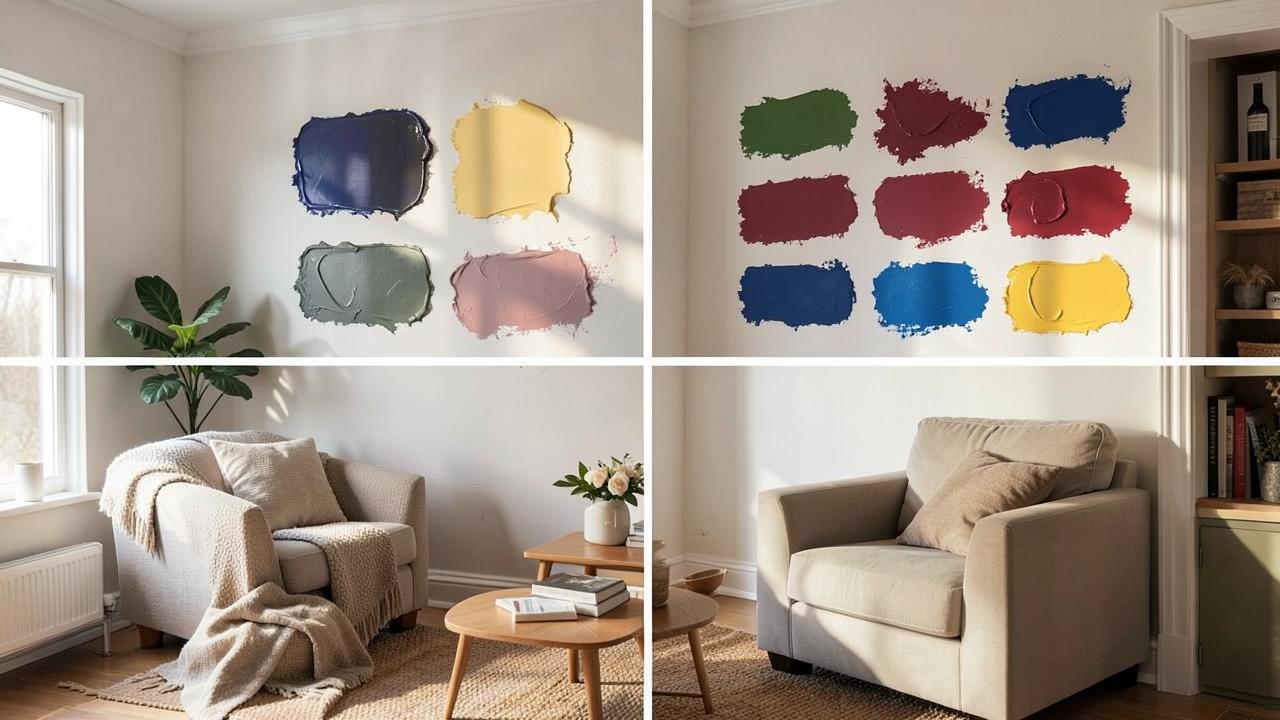
Paint 12x12-inch or larger swatches of your top two or three color choices directly on the wall (or on primed poster board you can move around), then look at them at three different times of day under your room's actual light. A 2x2-inch store chip under fluorescent showroom lighting will read noticeably different from a full wall under your home's north-facing window or warm 2700K bulbs.
Why does the same color look different in different rooms?
Light temperature, measured in kelvin, shifts how a pigment reads. North-facing rooms get cool, blue-toned indirect light that makes warm colors look muddier and grays look colder; south-facing rooms get warm, high-intensity light that saturates colors and can make a soft gray look almost tan by afternoon. Bulb choice compounds this — a 2700K warm-white bulb pulls colors toward yellow-orange, while a 4000K or 5000K bulb pushes them toward blue-white and makes off-whites look grayer or greenish.
What's the actual testing process?
- Narrow to 2-4 finalist colors using an app or fan deck, factoring in the room's exposure (north, south, east, west).
- Buy sample pots — usually $6-$10 each for an 8-oz sample, enough for two coats on a roughly 2x2-foot area.
- Paint swatches on at least two different walls, including one that gets direct window light and one in a shadowed corner.
- View them at morning, midday, and evening (with your normal lighting on) across at least two days, since overcast versus sunny days shift the reading too.
- Step back 6-8 feet, the typical viewing distance in a living space, rather than judging up close.
| Light condition | Effect on color | Adjustment to consider |
|---|---|---|
| North-facing window | Cooler, flatter, can gray out warm tones | Choose a shade warmer than you think you want |
| South-facing window | Warm, high saturation, intensifies color | Choose a shade lighter/cooler than the chip suggests |
| 2700K warm LED/incandescent | Pulls whites and grays toward yellow | Test true whites under this bulb specifically |
| 4000K+ cool LED | Pulls warm colors toward gray or green | Avoid pairing warm wall colors with cool-white bulbs |
How do return and exchange policies factor into color decisions?
Most paint retailers won't accept opened cans back, but many will exchange an unopened, unmixed can within a return window, typically 30 days, if you decide against a color before opening it. This is another reason sample pots matter — buying a single full gallon before testing risks being stuck with a $50-$70 can you can't return once it's tinted and opened, while an $8-$10 sample pot is a low-risk way to confirm the choice first.
Do digital visualizer apps replace physical samples?
No. Visualizer apps are useful for narrowing options, but phone cameras and screens auto-correct color and white balance, which can make a mustard yellow look like a soft gold. Every professional painter and colorist still recommends physical sample pots on the actual wall as the final check before buying full gallons at $50-$70 each.
How much does skipping this step actually cost?
A wrong color on a 12x14 bedroom (roughly 400 sq ft of wall) means repainting — about 2 gallons of paint at $50-$70 each plus a full day of labor, either your own weekend or $300-$600 if you hire it out. Two sample pots at $8-$10 each is the cheapest insurance in the entire project.
What role do existing finishes and furniture play in the decision?
A color that reads perfectly on a blank wall can clash once a room is furnished, because wood tones, metal fixtures, and fabric all interact with the wall color under the same light. A warm honey-oak floor next to a cool blue-gray wall can look muddy in evening light even though both colors tested fine independently. When possible, prop the sample swatch near the largest fixed element in the room — the floor, the countertop, or a large rug — rather than judging the wall color in isolation from everything it will sit next to.
How do professional painters and designers avoid color regret?
- They test at the darkest corner of the room, not just the brightest wall, since a color that looks fine in direct light can go noticeably darker or muddier in a shadowed nook.
- They account for the '50% rule' — most colors read roughly 1-2 shades darker on a full wall than on a small chip, because more surface area intensifies the perceived saturation.
- They keep a small stash of neutral off-white or gray-beige swatches on hand to test alongside a bold color choice, since bold colors often need a very specific neutral trim pairing to avoid looking harsh.
- They photograph the swatch at each time of day so they can compare morning, midday, and evening side by side rather than relying on memory alone.
How big should a paint test swatch be?
At least 12x12 inches, and ideally larger — 2x2 feet if you have enough sample paint. Small chips or 4-inch swatches don't give your eye enough surface area to judge how the color reads at a normal viewing distance across a whole wall.
Should I test on primed board or directly on the wall?
Testing directly on the wall is more accurate since it captures your actual wall texture and existing color bleed-through, but poster board coated with white primer is a good option if you're renting or don't want patchy test spots in a finished room.
How many days should I leave test swatches up?
At least 2-3 full days to see the color in different weather (sunny and overcast) and all lighting conditions, including daytime natural light and evening artificial light with your normal bulbs on.
Run the numbers for your own project
- Paint CalculatorHow much paint do I need for this room?
- Room Size and Furniture FitWill this furniture actually fit my room?
Keep reading
- How Much Paint Do You Actually Need for a Room?The tin says 400 square feet. Your wall says otherwise. Here is the arithmetic that actually holds up.
- DIY or Hire a Pro? A Decision Framework That Is Not About MoneyThe labour saving is real. So is the cost of a job done twice — and of tools you use once.
- Storage for Small Rooms That Does Not Make Them SmallerSmall rooms do not need more storage. They need storage that stops interrupting the eye.