Balcony Privacy and Shade Ideas That Don't Require Permission
By Jim Vernon · 5 min read · Last updated
Most balcony privacy problems are solved with weight and height, not permanent construction.
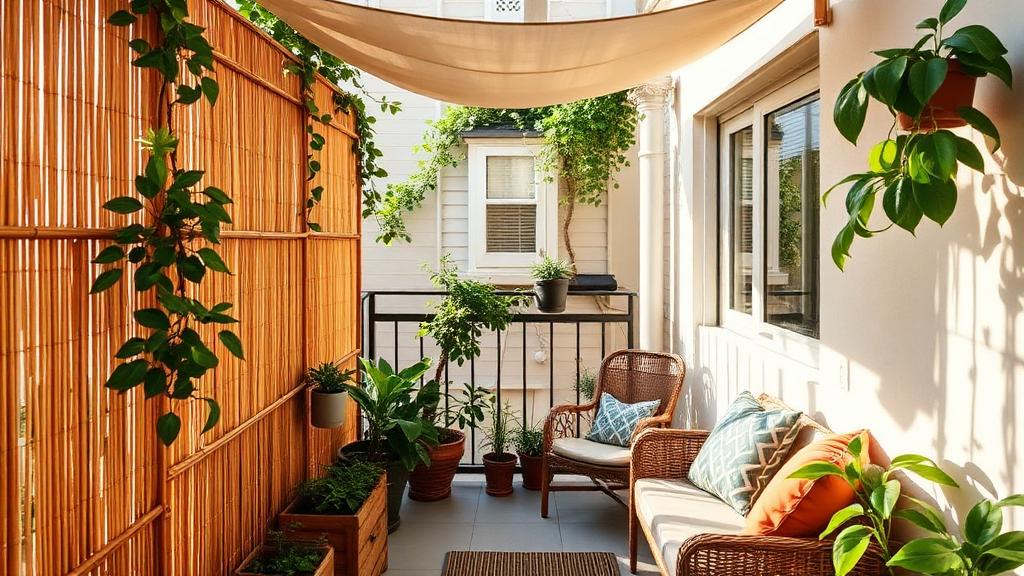
Balconies are usually shared structures with restrictions on drilling, attaching hardware, or altering railings, which rules out a lot of standard fence-building advice. The workable solutions almost all rely on freestanding weight, clip-on hardware, or tension rather than fasteners into the building itself.
Start with what you're actually blocking
- Sightlines from a neighboring balcony at eye level while seated or standing.
- Direct low-angle sun in the morning or evening that makes the space unusable at certain hours.
- Wind, which on higher floors can be a bigger comfort issue than either privacy or sun.
These three problems have different solutions, and it's worth identifying which one is actually bothering you before buying anything — a shade sail does nothing for a sightline problem at seated eye level, and a privacy screen does little against a strong crosswind.
Privacy without drilling
| Option | How it attaches | Best for |
|---|---|---|
| Freestanding planter screens with trellis | Weighted base, no attachment needed | Permanent-feeling privacy that can move with you |
| Bamboo or reed fencing panels | Zip-tied to existing railings | Cheap, quick coverage along a railing |
| Tension rods with curtain panels | Wedged between floor and ceiling or wall to wall | Vertical screening on a covered balcony |
| Tall potted grasses or clumping bamboo | Freestanding pots | Softening sightlines while adding greenery |
| Outdoor curtains on a freestanding frame | Clamped to a portable frame, not the railing | Fully reversible, moves with a renter |
Shade without a permanent structure
- A cantilever umbrella with its own weighted base, positioned to avoid needing any balcony attachment at all.
- A retractable side-mount awning designed specifically for balcony railings, using clamps rather than drilled fasteners.
- Tall, broad-leafed plants like a fiddle leaf fig or umbrella plant positioned to filter afternoon sun through foliage rather than block it outright.
- A shade sail rigged between two freestanding poles rather than fixed to the building wall.
Wind is often the real comfort issue
On higher floors, wind funneling around a building can make a balcony unusable even with good privacy and shade solved. Solid screens act like sails and can make wind worse by creating turbulence at the edges; semi-permeable materials like slatted screens or dense but not solid planting break wind speed more effectively than a solid barrier.
Measure before ordering anything online — balcony dimensions vary widely, and a planter or screen sized for a generic 'standard balcony' listing can end up too shallow to stand upright in wind, or too wide to fit through the door for setup.
A cheap fix worth trying before buying anything: hang a plain bedsheet or lightweight curtain temporarily to confirm which exact angle blocks the sightline, then buy screening sized to that measured angle rather than guessing.
Combining fixes when more than one problem exists
Many balconies actually have two problems at once — a sightline from one direction and harsh afternoon sun from another — and it's tempting to solve both with a single large screen. In practice, a corner planter with a trellis handling the sightline, paired with a separate freestanding umbrella angled for the sun, usually works better and costs less than one oversized structure trying to do both jobs, since a single tall barrier large enough to block both issues often eats most of the usable floor space.
A worked example: sizing a freestanding screen
For a standard 6-foot-wide balcony railing, a freestanding trellis planter around 24-30 inches wide and 5-6 feet tall placed at one end typically blocks the sightline from an adjacent balcony without requiring the full width of the railing to be covered — most sightline problems come from a specific angle, not the entire view, so measure the actual problem angle before buying enough screening for the whole railing.
What these fixes actually cost
| Fix | Approx. cost | Notes |
|---|---|---|
| Zip-tied reed or bamboo fencing, 6 ft run | $25-60 | Cheapest option; replace every 2-3 seasons outdoors |
| Freestanding trellis planter with weighted base | $60-150 | Add $15-30/bag for soil and $10-25 for a fast-growing vine or clumping grass |
| Cantilever umbrella with weighted base | $150-400 | Base alone can run $50-100 and is worth buying oversized for wind |
| Retractable clamp-mount balcony awning | $150-350 | Check the railing's tube or bar diameter before ordering |
| Outdoor curtain panels on a tension frame | $80-200 | Frame plus two panels; more if covering a wide opening |
A soil-filled planter roughly 18 inches in diameter and 18 inches tall can weigh 40-80 lbs once watered, even before counting the pot itself — worth knowing before lining up four or five of them along a railing edge on an upper floor.
Common mistakes
- Buying a shade sail sized for a patio and assuming it will fit a narrow balcony footprint.
- Choosing solid screening material in a windy, high-floor location, which increases wind load rather than blocking it.
- Overloading a balcony with heavy ceramic planters without checking the building's posted weight limit.
- Attaching anything with adhesive directly to railings without testing removal on a small area first.
- Solving a sun problem with a privacy screen, or a privacy problem with a shade umbrella, instead of matching the fix to the actual issue.
Will my lease let me add a freestanding screen?
Freestanding items that don't attach to the structure are almost always allowed, since they leave no marks or holes on move-out. Anything requiring drilling, adhesive, or permanent brackets should be checked with the landlord or building management first.
What's the fastest fix for a nosy sightline problem?
Zip-tied reed or bamboo fencing along the railing is the quickest and cheapest option, installable in under an hour with no tools beyond scissors.
Do plants alone provide meaningful privacy?
Dense, tall plants in a row do meaningfully reduce direct sightlines, though they take longer to establish full coverage than a fencing panel and need more consistent watering, especially in wind-exposed spots.
Run the numbers for your own project
- Curtain and Blind Size CalculatorWhat size curtains or blinds do I need for this window?
Keep reading
- Storage for Small Rooms That Does Not Make Them SmallerSmall rooms do not need more storage. They need storage that stops interrupting the eye.
- Balcony and Container Gardening That Survives AugustContainers fail in heat, not in cold. Almost all of that comes down to volume.
- Installing Floating Shelves That Actually Stay Level and LoadedA floating shelf that looks unsupported still needs real support — it is just hidden, not absent.