Attic Insulation Upgrade: Cost, R-Values, and Payback
By Jim Vernon · 4 min read · Last updated
If your attic insulation is level with or below the joists, you're likely under half the recommended R-value for your climate.
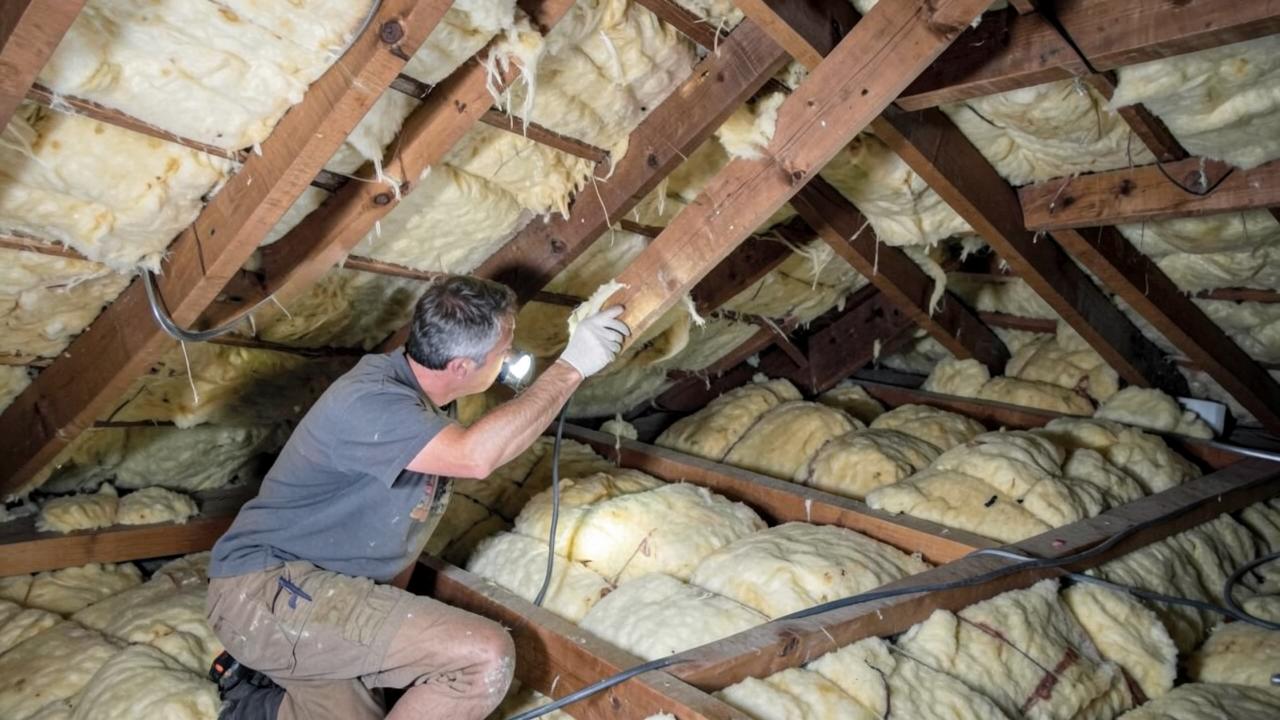
An attic insulation upgrade is worth it in most homes built or last insulated before the 2000s, where R-19 to R-30 is common versus the R-49 to R-60 now recommended for cold and mixed climates; the added insulation typically pays back through lower heating and cooling bills in 3-7 years. The exception is homes that already have deep, even, unsettled insulation at or above current code recommendations, where an upgrade offers only marginal further savings.
How do you check your current attic R-value?
Measure the depth of your existing insulation with a tape measure at several spots across the attic floor, then multiply by the R-value per inch for that material: roughly R-2.2 to R-2.7 per inch for loose-fill fiberglass, R-2.5 to R-3.7 per inch for cellulose, and R-3.1 to R-3.4 per inch for loose-fill mineral wool. A common finding in older homes is 6-8 inches of settled fiberglass batts, which works out to only R-13 to R-19 — roughly a third of what current recommendations call for in most US climates.
What R-value should you actually target?
| Climate zone (DOE) | Recommended attic R-value | Typical existing homes |
|---|---|---|
| Zone 1-2 (South FL, TX Gulf Coast) | R-30 to R-49 | R-19 to R-30 |
| Zone 3-4 (Southeast, mid-Atlantic, Pacific NW) | R-38 to R-49 | R-13 to R-30 |
| Zone 5-6 (Midwest, Northeast, Mountain West) | R-49 to R-60 | R-19 to R-38 |
| Zone 7-8 (Northern Plains, interior Alaska) | R-60 | R-19 to R-38 |
What does a real upgrade cost, and what's the payback?
- Blown-in cellulose or fiberglass top-up from R-19 to R-49: $1,200-$2,800 for a typical 1,200-1,800 sq ft attic, professionally installed.
- DIY blown-in with a rented machine (often free rental with material purchase from a home center): $400-900 in materials for the same job.
- Spray foam (closed-cell) at the roofline for a conditioned attic conversion: $4,500-$9,000, a different approach used mainly when ductwork lives in the attic.
- Typical annual heating/cooling savings from an R-19-to-R-49 upgrade: $150-$450 depending on climate and energy costs, giving a 3-7 year payback in most cases.
Which insulation material makes sense for your attic?
Blown-in cellulose is the most common upgrade choice for open attic floors because it settles into irregular spaces around joists and wiring better than batts and costs less than spray foam; it's treated with borate for fire and pest resistance. Blown-in fiberglass performs similarly and is slightly less prone to settling over time, but has marginally lower R-value per inch. Spray foam is reserved for cases where you want to bring ductwork or HVAC equipment inside the conditioned envelope, since it seals the roofline itself rather than just the attic floor — a fundamentally different and pricier approach.
How do you estimate your specific payback?
- Find your current R-value from measured depth and material type.
- Get 2-3 quotes for topping up to your zone's recommended R-value, or price DIY materials at a home center.
- Use your last year of utility bills to estimate current annual heating/cooling energy cost.
- Apply a rough 10-20% savings estimate for a jump from under-R-20 to R-49-60 (higher savings for bigger initial gaps) to project annual savings.
- Divide the project cost by projected annual savings to get payback years, and compare against how much longer you plan to stay in the house.
How do you know if attic ventilation needs attention during the same project?
Attics need a balance of intake (soffit vents) and exhaust (ridge or gable vents) roughly in a 1:1 or 1:1.5 ratio to allow natural airflow that keeps the roof deck cool in summer and dry in winter; a common rule of thumb is 1 square foot of net free vent area per 300 square feet of attic floor when a vapor barrier is present. Adding deep insulation without checking that soffit vents remain unblocked by baffles is one of the most common mistakes in a DIY upgrade — insulation pushed against the roof deck at the eaves chokes off airflow and can contribute to ice damming in cold climates or excessive roof deck heat in hot ones.
Are there rebates or incentives that reduce the net cost?
- Federal Energy Efficient Home Improvement Credit: 30% of insulation material cost up to $1,200 annually, claimed on your tax return with proper documentation.
- State and utility rebates: vary widely, often $200-800 for attic insulation upgrades meeting minimum R-value thresholds, sometimes requiring a pre- and post-project inspection.
- Combined with air sealing incentives, total rebates can offset 20-40% of a typical project's cost in states with active efficiency programs.
- Check your utility's website or the DSIRE database (a free federal database of state incentives) before starting, since some programs require enrollment before work begins, not after.
Can I just add more insulation on top of what's there without removing it?
Yes, as long as the existing insulation is dry and not compressed, moldy, or contaminated with pests. Topping up is standard practice and cheaper than removal and replacement; just run insulation perpendicular to any existing batts if adding a second batt layer.
Does attic insulation help with cooling, not just heating?
Yes — in summer, attic insulation slows heat radiating down from a hot roof deck (which can reach 150°F+ in direct sun) into living space below, reducing AC runtime. The savings show up on both winter heating and summer cooling bills.
Is there a point where more insulation stops helping?
Returns diminish above roughly R-49-60 in most climates — each additional inch reduces heat flow by a shrinking percentage. Beyond your zone's recommended level, money is usually better spent on air sealing or duct sealing than on additional insulation depth.
Run the numbers for your own project
- Insulation R-Value CalculatorWhat R-value do I need, and how much?
- Insulation Cost Payback CalculatorHow long until attic insulation pays for itself?
- Energy Savings CalculatorWill this upgrade pay for itself?
Keep reading
- How Much Paint Do You Actually Need for a Room?The tin says 400 square feet. Your wall says otherwise. Here is the arithmetic that actually holds up.
- DIY or Hire a Pro? A Decision Framework That Is Not About MoneyThe labour saving is real. So is the cost of a job done twice — and of tools you use once.
- Storage for Small Rooms That Does Not Make Them SmallerSmall rooms do not need more storage. They need storage that stops interrupting the eye.